Transcription of Classification of Chemical Substances
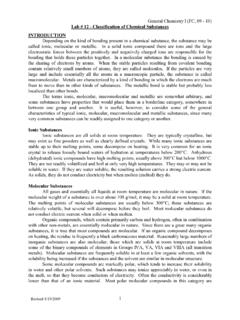
1 Classification of Chemical SubstancesINTRODUCTION:Depending on the kind of bonding present in a Chemical substance, the substance may becalled ionic, molecular or a solid ionic compound there are ions and the large electrostatic forces between thepositively and negatively charged ions are responsible for the bonding which holds theseparticles a molecular substance the bonding is caused by the sharing of electrons by atoms. Whenthe stable particles resulting from covalent bonding contain relatively small numbers of atoms,they are called molecules. If the particles are very large and include essentially all the atoms in amacroscopic particle, the substance is called are characterized by a kind of bonding in which the electrons are much freer to movethan in other kinds of Substances .
2 The metallic bond is stable but it is probably less localizedthan other terms ionic, molecular, macromolecular and metallic are somewhat arbitrary, and somesubstances have properties that would place them in a borderline category, somewhere inbetween one group and another. It is useful, however, to consider some of the generalcharacteristics of typical ionic, molecular, macromolecular and metallic Substances , since manyvery common Substances can be readily assigned to one category or Substances :Ionic Substances are all solids at room temperature. They are typically crystalline, but mayexist as fine powders as well as clearly defined crystals. While many ionic Substances are stableup to their melting points, some decompose on heating. It is very common for an ionic crystal torelease loosely bound water of hydration at temperatures below 200 C.
3 Anhydrous (dehydrated)ionic compounds have high melting points, usually above 300 C but below 1000 C. They arenot readily volatilized and boil at only very high Substances : All gases and essentially all liquids at room temperature are molecular in nature. If themolecular weight of a substance is over about 100, it may be a solid at room temperature. Themelting points of molecular Substances are usually below 300 C; these Substances are relativelyvolatile, but several will decompose before they boil. Most molecular Substances do not conductelectric current when solid or when molten (melted).Organic compounds, which contain primarily carbon and hydrogen, often in combinationwith other non-metals, are essentially molecular in nature. Since there are a great many organicsubstances, it is true that most compounds are molecular.
4 If an organic compound decomposeson heating, the residue is frequently a black carbonaceous material. Reasonably large numbersLab #12 PHYSICAL PROPERTIES of SOME REPRESENTATIVECHEMICAL ( C) ( C)Solubilityin waterSolubilityin CCl4 ElectricalConductanceClassificationNaCl8 011413 SolInsolHigh in meltand in sol solInsolLow in sat dsol nIonicCoCl2 Sublimes1049 SolInsolHigh in sol nIonicCoCl2 6H2O86 DecSolInsolHigh in sol nIonic hydrate,loses H2O at110 CC10H870255 InsolSolZero in meltMolecularC6H5 COOH122249Sl solSolLow in sat dsol nMolecular-ionicFeCl3282315 SolInsolHigh in sol nMolecular-ionicSnI4144341 DecSolZero in meltMolecularSiO216002590 InsolInsolZero in meltMacro-molecularFe15353000 InsolInsolHigh in solidMetallicKey: Sol = at least mole / L; Sl sol = appreciable solubility but < mol / LInsol = essentially insoluble.
5 Dec = inorganic Substances are also molecular; those which are solids at room temperature includesome of the binary compounds of elements in Groups IV A, V A, VI A and VII Substances are frequently soluble in at least a few organic solvents, with thesolubility being increased if the Substances and the solvent are similar in molecular molecular compounds are markedly polar, which tends to increase their solubility inwater and other polar solvents. Such Substances may ionize appreciably in water, or even in themelt, so that they become conductors of electricity. Often the conductivity is considerably lowerthan that of an ionic material. Most polar molecular compounds in this category are organic, buta few, including some of the salts of the transition elements , are Substances :Macromolecular Substances are all solids at room temperature.
6 They have very high meltingpoints, usually above 1000 C, and low volatility. They are typically very resistant to thermaldecomposition. They do not conduct electric current and are often good insulators. They are notsoluble in water or any organic solvents. They are frequently chemically inert and may be usedas abrasives or Substances :The properties of metals appear to derive mainly from the freedom of movement of theirbonding electrons. Metals are good electrical conductors in the solid form, and havecharacteristic luster and malleability. Most metals are solid at room temperature and havemelting points that range from below 0 C to over 2000 C. They are not soluble in water ororganic solvents. Some metals are prepared as black powders, which may not appear to beelectrical conductors; if such powders are heated, the particles will coalesce to give goodelectrical PROCEDURE1.
7 Take a dime-sized amount of one of the Substances and place it on a clean, dry watch glass. Ifthere are large pieces available, take one of Test the conductivity of the solid on the apparatus demonstrated by the instructor. If the solidis a powder, make sure that both "feet" of the conductivity apparatus are in contact with it. If thesolid consists of large, sturdy pieces clamp one with the alligator clips. Record the value of theconductivity in volts (0 - 25 V).3. Place the watch glass with the solid on it on the hot plate marked LOW. If the solid melts, theapproximate melting point is <100 C. If it does not melt after a couple of minutes, transfer thewatch glass using your crucible tongs and wire gauze to the hot plate marked MEDIUM.
8 If itmelts, the approximate melting point is 100 - 300 C. If it does not melt after a couple ofminutes, transfer the watch glass to the hot plate marked HIGH. If it melts, the approximatemelting point is 300 - 600 C. If it does not melt, the approximate melting point is >600 If the solid melts, test the conductivity of the melt. Make sure that the substance is a liquid atthis point. If it has resolidified, remelt it. Record the voltage. If the solid did not melt in step 3,do not test the conductivity of the melt. Simply put an X in the Discard the solid in the proper Take a pea-sized amount of the same solid. Put it in 10 mL of distilled water. Stir. Does thesolid dissolve?7. If the solid has dissolved, test the conductivity of the solution.
9 Record the voltage. If thesolid did not dissolve in step 6, do not test the conductivity. Simply put an X in the Discard the solution in the appropriate Repeat steps 1 through 8 with the other five Classify each of the six Substances and see the Pick two unknowns and check with the instructor for disposal Perform steps 1 through 8 with each #12 DATA SHEETNAME _____ SECTION_____Classification of Chemical SubstancesSubstance#Conductas asolid (V) , !!!! amelt(V)Solubilityin asolution(V)ClassificationWaste(<100,100 -300300-600600) #12 PRESTUDYANAME_____ SECTION_____CLASSIFICATION of SUBSTANCES1.(3 points) List three properties of a substance which would definitely establish that thematerial is (2 points) A powdery material has melting point of 625 C, does not conduct electricity in thesolid state but does conduct electricity in the molten state and in aqueous solution.
10 What wouldthe Classification of this substance be?3.(2 points) A white solid melts at 120 C, does not conduct electricity in the solid or moltenstate and is not soluble in H2O but is soluble in toluene, C7H8. What would the Classification ofthe substance be?4.(3 points) A white solid has a melting point of 60 C, is soluble in H2O and in polar organicsolvents. It does not conduct electricity in the solid or molten state, but does conduct in anaqueous solution. What would the Classification of this substance be?Lab #12 PRESTUDY BNAME_____ SECTION_____CLASSIFICATION of SUBSTANCES1.(3 points) List 3 differences between metallic and macro-molecular (2 points) A substance is a white, crystalline solid at 25 C. The solid does not conduct acurrent. It melts at 350 C without decomposing and the melt conducts an electric current.