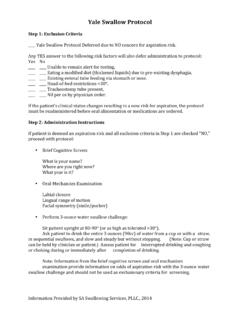
Transcription of CLINICAL BEDSIDE SWALLOWING ASSESSMENT
1 CLINICAL BEDSIDE SWALLOWING ASSESSMENT Patient:_____Date:_____ Note: Complete Cognitive and Communication portions of Speech Screening. Specifically note abilities to follow 1-3 step directions, answer yes/no questions, sustain attention, recall from short-term memory and note speech production A. OBSERVATIONS: Patient Status and Abilities Y N Y N Is able to independently feed him/herself? Is able to get out of bed? Is able to ambulate independently? Is able to consume at least of meal? Is on a mechanical ventilator? How long?: Is able to brush teeth/clean mouth himself?
2 Alert Lethargic Cooperative Uncooperative Aware of Difficulty Unaware of difficulty Poor Posture/ Positioning Other: B. REPORTS: By Patient, Family or Staff Y N Y N Reports problems with liquids more than thicker foods Reports indigestion or burning near sternum Reports problems with thicker foods more than liquids Reports coughing or choking while eating/drinking Reports problems SWALLOWING pills Reports runny nose after eating/ liquid reflux through nose? Reports feeling lump in throat or pain with swallow Reports acidy or metallic taste in mouth upon waking Reports wet or gugly voice after SWALLOWING Reports taking a long time to eat Reports increased phlegm or mucus after SWALLOWING Reports throat clearing after SWALLOWING Reports pocketing or finding food in mouth after swallow Reports dry mouth When do the SWALLOWING problems occur?
3 ( ) Frequently ( ) Infrequently ( ) Daily ( ) During eating ( ) After eating ( ) During drinking ( ) After drinking Do the SWALLOWING problems occur during specific meals? ( ) Breakfast ( ) Lunch ( ) Dinner Do the SWALLOWING problems occur during certain times of the day? ( ) Morning ( ) Afternoon ( ) Evening How long have you had this problem? ( ) Days ( ) Weeks ( ) Months ( ) Years Did the problem occur gradually or suddenly? ( ) Gradually ( ) Suddenly Are some foods easier to swallow? If so what foods?
4 List here: Are some foods more difficult to swallow? If so- what foods? List here: NOURISHMENT INTAKE STATUS: ( ) Oral Feeding (PO) ( )Non-Oral Feeding (NPO) ( ) Regular diet ( ) PEG ( ) Thin liquids ( ) Nasogastric Tube ( ) Thickened liquids ( ) IV ( ) Pureed ( ) Other:_____ ( ) Mechanical Soft ( ) Finely Ground ( ) Calorie Supplements ( ) Chopped ( ) Solids C.
5 dysphagia ASSESSMENT : Oral-Motor Evaluation ( ) CNA 1. Structure: Note any abnormalities:_____ __ Y N Y N Endentulous Dental cavities apparent Dentures ( ___partials, ___uppers, ___lowers) Wears dentures when eating Dentures in during evaluation Inflammation around teeth Natural upper teeth Missing teeth Natural lower teeth Teeth are decayed/ discolored 2. Awareness/Control of Secretions: ___drooling ___excess secretions in mouth ___wet breath sounds 3. Assessing Jaw, Lips, Tongue and Cheeks Jaw ( ) CNA WNL -L -R WNL -L -R Opens & closes jaw Opens & closes jaw w/ mild pressure Ability to open mouth adequately: Open your mouth as wide as possible Ability to rapidly open and close the mouth: Open and close yoru mouth as quickly as possible.
6 WNL= 2 reps per second Ability to lateralize the jaw: Move your jaw to the right, then to the left Labial Function ( ) CNA WNL -L -R WNL -L -R Lip closure at rest Holds air in cheeks: Puff out cheeks Retraction: Smile Please smile Protrusion: Pucker Pucker as if you were about to kiss someone Lip round /u/ Please round your lips Rapid protrusion/ retraction (3 seconds): Pucker and smile as fast as you can until I say stop. WNL: 2 sets of alternating movements in 3 seconds Lip smacking Smack your lips together Rapid Closure: Say puh, puh, puh as fast as you can.
7 WNL: 6 reps in 3 seconds Strength: Remove tongue depressor from between closed lips Sensitivity (upper & lower right, upper and lower left). Touch areas of lips and note any sensivitiy. Lingual Function ( ) CNA WNL -L -R WNL -L -R Protrusion: Stick out your tongue WNL: Fully extended midline protrusion for 2 seconds --- --- Tip Depression: To floor of mouth: Open your mouth. Put the tip of your tongue behind your bottom teeth . To lower lip: Try to reach your chin with your tongue . Lick Lips Tip Elevation: To hard palate - Open your mouth.
8 Put the tip of your tongue to the roof of your mouth behind your teeth . To upper lip Try to reach your nose with your tongue . Lateralization to corners: Left & Right Repetitive elevation of back /kuku/ Lateralization to buccal cavities : Left & Right Repetitive elevation of tip /tututu/ Rapid left/right lateralization: Move your tongue from corner to corner of your lips as fast as you can. WNL: at least 3 reps Retraction: Pull your tongue as far back into your mouth as you can Strength: Asking the patient to position the tongue in the following manner. Tip against tongue depressor --- --- Left side of tongue against tongue depressor --- --- Right side of tongue against tongue depressor --- --- Elevated blade against tongue depressor --- --- Tongue in left cheek against finger resistance --- --- Tongue in right cheek against finger resistance --- --- Tough Sensitivity: Ask the patient to close his eyes.
9 Tell patient: I m going to touch your tongue in different spots with this swab (or tongue depressor). Let me know if you can feel the touch. With a cotton-tipped swab or tongue depressor, touch the following locations and record patient response. Left Anterior Third --- --- Right Anterior Third --- --- Left Middle Third --- --- Right Middle Third --- --- Left Posterior Third --- --- Right Posterior Third --- --- ( - = deviation/ decreased) 4. Soft Palate ( ) CNA WNL -L -R Deviation from midline: Observe palate at rest Ability to raise palate: Say, ah - note symmetry in elevation Ability to sequentially raise and lower palate: Say, Ah, ah, ah.
10 Touch Sensiviity: Palatal Gag Reflex: Touch soft palate with a tongue depressor Diminished Hypersensitive Resonance: _____normal _____hypernasal _____hyponasal 5. Cheeks ( ) CNA WNL -L -R WNL -L -R Facial Symmetry: Observe facial symmetry at rest Ability to symmetrically puff cheeks: Puff out your cheeks 6. Oral Mucosa _____moist _____dry _____phlegm _____thick mucus _____foul smell / mouth odor Laryngeal Examination ( )CNA Tracheostomy Tube_____ Y N _____Cuffed _____Uncuffed Finger occluded PM valve Other:_____ Vocal Quality: normal hoarse breathy wet/gurgly Volitional Cough: strong weak absent Throat Clearing: strong weak absent Volume Control.