Transcription of Clinical Pathway
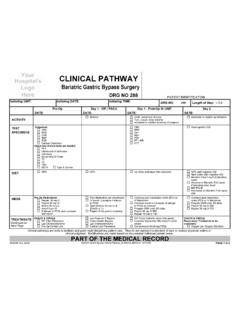
1 Outcomes/Goals 1. To Treat pain associated with injuries such as fractures and burns 2. Prevent/decrease pain associated with painful procedures 3. To relieve anxiety associated with painful procedures and conditions 4. Increase patient throughput with reduction of full procedural sedations and recovery time NURSE documentation Vital signs, development stage, ability to participate, parent s consent to participate, injury or procedure causing pain, anticipated pain or anxiety. Documentation that excludes the following contraindications: altered LOC, face or neck trauma, chest trauma, compromised respiratory status, B12 deficiency, suspected or known bowel obstruction or severe abdominal pain of undetermined origin, pregnancy or pneumothorax. INTERVENTIONS 1.
2 Evaluate for appropriateness of use / obtain verbal consent 2. Coordinate care to correspond with procedure 3. Turn on oxygen until the grey reservoir bag is inflated. 4. Select mask or nasal hood per patient preference and/or situation. a. For Masks: Instruct patient to form a tight seal with the mask or mouthpiece and take slow deep breaths as oxygen begins to flow, slowly add nitrous oxide up to and not to exceed 65% b. For Nasal Hood: Assure tight fit and ability to breath through nose and keep mouth closed during procedure. Instruct patient to take slow deep breaths as oxygen begins to flow, slowly add nitrous oxide up to and not to exceed 65% 5. Instruct patient to exhale into the mask or nosepiece to keep exhaled gas collected by scavenger 6. Allow patient to inhale gas for 3-4 minutes before beginning any procedure.
3 Begin distraction/visual imagery with patient. 7. Avoid unnecessary conversation to limit exhalation of nitrous oxide into room 8. Discontinue and notify MD if nausea, light-headedness or other side effects occur, or pain relief has not been achieved 9. Discontinue nitrous oxide and provide 100% oxygen for 3-5 minutes following procedure. Key nitrous tank off immediately following procedure. 10. Document total time of nitrous oxide use in minutes. Limit total nitrous administration to 30 minutes 11. Monitor throughout procedure, document vital signs and response to medication as patient condition warrants 12. Refer to Nitrous Oxide Policy for equipment storage, care of equipment and inclusion/exclusion criteria DIAGNOSTICS No specific diagnostics required prior to use PHYSICIAN (LIP) Evaluate patient for appropriateness of use Order Nitrous oxide for procedure If LIP required for procedure, or additional pain or sedation medications have been given prior to or with nitrous administration, LIP is required to be in room during administration Assure oxygen wash-out has occurred and patient return to baseline ADMISSION No specific documentation or actions required if patient is admitted following nitrous use in ED.
4 Special Considerations 1. Nitrous Oxide will not exceed 65% nitrous 2. Administration is discontinued when the acute need for pain and/or anxiety relief has been met 3. The LIP will be notified for additional medications when contraindications exist or pain relief has not been adequately achieved. Clinical Pathway Nitrous Oxide Administration February 2013 Clinical Pathway Decision Making Process Nitrous Oxide Administration February 2013 Does patient currently have painful injury, is painful procedure anticipated, or does patient have anxiety about anticipated procedure or condition? Obtain verbal consent and begin patient/family education Equipment Check Equipment has been checked Monitoring equipment on patient NRB mask /ambu bag at bedside Administration 1.
5 Turn on oxygen and fill reservoir bag with oxygen before beginning. 2. Inform patient to form a tight seal with the mask or nosepiece, instructing pt to take slow deep breaths and begin flow of oxygen, slowly adding nitrous up to 65% 3. Instruct patient to exhale into the mask or nosepiece to keep exhaled gas collected by scavenger 4. Allow patient to inhale gas for 3-4 minutes before beginning any procedure. Begin distraction/visual imagery. 5. Avoid unnecessary conversation to limit exhalation of nitrous oxide into room 6. Discontinue and notify MD if nausea, light-headedness or other side effects occur, or pain relief has not been achieved. 7. Discontinue nitrous oxide and provide 100% oxygen for 3-5 minutes following procedure. 8. Key nitrous tank off immediately following procedure.
6 9. Document total time of nitrous oxide use in minutes. Limit total nitrous administration to 30 minutes. 10. Monitor throughout procedure, document vital signs and response to medication. Does patient have any of the following conditions or exclusions? Altered LOC Chest injuries / respiratory distress Pregnancy Abdominal pain / suspected or known bowel obst. Facial or neck injuries where ability to create seal may be impaired Respiratory distress Yes No Initiate alternative comfort measures Initiate alternative comfort measures Yes No Nitrous Oxide Rationale and Data Goals of Clinical Pathway 1. To Treat pain associated with injuries such as fractures and burns 2. Prevent/decrease pain associated with painful procedures 3. To relieve anxiety associated with painful procedures and conditions 4.
7 Increase patient throughput with reduction of full procedural sedations and recovery time. Data Considerations Rationale Historical Use Nitrous oxide is a colorless, virtually odorless gas with anxiolytic, amnestic, and mild-to-moderate analgesic properties. The advantages of this sedation process are invested in its rapid onset of effect and rapid recovery (both typically less than 5 minutes), patient's ability to remain awake and be able to follow commands, and minimal side effects (AAPD, 2005; Kennedy & Luhmann, 1999; Rodriguez & Jordan, 2002; Webb & Moore, 2002). Nitrous oxide use for a variety of pediatric medical procedures, including lumbar puncture, bone marrow aspiration, venous cannulation, dressing changes, bronchoscopy, otomicroscopic examination, and gastrointestinal endoscopy, has been established world-wide (Annequin et al.)
8 , 2000; Burnweit et al., 2004; Fauroux et al., 2004; Fishman, Botzer, Marouani, & DeRowe, 2005; Kanagasundaram, Lane, Cavalletto, Keneally, & Cooper, 2001; Michaud et al., 1999). There are numerous studies throughout the years on the efficacy and safety of Nitrous oxide (N2O). N2O gas has been known to have analgesic and sedative properties for over two hundred years. The gas was discovered by a Yorkshire chemist named Joseph Priestly and in 1799 the scientist Humphry Davy inhaled the gas and found it gave him rapid pain relief from an infected tooth; on one occasion he reported momentarily losing consciousness, waking up laughing about the pleasurable feelings he had experienced [1]: hence the term 'laughing gas'. As a medicinal gas, it is available as a mixture containing equal parts of N2O and oxygen (O2).
9 Since the 1960s has most frequently been associated with childbirth and use by ambulance crews. Pediatric ED Use Nitrous oxide has been shown to be an effective analgesic in pediatric laceration repairs, displaying less pain behavior than those receiving a placebo (P<.05). No side effects were encountered during the study. N=34. Annequin et al (2000) completed a nationwide 2 month prospective multicenter study with 1019 nitrous oxide administrations for ED procedures. Staff satisfaction regarding efficacy was 88% satisfied to very satisfied, side effects < all which were transient and required nothing more than removing inhalation device. Outpatient Use From same day surgery clinics to pediatric specialty clinics to EDs, nitrous oxide is growing in use for outpatient procedures.
10 Nitrous, combined with a hematoma block, was found to be a safe and effective treatment for fracture reduction (Hennrikus 1995). Outpatient otomicroscopic exams utilizing nitrous oxide in pediatric patients was beneficial from the patient and family standpoint, but also from the efficiency standpoint for patient flow and scheduling (Fishman 2005). A study by Zier, 2007, for outpatients undergoing urinary catheterization resulted in the development and expansion of a nurse-administered nitrous oxide program. Special Considerations Contraindications 1. Administration is discontinued when the acute need for pain and/or anxiety relief has been met 2. The LIP will be notified for additional medications when contraindications exist or pain relief has not been adequately achieved.