Transcription of Clinical Performance Guideline Neonatal Resource Services ...
1 Medical Necessity GuidelineClinical Performance Guideline Neonatal Resource Services Neonatal abstinence syndrome (NAS)Purpose: To provide guidelines for the monitoring and management of neonates with intrauterine exposure to illicit substance and for treatment of infants with Neonatal abstinence syndrome (NAS).Target Client Population: This Guideline applies to the neonate who exhibits NAS from intrauterine exposure to illicit drugs or as a result of pain management during NICU hospitalization. BackgroundNeonatal abstinence syndrome has been described as a group of Clinical findings associated with infant opioid withdrawal although signs of withdrawal can be also exhibited in infants exposed in utero to other substances such as benzodiazepines, barbiturates and alcohol. (AAP, 2012) The symptoms of NAS vary based on maternal and Neonatal factors but may include irritability, lethargy, poor feeding, vomiting or diarrhea, hypertonicity, and occasionally seizures.
2 For infants with suspected or known substance exposure, observation and supportive care should be initially provided. Supportive care could include adjustment of the environment to decrease stimulation, swaddling of the infant, nutritional support and introduction of a pacifier for excessive sucking. Mild NAS symptoms may resolve within a few days without additional treatment may be necessary for infants exhibiting signs of moderate to severe withdrawal symptoms despite supportive care. Failure to provide the appropriate treatment for NAS may result in significant morbidity and mortality for the neonate. Preterm infants have a lesser risk of NAS and withdrawal symptoms than late preterm or term infants. Medical evidence has validated Finnegan scoring for term and late-preterm neonates. The use of Finnegan scoring in preterm infants may result in an inaccurate assessment of Neonatal withdrawal screening identifies substance use and assists in recognizing infants that are at risk for NAS.
3 The management of NAS should be based on the symptoms of the infant and individualized for each neonate. Treatment CriteriaClinical evidence in the medical literature supports the following: Postnatal monitoring for withdrawal symptoms is indicated if there is a history of maternal substance use or enrollment in a methadone program, exposure to certain prescribed medications (benzodiazepines, barbiturates, etc.) or as part of a differential diagnosis when the infant has unexplained seizures, irritability or encephalopathy. In infants at high-risk for NAS, including those with mothers positive for substance use and those who exhibit signs/symptoms of withdrawal, the first urine and/or meconium specimen should be obtained for drug exposure screening. Urine specimens can detect recent substance exposure while meconium screening can detect substance exposure from the time of gut development.
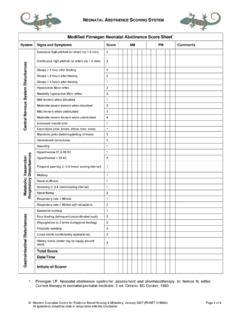
4 (This screening must comply with state laws, AAP 2012) Neonatal abstinence syndrome Medical Policy. Effective 1/1 Information of Optum. Copyright 2014 Performance Guideline Medical Necessity Guideline Neonatal Resource Services Neonatal abstinence syndrome (NAS)Treatment Criteria (continued) Infants presenting with signs of Neonatal opioid withdrawal without history or suspicion of maternal substance abuse should have additional diagnostic testing performed to differentiate NAS from other conditions. Neonatal abstinence scoring using a tool such as the Finnegan NAS scoring system should be performed at least 2 hours after birth for infants with known or suspected substance exposure. This scoring includes Clinical attributes or signs of withdrawal related to metabolic, gastrointestinal, neurological and respiratory status.
5 Subsequent serial NAS scoring should follow -1 hour after each feeding. It is preferable to use the same reviewer/scorer each shift to minimize inter-rater variability and to give more reliable scores Infants with Finnegan scores 7 require only observation and supportive care. An inpatient stay of 3-7 days for observation of Neonatal abstinence syndrome is warranted for asymptomatic at-risk infants although the duration of monitoring is variable based on the maternal drug history. Observation and NAS scoring can be performed in the normal newborn nursery or the mother s room. Pharmacologic management may be initiated for an infant when 3 consecutive Finnegan scores average 8 or when 2 consecutive scores are 12. It may also be warranted for infants with seizures, significant feeding intolerance (diarrhea, emesis) and weight loss or failure to gain weight, or unexplained fever and inability to sleep despite supportive measures.
6 (Dow, 2012) Options for pharmacologic treatment of withdrawal symptoms may include morphine, methadone, and phenobarbital or combination therapy. The choice of drug should match the class of drug used by the mother, including the duration of action. Morphine provides short-acting control of withdrawal symptoms and is the preferred agent over the longer-acting methadone for opioid withdrawal. (Kraft, 2012; Bio, 2011) Morphine may be started at an initial dose of PO administered with feedings every 3-4 hours. The dose may be increased depending on NAS scores by increments of mg/kg/dose up to a maximum of mg/kg per dose. ( A A P, 2 012) Methadone, as a second line alternative to morphine, may be started at an initial dose of mg/kg/dose PO administered with feedings every 6 hours.
7 The dose may be increased depending on NAS scores by increments of mg/kg/ dose. (AAP, 2012) Phenobarbital is a nonspecific central nervous system depressant used as an adjunct in opioid withdrawal in addition to treatment of non-opioid withdrawal. Combination therapy utilizing morphine/phenobarbital may reduce not only the severity/duration of symptoms but also the length of hospital stay. Benzodiazepines are not recommended as first line or adjunct agents. Benzodiazepines have a synergistic effect with opioids leading to respiratory depression/hypotension and the neonate has a limited capacity to metabolize diazepam. Paregoric is a short-acting opiate that is no longer recommended for managing opiate withdrawal because it contains alcohol benzoic acid camphor, which can be neurotoxic.
8 (Bio 2011) Neonatal abstinence syndrome Medical Policy. Effective 1/1 Information of Optum. Copyright 2014 Performance Guideline Medical Necessity Guideline Neonatal Resource Services Neonatal abstinence syndrome (NAS)Treatment Criteria (continued) Although reports on the use of clonidine (an alpha 2-adrenergic receptor agonist), chlorpromazine, and buprenorphine in controlling NAS seem promising; further studies are needed before recommendation for widespread use of these agents is made (Agthe 2009, Kraft 2008, Broome 2011). Weaning should be initiated when the infant s NAS scores consistently remain < 8 for 1-2 days. The dose should be decreased 10-20% of the initial total daily dose every1-2 days for oral morphine and every week for oral methadone based on symptoms. Babies with NAS are in a hypermetabolic state.
9 Their high caloric needs (up to 250cal/kg/day) may require high caloric density formula or fortified breast milk to prevent excessive weight loss and promote optimal weight gain. Women who are on methadone or buprenorphine maintenance and not abusing other drugs should be encouraged to breast-feed. Breastfeeding is associated with decreased severity and duration of NAS (McQueen 2011, D Apolito 2013 ) Clinical Evidence In 2012 the American Academy of Pediatrics published an updated Clinical report on Neonatal Drug Withdrawal. This report provides guidance on the identification and management of infants exposed to intrauterine substances in addition to the management of hospitalized neonates who need weaning from analgesics or sedatives. A prospective multicenter cohort study by Wachman et al (2013) attempted to identify genetic factors that may influence the incidence and severity of Neonatal abstinence syndrome (NAS).
10 Participants from 5 tertiary care facilities included infants 36 weeks gestation who were being treated for NAS according to the institutions treatment protocols. Although there were limitations to this study, the authors concluded single-nucleotide polymorphisms in the OPRM1 and COMT genes were associated with NAS and resulted in reduced need for medical treatment and length of hospital stay for these infants. They also acknowledged these were preliminary findings and additional studies are needed in order to replicate these results. A 2013 National Survey by Mehta et al outlined the variety of management strategies in Neonatal abstinence syndrome . The authors concluded that increased prenatal counseling and home treatment programs could improve the care of these infants. A 2013 Cochrane review by Minozzi et al compared maternal maintenance treatment programs.