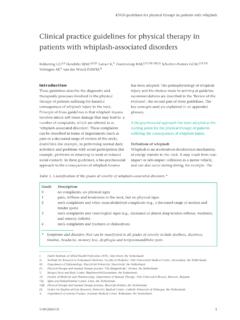
Transcription of Clinical practice guidelines for physical therapy in ...
1 1 KNGF- guidelines for physical therapy in patients with whiplashV-09/2003/USIntroductionThese guidelines describe the diagnostic andtherapeutic processes involved in the physicaltherapy of patients suffering the harmfulconsequences of whiplash injury to the of these guidelines is that whiplash traumainvolves minor soft tissue damage that may lead to anumber of complaints, which are referred to as whiplash-associated disorders . These complaintscan be described in terms of impairments (such aspain or a decreased range of motion of the neck),disabilities (for example, in performing normal dailyactivities) and problems with social participation (forexample, problems in returning to work or reducedsocial contact).
2 In these guidelines , a bio-psychosocialapproach to the consequences of whiplash traumahas been adopted. The pathophysiology of whiplashinjury and the choices made in arriving at guidelinerecommendations are described in the Review of theevidence , the second part of these guidelines . Thekey concepts used are explained in an bio-psychosocial approach has been adopted as thestarting point for the physical therapy of patientssuffering the consequences of whiplash of whiplashWhiplash is an acceleration-deceleration mechanismof energy transfer to the neck. It may result from rear-impact or side-impact collisions in a motor vehicle,and can also occur during diving, for example.
3 TheClinical practice guidelines for physical therapy inpatients with whiplash-associated disordersBekkering GE,I,IIHendriks HJM,I,III,IVLanser K,VOostendorp RAB,I,VI,VII,VIII,IXScholten-Peeters GGM,I,VI,VIIV erhagen AP,Xvan der Windt Dutch Institute of Allied Health Professions (NPi), Amersfoort, the NetherlandsII. Institute for Research in Extramural Medicine, Faculty of Medicine, Vrije Universiteit Medical Center, Amsterdam, the NetherlandsIII. Department of Epidemiology, Maastricht University, Maastricht, the NetherlandsIV. physical therapy and manual therapy practice The Klepperheide , Druten, the NetherlandsV. Integral Neck and Back Center, Hardinxveld-Giessendam, the NetherlandsVI.
4 Faculty of Medicine and Pharmacology, Department of Manual therapy , Vrije Universiteit Brussel, Brussels, BelgiumVII. Spine and Rehabilitation Center, Uden, the NetherlandsVIII. physical therapy and manual therapy practice , Heeswijk-Dinther, the NetherlandsIX. Center for Quality-of-Care Research, University Medical Center, Catholic University of Nijmegen, the NetherlandsX. Department of General practice , Erasmus Medical Center Rotterdam, the NetherlandsGradeDescription0no complaints, no physical signs1pain, stiffness and tenderness in the neck, but no physical signs2neck complaints and other musculoskeletal complaints ( , a decreased range of motion andtender spots)3neck complaints and neurological signs ( , decreased or absent deep tendon reflexes, weakness,and sensory deficits)4neck complaints and fractures or dislocations*Symptoms and disorders that can be manifested in all grades of severity include deafness, dizziness,tinnitus, headache, memory loss, dysphagia and temporomandibular 1.
5 Classification of the grades of severity of whiplash-associated disorders.*impact may result in injury to bony or soft tissue ( ,whiplash injury), which in turn may lead to a varietyof Clinical manifestations. Frequently occurringsymptoms are neck pain, decreased mobility of thecervical spine, headache, and dizziness. The clinicalsymptoms, which are known as whiplash-associateddisorders, can be classified into five grades of severity(Table 1). These guidelines concentrate on patientswith grade-1 and 2 whiplash-associated with neurological signs, fractures ordislocations are not covered by addition, the time that has passed since the injurycan be divided into six phases: less than four days;four days to three weeks; three to six weeks; six weeksto three months; three months to six months, andmore than six months.
6 In these guidelines , the timethat has passed since the injury is related to theconsequences of data on the incidence of whiplashare mainly derived from insurance claim , the reported annual incidence of whiplashvaries widely between countries and continents:figures vary from 16 per 100,000 inhabitants eachyear in New Zealand to 70 per 100,000 inhabitantseach year in Quebec, Canada. In the Netherlands, thenumber of new patients who have experiencedwhiplash is estimated to be 94 188 per 100,000inhabitants each year. These figures are much higherthan international estimates because they are derivedfrom accident statistics. There are no Dutch data onthe prevalence of specific symptoms after is no consensus in the literature on theprognosis of the consequences of whiplash.
7 Theprevalence of long-term complaints ( , from sixmonths to two years) varies from 19 60%. ACanadian research group, the Quebec Task Force onwhiplash-associated disorders (QTF-WA D), reported thatthe prognosis is favorable: around 85% of patientsreturn to work within six months after the whiplashinjury. Recently, this conclusion has been criticizedbecause the severity and duration of the complaintsmay have been and delayed recoveryA distinction is made between patients who undergonormal recovery and those who undergo delayedrecovery after whiplash injury. Normal recovery refersto the average or expected course of recovery fromthe consequences of whiplash.
8 Normally, over timethe patient s functions improve, the patient s levels ofactivity and participation increase, and the patient spain level declines. Moreover, there is someinterrelationship between impairments, disabilitiesand participation problems. When recovery isdelayed, it may be that the patient s functions donot improve or the patient s levels of activity andparticipation do not increase or the patient s painlevel does not decline with time. Moreover, theinterrelationship between impairments, disabilitiesand participation problems is less obvious. In theworking group s view, recovery can be said to bedelayed if a patient suffering the consequences ofwhiplash shows no progress in terms of levels ofactivity and participation within four for physical therapy in patients with whiplashV-09/2003/USTable 2.
9 Prognostic factors associated with delayed recovery after factors: decreased mobility of the neck immediately after injury; pre-existing head trauma; female gender; volder related to chronic pain: coping strategy;* psychosocial factors ( , passive coping, fear or job dissatisfaction).* can be influenced by physical therapyWith normal recovery, activity and participationlevels increase over time. This is not the case withdelayed factorsA number of factors are associated with delayedrecovery after whiplash injury (Table 2). The first fourfactors listed in the table are related to whiplash; thelast two factors concern chronic pain in strategyDuring recovery, patients may cope with theircomplaints either adequately or inadequately.
10 Copingis connected with the extent to which a person is ableto adjust his* load ( , what he wishes to do) to hisload-bearing capacity ( , what he can do). Load-bearing capacity depends on the patient and is, amongother things, determined by the time that has passedsince the injury, which is related to the physiologicalrecovery phase, and by psychosocial who continue to perform their activities orwork in appropriate ways have adequate copingstrategies. When complaints persist, the adoption ofstrategies such as seeking distraction from pain oraiming for an active life style indicate adequatecoping. People who, on the other hand, restrict theirmovements because of their complaints, who persistin avoiding certain activities, or who rest a lot torelieve pain have inadequate coping significance attached to pain and the level ofcontrol experienced are important in respect tocoping.