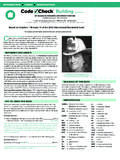
Transcription of Code 3Check Building
1 AbbreviAtions seQUenCe oF tHe booKPages 2 10 of this book cover topics that are relevant to planning, inspections, and non-structural issues. Pages 11 23 deal with foundations & framing. Pages 24 30 deal with ladding, coverings, and other items typically covered in the final inspection. The inside back cover summarizes significant changes in the 2015 IRC. For updates and information related to this book, visit 3 Check Building Fourth Editionby DoUGLAs HAnsen & reDwooD KArDonIllustrations & Layout: Paddy Morrissey 2016 by The Taunton Press, Inc. ISBN-13: XXX-X-XXXXX-XXX-XCode Check is a registered trademark of The Taunton Press, Inc., registered in the Patent & Trademark Office. Printed in oF tHis booKCode Check Building is a field guide to commonly used provisions of chapters 1-10 of the 2015 editions of the International Residential Code (IRC).
2 The scope of the IRC is 1- & 2-family dwellings and townhouses and their accessory structures (such as detached garages). A townhouse, in this sense, is a single family dwelling unit constructed in a group of 3 or more units with each unit extending from foundation to roof and open to a yard or public way on at least 2 sides. In all cases, the scope of the IRC and this book is limited to structures not more than 3 stories above grade plane in height. Other books in the Code Check series deal with the electrical, mechanical, and plumbing aspects of the IRC. Multi-family dwelling units are within the scope of the International Building Code (IBC). The IRC contains prescriptive requirements. Within specified geologic & climatic conditions, it provides construction methods that do not require further engineering design.
3 The methods and materials covered in the IRC are not the only ones allowed; rather, they are simply the ones for which there is a standard methodology. As an ex-ample, the IRC tells us how far we need to set back the foundation from a slope break ( ). If you want to build it closer than allowed by the IRC, a design professional must apply the engineering requirements of the IBC. The text lines in Code Check provide a brief summary of a code citation, followed by the code number. The amount of text in Code Check is not the complete code, and we encourage you to refer to the entire code text whenever possible. The full text of each code cited in Code Check is available on line on ICC s web site. For 2015 IRC references, go to For 2012 and earlier IRC references, go to Always consult with the local Building department before beginning a project.
4 They will provide information on which model code editions are used in your area and on the state or local amendments that apply. The codes for some states and cities are also available on ICC s web site, at This book is primarily geared to wood frame buildings over concrete or CMU foundations. Other topics covered in the IRC, such as wood foundations, structural insulated panel (SIP) construction, insulated concrete forms (ICF), and steel framing cannot be included because of space limitations. The actual code lines in the IRC begin with the letter R - we have omitted the R to save to UsinG tHis booKThe line for each code rule starts with a checkbox and ends with a code reference from the 2015 IRC. Exceptions and lists start with a bullet, and exception lines also end with a code reference.
5 Changes from the 2012 code are highlighted by having the reference in a different color and an endnote to the table on the inside back cover. In some cases, the change occurred in the 2012, as shown in the from :n Footings supported on undisturbed soil or engineered fill F18 line is telling us that section req s footings on previously undistirbed soil & that figure 18 is an to a code rule are noted by EXC at the end of a line, followed by a bulleted line with the exception, as in this example from :n Threshold at req d egress door max 1 in. above landing or floor EXC F7 7 in. below threshold OK if door not swinging over landing lines tell us that section limits the req d egress door threshold height to 11 for a landing which can be 73/4 inches below if the door does not swing over it, and.
6 1 req s footings on previously undistirbed soil & that figure 7 is an changes are given a different color code citation followed by a superscript number that is commented on in the inside back cover, as in this example from : n Min. 6 ft. 8 in. bathrooms, toilet rooms & laundry rooms rule for a min ceiling height has been lowered from 7 ft. to 6 ft. 8 in. for these rooms. It can be found in section of the IRC. On the inside back cover, this line is explained as code change # In accordance with Manufacturers InstructionsAstM American Society for Testing & Materialsbo Building OfficialbwL Braced Wall LinebwP Braced Wall Panelcfm cubic feet per minuteCMU Concrete Masonry UnitDFe Design Flood Elevationexc excepteXC Exception (follows in next line)Frt Fire-Retardent TreatedFsD Fire Separation DistanceGb Gypsum Boardhr hourib C International Building CodeL&L Listed & LabeledLL Lot Linemax maximummin minimummph miles per on centerPt Pressure Treatedpsf pounds per square footpsi pounds per square inchreq requirereq d req dreq s requires, requirementssDC Seismic Design CategorysDC D SDC D0, D1, & D2UL Underwriters Laboratoriesw/ withw/o withoutwrb Water Resistive BarrierwsP Wood Structural PanelBased on the 2015 International Residential Code Including major changes from the 2012 editionALternAtive DesiGn DoCUMentsThe American Forest and Paper Association publishes the Wood Frame Construction Manual for One- and Two-Family Dwellings (WFCM)
7 Which can be used as an alternate to IRC designs for wood framing and can be used for build-ings where wind design is American Iron and Steel Institute (AISI) publishes the Standard for Cold-Formed Steel Framing Prescriptive Method for One- and Two-Family Dwellings (AISI S230) which can be used as an alternative to the IRC. It can also be used for buildings where wind design is American Concrete Institute (ACI) publishes two documents that supple-ment the prescriptive rules of the IRC. These are ACI 318 Building Codes for Structural Concrete, and ACI 530 Building Code Requirements for Masonry Truss Plate Institute (TPI) publishes TPI 1 - National Design Standard for Metal Plate Connected Wood Truss Construction, which is mandatory for metal-plate-connected truss design.
8 TPI also contributes to BCSI 1-03 Guide to Good Practice for Handling, Installing & Bracing of Metal Plate Connected Wood American Society of Civil Engineers (ASCE) publishes ASCE 24 Flood-Resistant Design and Construction, which can be used as an alternative to the prescriptive requirements of IRC R322. It is mandatory for construction in identi-fied floodways. The American Society of Civil Engineers (ASCE) publishes ASCE 7 Minimum Design Loads for Buildings and Other Structures. It is the basis of the structural engineering provisions of the IBC. It can be used for buildings where wind design is International Code Council (ICC) publishes ICC 600 The Standard for Residential Construction in High-Wind Regions. It can be used for buildings where wind design is thanks to Skip Walker for his invaluable assistance in making this book, cheers!
9 Fastener: Generic category that includes nails, screws, bolts, or anchors also see separation distance: The distance measured perpendicular from the Building face to the closest interior lot line or to the centerline of a street, alley, or public way. Grade: The finished ground level adjoining the Building at all exterior space: Space in a Building for living, sleeping, eating, or cooking. Bath-rooms, bathroom closets, hallways, storage, or utility areas are not considered habitable loads: Loads produced by use and occupancy of the Building and not including wind, snow, rain, earthquake, flood, or dead : Concrete cast in one continuous operation with no joints, such as a footing and floor slab or a footing and foundation stem : The unit of measurement of water vapor transmission through a material, based on the number of grains of water vapor at a given pressure differential.
10 Vapor retarders are rated in concrete or masonry: Structural concrete or masonry with less reinforcement than the minimum amount specified for reinforced concrete or Design Category (sDC): Classification assigned to buildings based on the occupancy category & severity of earthquake ground motion expected at the : That portion of a Building that is between the upper surface of one floor and below the upper surface of the next floor above or the above grade: The parts of the Building that are entirely above grade, or base-ments that are more than 6 feet above grade for more than 50% of the total Building perimeter or more than 12 feet above ground at any : Single-family dwelling unit constructed in groups of three or more at-tached units in which each unit extends from foundation to roof and with a yard or public way on at least two : Materials that protect walls or other Building elements from the pas-sage of moisture as either vapor or liquid under hydrostatic structural panel (wsP): A panel manufactured from veneers (plywood) or wood strands (OSB) and bonded with waterproof synthetic resins.