Transcription of Cognitive Behavioral Intervention (CBI) - TSLAT
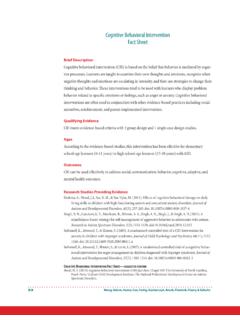
1 Cognitive Behavioral Intervention (CBI)Brief Introduction Cognitive Behavioral interventions (CBI) refer to a variety of related interventions that are used to alter behavior by teaching individuals to understand and change thoughts and behaviors. Cognitive Behavioral Intervention is based on the belief that behavior is mediated by Cognitive processes. Learners are taught to examine their own thoughts and emotions, recognize when negative thoughts and emotions are escalating in intensity, and then use strategies to change their thinking and behavior. Description These interventions tend to be used with learners who display problem behavior related to specific emotions or feelings, such as anger or anxiety.
2 Cognitive Behavioral interventions are often used in conjunction with other evidence based practices including social narratives, reinforcement, and parent implemented Intervention . CBI meets evidence based criteria with three group design studies and one single case design study. According to the evidence based studies, this Intervention has been effective for elementary school age learners (6 11 years) to high school age learners (15 18 years) with ASD. CBI can be used effectively to address social, communication, behavior, Cognitive , adaptive, and mental health outcomes. Brief Adapted from: Brock, M.
3 E. (2013). Cognitive Behavioral Intervention (CBI) fact sheet. Chapel Hill, NC: The University of North Carolina, Frank Porter Graham Child Development Institute, The National Professional Development Center on Autism Spectrum Disorders. Matrix of CBI by Outcome and Age (years)SocialCommunicationBehaviorJoint AttentionPlayCognitiveSchool ReadinessAcademicMotorAdaptiveVocational Mental Health0-56-1415-220-56-1415-220-56-1415- 220-56-1415-220-56-1415-220-56-1415-220- 56-1415-220-56-1415-220-56-1415-220-56-1 415-220-56-1415-220-56-1415-22 Cognitive Behavioral Intervention (CBI) Research Summary Ages Skills/ Intervention Goals Settings Outcome 65 years Behavior, social Clinic EBP *The information found in the Research Summary table is updated yearly following a literature review ofnew research and this age range reflects information from this review.
4 August 2015 Cognitive Behavioral Intervention (CBI) Research Drahota, A., Wood, J. J., Sze, K. M., & Van Dyke, M. (2011). Effects of Cognitive Behavioral therapy on daily living skills in children with high functioning autism and concurrent anxiety disorders. Journal of Autism and Developmental Disorders, 41(3), 257 265. doi: 010 1037 4 Ehrenreich May, J., Storch, E. A., Queen, A. H., Hernandez Rodriguez, J., Ghilain, C. S., Alessandri, M., .. Wood, J. J. (2014). An open trial of Cognitive Behavioral therapy for anxiety disorders in adolescents with autism spectrum disorders. Focus on Autism and Other Developmental Disabilities, 29(3), 145 155.
5 Doi: Gearing, R. E., Schwalbe, C. J., Lee, R., & Hoagwood, K. E. (2013). The effectiveness of booster sessions in CBT treatment for child and adolescent mood and anxiety disorders. Depression & Anxiety (1091 4269), 30(9), 800 808. doi: Ho, B. V., Stephenson, J., & Carter, M. (2015). Cognitive Behavioral approach for children with autism spectrum disorder: A literature review. Journal of Intellectual & Developmental Disability, 40(2), 213 229. doi: Nadeau, J. M., Arnold, E. B., Selles, R. R., Storch, E. A., & Lewin, A. B. (2015). A Cognitive Behavioral approach for anxiety in a preschool aged child with autism spectrum disorder.
6 Clinical Case Studies, 14(1), 47 60. Pugliese, C., & White, S. (2014). Brief report: Problem solving therapy in college students with autism spectrum disorders: feasibility and preliminary efficacy. Journal of Autism & Developmental Disorders, 44(3), 719 729. 013 1914 8 Riccomini, P., Williams Bost, L., Katsyannis, A., & Zang, D. (2015). Cognitive Behavioral interventions : An effective approach to help students with disabilities stay in school (1st ed.). Clemson, SC: National Dropout Prevention Center for Students with Disabilities. Retrieved from Russell, A. J., Jassi, A., Fullana, M. A.
7 , Mack, H., Johnston, K., Heyman, I., & .. Mataix Cols, D. (2013). Cognitive behavior therapy for comorbid obsessive compulsive disorder in high functioning autism spectrum disorders: A randomized controlled trial. Depression & Anxiety (1091 4269), 30(8), 697 708. Singh, N. N., Lancioni, G. E., Manikam, R., Winton, A. S., Singh, A. N., Singh, J., & Singh, A. D. (2011). A mindfulness based strategy for self management of aggressive behavior in adolescents with autism. Research in Autism Spectrum Disorders, 5(3), 1153 1158. doi: Sofronoff, K., Attwood, T., & Hinton, S. (2005). A randomized controlled trial of a CBT Intervention for anxiety in children with Asperger syndrome.
8 Journal of Child Psychology and Psychiatry, 46(11), 1152 1160. doi: August 2015 Cognitive Behavioral Intervention (CBI) Sofronoff, K., Attwood, T., Hinton, S., & Levin, I. (2007). A randomized controlled trial of a Cognitive Behavioral Intervention for anger management in children diagnosed with Asperger syndrome. Journal of Autism and Developmental Disorders, 37(7), 1203 1214. doi: 006 0262 3 Soorya, L. V., Siper, P. M., Beck, T., Soffes, S., Halpern, D., Gorenstein, M., & .. Wang, A. T. (2015). Randomized comparative trial of a social Cognitive skills group for children with autism spectrum disorder.
9 Journal of The American Academy Of Child & Adolescent Psychiatry, 54(3), 208 216. Storch, E. A., Lewin, A. B., Collier, A. B., Arnold, E., De Nadai, A. S., Dane, B. F., .. Murphy, T. K. (2015). A randomized controlled trial of Cognitive Behavioral therapy versus treatment as usual for adolescents with autism spectrum disorders and comorbid anxiety. Depression and Anxiety, 32(3), 174 181. doi: Sukhodolsky, D. G., Bloch, M. H., Panza, K. E., & Reichow, B. (2013). Cognitive Behavioral therapy for anxiety in children with high functioning autism: A meta analysis. Pediatrics, 132(5), E1341 E1350.
10 Doi: 1193 van Steensel, F. J. A., & Bogels, S. M. (2015). CBT for anxiety disorders in children with and without autism spectrum disorders. Journal of Consulting and Clinical Psychology, 83(3), 512 523. doi: Wood, J. J., Ehrenreich May, J., Alessandri, M., Fujii, C., Renno, P., Laugeson, E., .. Storch, E. A. (2015). Cognitive Behavioral therapy for early adolescents with autism spectrum disorders and clinical anxiety: A randomized, controlled trial. Behavior Therapy, 46(1), 7 19. doi: Wood, J., Fujii, C., Renno, P., & Van Dyke, M. (2014). Impact of Cognitive Behavioral therapy on observed autism symptom severity during school recess: A preliminary randomized, controlled trial.