Transcription of Cognitive Disabilities Model (CDM): Intervention Outcome ...
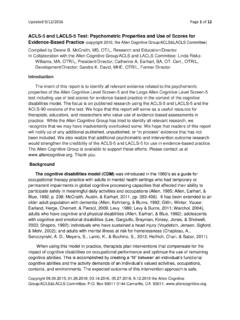
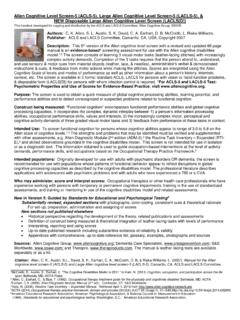
1 Cognitive Disabilities Model (CDM): Intervention Outcome Evidence - These studies demonstrate that use of scores from CDM-based assessments of functional cognition along with other assessments, contributes in part to therapists ability to provide effective interventions. Study Authors population Design/Sample Size CDM Assessments Intervention Outcomes Chapleau, Seroczynski, Meyers, Lamb, & Buchino (2012) Adults with mental illness at risk for homelessness, community support program Repeated measure experimental design (N = 57) ACLS 90 Occupational therapy consultation based in part on CDM ACL II Significant improvement in housing stability and individualized goals Gitlin, Mann, Vogel, & Arthur (2013); Howell (2014)a Community-dwelling older adults with dementia and caregivers Phase III efficacy trial (N = 160 dyads) LACLS 5.
2 ADM 2 TAP VA (includes CDM ACL II) Improved QoL and reduction in challenging behaviors Gitlin et al. (2008, 2009) Community-dwelling older adults with dementia and caregivers Randomized pilot study (N = 60 dyads) ACLS 90; LACLS 90; ADM 2 TAP (includes CDM ACL II and caregiver education) Reduction in challenging behaviors, increased engagement and expressions of pleasure, increased caregiver confidence Gitlin, Winter, Dennis, Hodgson, & Hauck (2010) Community-dwelling older adults with dementia and caregivers RCT (N = 237 dyads) ACLS 90, LACLS 90, ADM 2 COPE (includes CDM ACL II) Reduction in dependence, improved engagement, improved caregiver confidence and well-being Gitlin, Marx, Alonzi, Kvedar, Moody, Trahan, & Van Haitsma (2016).
3 Kvedar & Alonzi (2014)b Hospitalized adults with mental illness or dementia Feasibility study, time series design with multiple observations (N = 20) ACLS 5, LACLS 5, ADM 2 CDM ACL II, TAP Feasibility study determined Intervention to be effective Holm et al. (1999) Dementia and mental illness: inpatient geriatric care unit Intervention Outcome study, evaluation at admission and discharge (N = 250) ACLS 90 Interdisciplinary with CDM ACL II pharmacological Intervention Significant reduction in agitated behaviors, improved function by discharge Ngoh, Lewis, & Connolly (2005) Inpatient geriatric: psychiatry unit Intervention Outcome study, evaluation at admission and discharge (N = 106) ACLS 90 Interdisciplinary with CDM ACL II Significant improvements in function by discharge Raweh & Katz (1999) Adults with schizophrenia.
4 Outpatient Treatment effectiveness with control group (N = 11) ACLS 90; RTI 2 CDM ACL II Significant improvement in Cognitive abilities and ADL/IADL by discharge Wesson et al. (2013) Community-dwelling older adults with mild dementia and caregivers Feasibility study, RCT (N = 22 dyads) LACLS 5 Falls Prevention Program in context of CDM ACL II Intervention determined to be acceptable Note. ACLS 90 = Allen Cognitive Level Screen; ADL = activities of daily living; ADM 2 = Allen Diagnostic Model 2; CDM ACL II = CDM Allen; Cognitive Level Individualized Intervention ; COPE = Care of Persons with Dementia in their Environments; IADL = instrumental activities of daily living; LACLS 5 = Large Allen Cognitive Level Screen; QoL = quality of life; RCT = randomized controlled trial; RTI = Routine Task Inventory; TAP = Tailored Activity Program.
5 A T. Howell (2014), the occupational practitioner in this study, presented the occupational therapy Intervention based on the CDM described in Gitlin, Mann, Vogel, and Arthur (2013). For a copy of this study, please contact bT. Kvedar and D. Alonzi (2014), the occupational practitioner in this study, presented on the occupational therapy Intervention based on the CDM described in Gitlin, Marx, Alonzi, Kvedar, Moody, Trahan, and Van Haitsma, (2016). Source: Compiled by Deane B. McCraith, MS, OT/L, Research and Education/Director for the Allen Cognitive Group/ACLS and LACLS Committee, 2017. Copyright 2017 by ACLS and LACLS Committee, Camarillo, CA.
6 Available as a PDF download under the Resources Tab on the ACG website, References: Allen, C. K., Austin, S. L., David, S. K., Earhart, C. A., McCraith, D. B., & Riska-Williams, L. (2007). Manual for the Allen Cognitive Level Screen-5 (ACLS-5) and Large Allen Cognitive Level Screen-5 (ACLS-5). Camarillo, CA: ACLS and LACLS Committee. Allen, , Kehrberg, K. & Burns, T. (1992). Evaluation instruments, 31-84. In Allen, Earhart & T. Blue (Eds.), Occupational Therapy treatment goals for the physically and Cognitive disabled. Bethesda, MD: American Occupational Therapy Association. Chapleau, A., Seroczynski, A.
7 D., Meyers, S., Lamb, K., & Buchino, S. (2012). The Effectiveness of a Consultation Model in Community Mental Health, Occupational Therapy in Mental Health, 28:4, 379-395. Earhart, C. A. (2006). Allen Diagnostic Module: Manual (2nd Ed.). Colchester, CT: S&S Worldwide. Gitlin, L. N., Mann, , Vogel, , & Arthur, (2013). A non-pharmacologic approach to address challenging behaviors of Veterans with dementia: description of the tailored activity program-VA randomized trial. BMC Geriatrics, 13(96). doi: Gitlin, L. N., Marx, K. A., Alonzi, D., Kvedar, T., Moody, J., Trahan, M., & Van Haitsma, K. (2016). Feasibility of the Tailored Activity Program for Hospitalized (TAP-H) patients with behavioral symptoms.
8 Gerontologist, 2016, 00(00), 1-10. Gitlin , Winter L., Burke J., Chernett N., Dennis , & Huack (2008).Tailored activities to manage neuropsychiatric behaviors in persons with dementia and reduce caregiver burden: a randomized pilot study. American Journal of Geriatric Psychiatry, 16, 229 239. Gitlin, L. N., Winter, L., Dennis, M. P., Hodgson, N., & Hauck, W. W. (2010). A biobehavioral home-based Intervention and the well-being of patients with dementia and their caregivers: The COPE randomized trial. Journal of the American Medical Association, 304, 983 991. doi: Gitlin , Winter, L., Vause Earland, T.
9 , Herge, A. E., Chernett, N., & Piersol, C. V. (2009). The tailored activity program to reduce behavioral symptoms in individuals with dementia: feasibility, acceptability, and replication potential. Gerontologist, 49, 428 439. Holm, A., Michel, M., Stern, G. A., Hung, T., Klein, T., Flaherty, L., Michel, S. & Maletta, G. (1999). The outcomes of an inpatient treatment program for geriatric dementia and dysfunctional behaviors. Gerontologist, 39(6), 668-676. Howell, T. (October 2014). Activity selection process for persons with dementia and caregivers. Presented at the 10th Annual Cognitive Symposium, Redondo Beach, CA.
10 Contact the author at for a copy of this presentation. Katz, N. (2006). Routine Task Inventory RTI-E manual, prepared and elaborated on the basis of Allen, (1989 unpublished). Available to download at Note: This is an updated version of the Routine Task Inventory 2. Kvedar, T. & Alonzi, D. (October, 2014). Translating the Tailored Activity Program in a chronic care hospital for dementia patients. Presented at the 10th Cognitive Symposium Cognitive Symposium sponsored by the Allen Cognitive Network. Redondo Beach, CA. Contact (still trying to get an author contact email address for copies of this presentation).