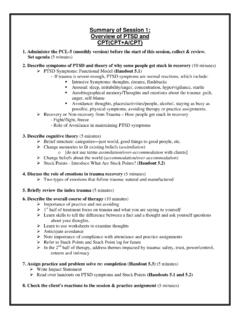
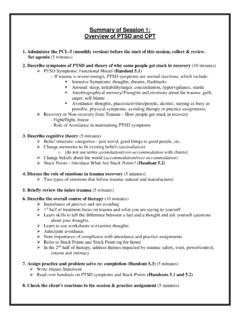
Transcription of COGNITIVE PROCESSING THERAPY SEXUAL ABUSE (CPT-SA ...
1 COGNITIVE PROCESSING THERAPY SEXUAL ABUSE (CPT-SA) individual treatment manual Kathleen M. Chard, Do not cite without permission from the author. 2012 PCL-S: WEEKLY Instructions: 1. Consider the most stressful experience you have experienced _____. (event) 2. Here is a list of problems and complaints that people sometimes have in response to stressful life experiences. Please read each one carefully, and then indicate, using the numbers to the right, how much you have been bothered by that problem in the past week. PCL-S for DSM-IV (11/1/94) Weathers, Litz, Huska, & Keane National Center for PTSD Behavioral Science Division.
2 Not at all A little bit Moderately Quite a bit Extremely 1. Repeated, disturbing memories, thoughts, or images, of the stressful experience? 1 2 3 4 5 2. Repeated, disturbing dreams of the stressful experience? 1 2 3 4 5 3. Suddenly acting or feeling as if the stressful experience was happening again (as if you were reliving it)? 1 2 3 4 5 4. Feeling very upset when something reminded you of the stressful experience? 1 2 3 4 5 5. Having physical reactions ( , heart pounding, trouble breathing, sweating) when something reminded you of the stressful experience? 1 2 3 4 5 6. Avoiding thinking about or talking about the stressful experience or avoiding having feelings related to it?
3 1 2 3 4 5 7. Avoiding activities or situations because they reminded you of the stressful experience? 1 2 3 4 5 8. Trouble remembering important parts of the stressful experience? 1 2 3 4 5 9. Loss of interest in activities that you used to enjoy? 1 2 3 4 5 10. Feeling distant or cut off from other people? 1 2 3 4 5 11. Feeling emotionally numb or being unable to have loving feelings for those close to you? 1 2 3 4 5 12. Feeling as if your future will somehow be cut short? 1 2 3 4 5 13. Trouble falling or staying asleep? 1 2 3 4 5 14. Feeling irritable or having angry outbursts? 1 2 3 4 5 15.
4 Having difficulty concentrating? 1 2 3 4 5 16. Being super-alert or watchful or on guard? 1 2 3 4 5 17. Feeling jumpy or easily startled? 1 2 3 4 5 Individual treatment Plan Session/Week 1 Introductions: The purpose of this first session is largely to get to know each other and to go over the format for this treatment in more detail. Because I ll be giving you some new information, I will be talking much more than I normally will in future sessions. Explain PTSD: The reason you have been asked to participate in this treatment program is because the assessments you completed revealed you have Posttraumatic Stress Disorder (PTSD).
5 This treatment is designed to help reduce the symptoms of PTSD. Have you ever heard of PTSD before? This disorder is most often associated with Vietnam Veterans or with natural disasters, but it is also found in survivors of childhood SEXUAL ABUSE . PTSD is made up of three clusters of symptoms: 1. Reexperiencing consisting of disturbing thoughts, nightmares, and flashbacks or suddenly feeling that the ABUSE is recurring. (Stop and discuss: What type of reexperiencing have you had?) It is common to have these intrusions when you are falling asleep, when you relax, or when you are bored. 2.
6 Arousal consisting of problems falling or staying asleep, irritability or outbursts of anger, difficulty concentrating, startle reactions, feeling on-guard, & having strong physical reactions to reminders of the ABUSE . (Stop and discuss.) If someone is having these strong reexperiencing and arousal reactions, he/she is likely to want to do the final symptom category which is to avoid. 3. Avoidance consisting of active avoidance of anything which may remind you of the trauma(s) like television, movies, people, sex, dating, reading or watching the news, and/or thinking or feeling your feelings.
7 (Stop and discuss.) ** It is important that you abstain from alcohol and drug use, if possible throughout the treatment , but especially on days of treatment and days you complete homework assignments. Because you have PTSD, and because a category of PTSD is avoidance, it makes perfect sense that you will want to avoid doing your homework and coming to session. As part of the treatment , I am going to ask you to do some things you may try to avoid in your everyday life (like thinking and talking about the ABUSE ). So, there will be times when you will want to avoid coming to sessions and doing the homework assignments.
8 The truth is that avoiding probably worked for you in some situations and avoiding may have helped you survive through today. What you have told me, though, is that avoiding is not working very well for you right now. In fact, it sounds like avoiding gets in the way much of the time (restate some areas of avoidance the client mentioned previously). The challenge for both of us will be to figure out when you are avoiding and to find a new way for you to cope. Please call me if you feel a need to avoid sessions or your homework. This treatment is designed to reduce all of these symptoms of PTSD and it follows a structured format.
9 Here is an outline of what we will be doing for the next 16 weeks. (Pass out treatment outline and give client a folder to use for weekly assignments.) Now that I have told you what some of the goals are of this treatment , I would like to know what your personal goals are. What is your purpose for beginning THERAPY ? Provide the treatment Rationale: (You need to allow at least 20 minutes for this.) Now I would like to explain why you developed these symptoms. When you were growing up you learned about the world and organized it in your mind into categories or files. For example, when you were small, you learned that a thing with a back, seat, and four legs is a chair and you created a file for chair.
10 As you got older, through experience, you learned more complex categories of chairs such as dining room chair, rocking chair, recliner, or folding chair. You then had a file for chair, which was further divided into all of these different subcategories. As another example, have you ever spent time with children? Perhaps you have noticed them doing the following. First, kids may learn that a doggie is an animal with fur, four legs, and pointed ears. Then when they see a cow they excitedly call it a doggie; they call a cat doggie; and they call a horse doggie. Everything fits into that category of doggie until they are able to create new files for all the different animals through experience.