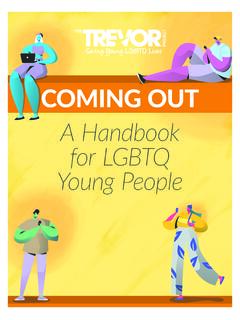
Transcription of COMING OUT - The Trevor Project
1 COMING OUTA Handbook for LGBTQ Young People2 CONTENTSIDENTITY 4 THE BASICS 4 What Is Sex Assigned at Birth? 5 What Is Gender? 5 Gender Identity 6 Gender Expression 7 Transitioning 8 What Is Sexual Orientation? 9 Sexual Orientation 10 Sexual/Physical Attraction 11 Romantic Attraction 12 Emotional Attraction 13 COMING OUT 14 Planning Ahead 14 Testing The Waters 15 Environment 15 Timing 15 Location 15 School 16 Support 16 Safety Around COMING Out 16 HEALTHY RELATIONSHIPS 17 SELF-CARE 18 Checking in on Your Mental Health 19 Warning Signs 19 RESOURCES 20 Trevor PROGRAMS 21 Map Your Own Identity 213 Exploring your sexual orientation and/or gender identity can bring up a lot of feelings and questions.
2 Inside this handbook, we will work together to explore your identity, what it might be like to share your identity with others, and provide you with tools and guiding questions to help you think about what COMING out means to Trevor Project s COMING Out: A Handbook for LGBTQ Young People is here to help you nav-igate questions around your identity. You know yourself and what works for you better than any-one else. Each of us has the right to share or not share different aspects of ourselves with others. No one else is entitled to information around your identities, if you do not want them to know. If you choose not to share parts of your identity with others, it does not make you any less valid than those who may choose to share their identi-ties with other people.
3 I ve slowly been fig-uring out who I really am, and every step of the way I like who I find more and more. Hayley, 16 (Virginia)You may have heard people talking about com-ing out before in ways that are oversimplified, judgmental, or just plain scary. The truth is that there is no one way to come out or be out. There may be certain people in our lives with whom we want to share our sexual orientation and/or gender identity, and there may be others with whom we know that we do not feel com-fortable or safe sharing. This is more than okay! Some people may share their identity with a few trusted friends online, some may choose to share with a counselor or a trusted family member, and others may want everyone in their life to know about their identity.
4 An important thing to know is that for a lot of people, COMING out doesn t just happen once. A lot of folks find themselves com-ing out at different times to different is all about what works for you, wherever you are at. The things you hear about COMING out may make you feel pressured to take steps that don t feel right for you, or that you don t feel pre-pared for. Your experience is truly unique to you. You get to decide. This handbook is here to help you think through what might be best for thinking it through, you may decide to be out to yourself, but not to anyone else and that s okay. Many people choose not to come out to others for different reasons.
5 You are val-id and deserve support no matter who you do or do not share your identities with. This resource is for you to explore how you feel and what choices are right and safe for identity and sexual orientation can be significant parts of who we are. And for many of us, there are lots of other aspects of ourselves that are meaningful and help make us the people we are. All of these identities help shape us into ourselves. Race, ethnicity, (dis)ability, national origin, the lan-guage(s) we speak, age, social class, religion/spirituality, and many other identity categories help us tell a larger picture about what it means to be us. Gender identity and sexual orientation can be just one piece of the puzzle.
6 We are all complex human beings, and that is wonderful!THE BASICSQ uestioning your identity is an experience that lots of people have many times through-out their life. Identity is complicated and if you aren t sure how you identify, that s ok! You are allowed to not have everything figured out right at this moment. Taking some time to think through how you feel can be helpful in better understanding your gender identity, gender expression, and/or sexual people aren t sure of the difference be-tween gender identity, gender expression, sex assigned at birth, and sexual orientation. It isn t something many of us are taught.
7 Instead, lots of us end up figuring out what these cat-egories mean on our own. Let s spend some time breaking down the difference between each of these terms and exploring what they mean Is Sex Assigned at Birth?When we are born, doctors decide whether female or male will be listed on our birth certificate. This is often one of the first instances when gender is ascribed to us. This sex assignment at birth is typically based solely on one s genitals. Just like a lot of the concepts in this handbook, sex assign-ment at birth is far more intricate than meets the label of one s sex assignment at birth is often attributed to a child before they can speak, walk, or know for themselves what their gender identity is.
8 As such, sex assignment does not take into ac-count one s true gender identity. Your true gender may be different than the gender that a doctor assigned you, which is perfectly normal, valid, and , there is so much diversity between bodies. For some babies, their bodies do not fit neatly into the category of male or female. These people may come to identify themselves as in-tersex, which is a term used for a variety of conditions in which a person is born with a reproductive or sexual anatomy that doesn t seem to fit the typical definitions of female or male (Intersex Society of North America).It is not always an easy process to figure out what your sex assignment at birth and your gender mean to you, so we want to take a moment to recognize all that it took to discover who you Is Gender?
9 Some people say that gender looks like this:BoyGirlOthers say that gender is this:BoyGirl6In actuality, gender often looks a lot like this:Now, let s zoom in!Gender IdentityGender Identity describes our internal understanding and experience of our own gender. Each per-son s experience with their gender identity is unique and people think that there are only two gender identities possible: boy or girl. But, in fact, thou-sands and thousands of people experience their gender outside of this gender binary (binary mean-ing made up of two things). Some people identify as being both a boy and a girl, or being neither a boy nor a girl. Some folks identity as a gender that is different than boy or girl, or they don t experience gender at all.
10 Non-binary is a term that refers to people who don t experience their gender(s) as com-pletely a girl/woman or of how many different ways there are to be a boy or a girl; there are millions of different ways to be non-binary too. Throughout the course of history and all around the world, there have always been people who experience their gender(s) in diverse many people identify with the sex they were assigned at birth, some people may find that their gender identity differs from the sex they were assigned at birth. Exploring your gender is normal at all ages and at any stage of life. All of these experiences are equally do I experience my gender?How do I feel in relation to the sex I was assigned at birth?


![WELCOME! [www.thetrevorproject.org]](/cache/preview/b/8/d/9/a/1/c/7/thumb-b8d9a1c7785968c282cb5f8ffa51c8c7.jpg)