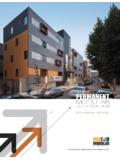
Transcription of COMMERCIAL MODULAR CONSTRUCTION REPORT
1 COMMERCIAL MODULAR CONSTRUCTION REPORT The MODULAR Building Institute (MBI) is the only international, non-profit trade association representing the COMMERCIAL MODULAR CONSTRUCTION industry and was founded in 1983. MBI serves the non-residential MODULAR CONSTRUCTION industry in its mission to grow industry capabilities by encouraging innovation, quality, and professionalism. Our regular membership includes wholesale manufacturers, direct manufacturers, and dealers of COMMERCIAL MODULAR buildings, while our associate members are companies supplying building components, services, and financing to the industry. MBI also provides the only industry and annual trade-show along with the only financial industry REPORT that surveys the COMMERCIAL MODULAR CONSTRUCTION industry.
2 It is relied upon by both banking and financial sectors for projects and forecasting on COMMERCIAL MODULAR CONSTRUCTION in all its respective Brigade/Battalion Headquarters building for the Combat Aviation Brigade at Fort Bliss, El Paso, Texas. Currently under CONSTRUCTION and scheduled for completion in fall 2009. CONTENTSE xecutive Summary ..1 Introduction ..1 Sustainable MODULAR CONSTRUCTION ..3 Permanent MODULAR Applications ..5 Temporary MODULAR Applications ..7 Regional Reports ..11 Alberta, Canada ..11 Central/Midwest United States ..11 Mid-Atlantic United States ..12 Northeast United States ..12 Northwest United States ..12 Southeast United Southwest United States ..13 West United States.
3 14 Robert W. Baird Financial Survey ..15 Data Collection ..15 Review of Descriptive Statistics ..15 Dealers: Industry Data ..16 Dealers: Supplemental Data ..18 Manufacturers: Industry Data ..20 Manufacturers: Supplemental Data ..22 Market Indicators ..22 Summary ..23c o n t e n t e g i o n a l R e p oR t sCOMMERCIAL MODULAR CONSTRUCTION REPORT | 2009 B o aR D oF Di R e c t oR sM Bi s t aF FExecutive DirectorTom Hardimanx 158, of Operations Steven Williamsx 153, of Member ServicesAileen Hollandx 156, Communications ManagerAudra Bookx 152, Regional ManagerBob 209-786-5116 Office ManagerAnnie Diggsx 157, Marty MullaneyPresident/CEO Satellite Shelters, President Joseph LopardoVice President, MODULAR Buildings Williams Scotsman 2nd Vice President-Elect Mike RidleyExecutive Vice President Britco Structures Past President Mike Mount President Sunbelt MODULAR , Inc Secretary Brent Morgan Vice President & General Manager ATCO Structures Inc.
4 Treasurer Gary BockrathCFOA cton Mobile Industries Executive Director Tom HardimanExecutive DirectorModular Building Institute Board MembersMichael Bollero President/CEO Southern MODULAR Industries, LP Kendra Cox Assistant Production Manager Blazer Industries, Inc. Walter Griffin MODULAR Program Manager Mule-Hide Products Co., Inc Gary Humphrey VP of Operations Pac-Van, Inc. John Kennedy Manager M Space Holdings LLC Harry Klukas Senior VP Black Diamond Group John Lieffrig Regional Vice President ModSpace John Michael COO Atex Distributing, Inc. HEADQUARTERS944 Glenwood Station Lane Ste. 204 Charlottesville, VA 22901 Toll Free: 888-811-3288 Fax: 434-296-3361 MBI WESTERN OFFICEPO Box 1057 Valley Springs, CA 95252 Phone: 209-786-5116 Fax: 209-786-5114 Strada at Mercato, Naples, FL page MODULAR CONSTRUCTION REPORT | 2009 M Bi s t aF FExecutive DirectorTom Hardimanx 158, of Operations Steven Williamsx 153, of Member ServicesAileen Hollandx 156, Communications ManagerAudra Bookx 152, Regional ManagerBob 209-786-5116 Office ManagerAnnie Diggsx 157, x e c u t i v e s uM Ma R yAlthough 2008 was a down year for CONSTRUCTION in general, those familiar with MODULAR CONSTRUCTION have many reasons to be optimistic about the future growth of the industry.
5 In October of 2008, Building Design+ CONSTRUCTION conducted a survey of a subsection of its subscriber base, asking readers about MODULAR CONSTRUCTION . These respondents were made up of architects, engineers, developers, business owners, facility managers, and general contractors representing a cross section of non-residential markets. Speed of CONSTRUCTION was the primary advantage of MODULAR CONSTRUCTION cited, with 79% believing MODULAR was as fast or much faster than conventional CONSTRUCTION . Further, 69% percent said MODULAR CONSTRUCTION was as sustainable or a more sustainable CONSTRUCTION process than site-built. Given these advantages, it would seem that MODULAR CONSTRUCTION would have captured more than one percent of the COMMERCIAL CONSTRUCTION market in North America.
6 There is, however, much confusion and misconception about MODULAR CONSTRUCTION that still exists, as evidenced by these same respondents reporting lack of perceived quality as the primary disadvantage. It helps to think of MODULAR CONSTRUCTION as a process not a specific product. Using the MODULAR CONSTRUCTION process, you can build temporary or permanent facilities for virtually any market: Temporary Permanent An important distinction between temporary and permanent is that temporary structures are typically classified as personal property or equipment while permanent structures are classified as real property. This REPORT will focus primarily on the COMMERCIAL and institutional segment in North America.
7 Data included in this REPORT will reflect sales, leasing and production data for the calendar year 2008 and, when available, the first quarter of 2009. i n tR oD u c t i o nAbout the MODULAR Building InstituteFounded in 1983, the MODULAR Building Institute (MBI) is the only international non-profit trade association serving the COMMERCIAL MODULAR buildings industry. Members are manufacturers and dealers of COMMERCIAL MODULAR structures, as well as associates supplying building components, services, and financing. Members are located in 15 countries around the globe and provide all types of building space, from temporary storage units to complex multi-story permanent buildings. It is MBI s mission to grow the industry and its capabilities by encouraging innovation, quality, and professionalism through communication, education, and recognition.
8 About the COMMERCIAL MODULAR CONSTRUCTION IndustryCommercial MODULAR buildings are non-residential, factory built structures designed to meet federal, provincial, state and local building codes and are capable of being relocated. The COMMERCIAL MODULAR building industry is comprised of four distinct participants: Manufacturers/Wholesale that sell primarily to dealers; Manufacturers/Direct that sell primarily to the end user/customer; Dealers which may maintain a fleet of buildings for lease and sell to the end user; and Suppliers to the dealers and manufacturers. The industry itself encompasses many markets and applications. For practical purposes, and for this REPORT , the industry can be generally segmented into two categories: For more information about the association, go to - coded manufactured housing MODULAR home CommercialConstruction office, sales office, relocatable classroom, Not HUD-CodeSchools, hospitals, retail stores, banks, offices, restaurants Industrial/InstitutionalTemporary barracks, guard houses, emergency response and relief unitsMilitary installations, workforce housing, in-plant offices, border patrol unitspage 2 Temporary applications Facilities and products meeting short-term needs including storage units, containers, CONSTRUCTION site offices, relocatable classrooms, and other types of mobile offices.
9 Revenue from this segment is generally derived from the rental, lease, or sale of fleet products, fairly standardized in terms of CONSTRUCTION , and all built to applicable local and state building codes where the units are to be located. Permanent applications Comparable to site-built CONSTRUCTION in terms of life span, quality, and materials, consisting of MODULAR units built off site and assembled on site to create a permanent facility, not intended to be relocated. The buildings themselves can be leased or purchased and typically flow through one of two distribution channels: Dealers Companies that typically maintain an inventory of existing buildings available for lease or sale. These companies also serve as general contractors on new CONSTRUCTION projects and acquire the MODULAR buildings though a network of unrelated wholesale manufacturers.
10 Direct Manufacturers Companies that typically serve as the general contractor or subcontractor and sell direct to the end user. Generally, these companies do not maintain a fleet of existing buildings and focus on more customized projects. Unlike residential manufactured housing, the COMMERCIAL industry does not have an equivalent national building code or COMMERCIAL HUD-code program. Most states have adopted versions of the International Building Code providing some degree of consistency from region to region. However, regardless of the application, both temporary and permanent MODULAR CONSTRUCTION facilities are required to meet all applicable building codes where they are located. Countless industries regularly use permanent or temporary MODULAR buildings including schools, banks, restaurants, hospitals, medical clinics, daycare centers and correctional facilities just to name a few.