Transcription of Common Core Standards - Resource Page - RPDP
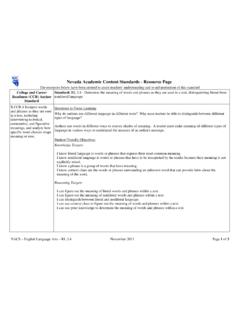
1 CCSS English Language Arts January 2013 Page 1 of 3 [Type text] [Type text] Common core Standards - Resource Page The resources below have been created to assist teachers' understanding and to aid instruction of this standard. College and Career Readiness (CCR) Anchor Standard Standard: - Explain events, procedures, ideas, or concepts in a historical, scientific, or technical text, including what happened and why, based on specific information in the text. Analyze how and why individuals, events, and ideas develop and interact over the course of a text. Questions to Focus Learning How do authors explain the events, procedures, ideas, or concepts in informational text?
2 Why is it important to understand why these things occur in informational text? To better comprehend informational text, readers need to understand an author's organizational techniques and how they affect the overall meaning of the text. Good readers know that what happens in an informational text is as important as why it happens. Student Friendly Objectives Knowledge Targets I know a technical text is a text written about mechanical or technological subjects. I know specific information from the text must be used to knowledgeably support an explanation. I can identify key events, procedures, ideas, or concepts in an informational text.
3 Reasoning Targets I can explain events, procedures, ideas, or concepts in an informational text by describing what happened, why it happened, and how it I can find specific information in the text to support my explanations. Vocabulary historical scientific technical technical text CCSS English Language Arts January 2013 Page 2 of 3 [Type text] [Type text] Teacher Tips Definition of Text Types This eHow article defines narrative, expository, technical, and persuasive texts. Paraphrasing Informational Texts Lesson This Read Write Think lesson teaches students how to paraphrase information to monitor comprehension and acquire new information.
4 Strategy/Lesson Suggestions Scroll to page 48 of this PDF document to find strategy and lesson suggestions such as the SQ3R Strategy (Survey, Question, Read, Recite, Review) and the Tournament Activity where students determine what words serve the highest importance in the text. Teaching Science Through Picture Books: A Rainforest Lesson This lesson (aimed at third through fifth grade students) helps students to identify patterns in text structure and identify vocabulary in context. Science and Historical Websites for Informational Texts San Diego Zoo National Geographic for Kids Natural History Education Clearinghouse NASA for Students in K-4 CCSS English Language Arts January 2013 Page 3 of 3 [Type text] [Type text] Vertical Progression - With prompting and support, describe the connection between two individuals, events, ideas, or pieces of information in a text.
5 - Describe the connection between two individuals, events, ideas, or pieces of information in a text. - Describe the connection between a series of historical events, scientific ideas or concepts, or steps in technical procedures in a text. - Describe the relationship between a series of historical events, scientific ideas or concepts, or steps in technical procedures in a text, using language that pertains to time, sequence, and cause/effect. - Explain the relationships or interactions between two or more individuals, events, ideas, or concepts in a historical, scientific, or technical text based on specific information in the text.
6 - Analyze in detail how a key individual, event, or idea is introduced, illustrated, and elaborated in a text ( , through examples or anecdotes). - Analyze the interactions between individuals, events, and ideas in a text ( , how ideas influence individuals or events, or how individuals influence ideas or events). - Analyze how a text makes connections among and distinctions between individuals, ideas, or events ( , through comparisons, analogies, or categories). - Analyze how the author unfolds an analysis or series of ideas or events, including the order in which the points are made, how they are introduced and developed, and the connections that are drawn between them.
7 - Analyze a complex set of ideas or sequence of events and explain how specific individuals, ideas, or events interact and develop over the course of the text. The above information and more can be accessed for free on the Wiki-Teacher website. Direct link for this standard.