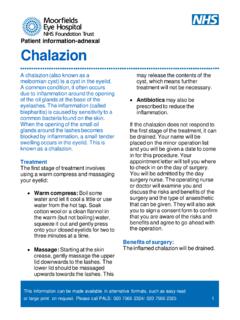
Transcription of Common eye condition management
1 Common eye condition management3 Thank you for taking the time to read this concise advice booklet about Common eye conditions. It has been produced by clinicians and other staff at Moorfields to help you to make informed clinical decisions about your patients eye conditions locally, and avoid them having to attend hospital each of the most Common conditions you might see in your practice, we have listed signs and symptoms, the equipment you will need to examine the patient, and the procedure to follow in undertaking that the end of the booklet, we have included a table divided into four levels of urgency for onward referral immediate, within 24 hours, within one week and routine with a list of relevant circumstances and conditions for each.
2 We have also provided a table of the several locations in which Moorfields provides care in and around London, and the sub-specialty services we offer in each hope you find this guide helpful, and welcome your views on how we might improve future editions. Please contact our GP liaison manager on 020 7253 3411, ext 3101 or by email to with your comments. Please remember that we also have a section of our website dedicated to primary care colleagues, which we will keep updated with the latest information. You can find this section at You can also download further copies of this booklet from that by Moorfields medical directorCONTENTSI ntroduction by Moorfields medical director .. 3 Schematic diagram of the human eye .. 4 General information Equipment and drugs to keep at hand in the surgery.
3 4 General good practice advice .. 5 Eye examination .. 5 Care pathways for commoneye conditions: Conjuntivitis .. 6 Dry eyes .. 7 Blepharitis .. 8 Chalazion (meibomian cyst) ..10 Stye ..11 Corneal abrasion ..12 Corneal foreign body ..13 Subtarsal foreign body ..14 Subconjunctival haemorrhage ..15 Episcleritis ..16 When to refer to the ophthalmic department ..17 Moorfields sites and services ..18 Referral information .. 20-23 Declan FlanaganMedical directorMoorfields Eye Hospital NHS Foundation Trust General informationGeneral informationSchematic diagram of the Human Eye Schematic diagram of the Human Eye EvaluationEquipment and drugs to keep at hand in the Surgery: Vision testing chart Good light source with magnifier (and ideally blue light source) Fluorescein Chloramphenicol ointment 1% Cotton Buds Eye padsEquipment and drugs to keep at hand in the surgery.
4 Vision testing chart Good light source with magnifier (and ideally blue light source) Fluorescein drops Chloramphenicol ointment 1% Cotton buds Eye pads Tape Direct ophthalmoscope Patient information leafletsSchematic diagram of the human eye4 5 General good practice adviceInitial checks: It is good practice to check visual acuity for patients presenting with an eye condition Check the visual acuity in each eye separately for distance; if the patient wears distance glasses, these should be worn for the test Record best corrected visual acuity that is, wearing glasses or contact lenses where used If vision is reduced, recheck with the patient looking through a pinhole viewer, which improves the vision if there is any uncorrected need for glasses/lenses Significant reduction in the visual acuity is a good indicator for referral Review patient history, noting allergies, medical and ocular history, including amblyopia Always establish and record symptoms and onset (sudden/gradual/all/part/pain)
5 Refer red eye with vision loss or other signs of concern to an ophthalmologist for evaluation Eye examination Wash hands Observe lid margins, conjunctiva and cornea with white light Instil 1 drop of fluorescein Observe for corneal staining (preferably using a blue light source) Diagnosis confirmed Treat accordingly If concerned, seek advice from an ophthalmologist6 Conjunctivitis can be bacterial, viral or pathway for coNjuNcTIvITIS Bacterial often has mucopurulent discharge/lashes stuck togetherViral often watery, associated with cold/sore throat, pre-auricular lymph nodesBlurring of vision due to disturbance of the tear film/corneal involvement (adenoviral)Seasonal/hayfever allergic conjunctivitisRedness affects all conjunctiva (vs uveitis-circumcorneal injection & photohobia/ scleritis-ache)Small white stellate corneal infiltrates in adenoviralInstil 1 drop of fluorescein Look for multiple fine white spots or fluorescein stains on cornea.
6 Major corneal staining or clouding suggests an alternative diagnosis corneal ulcer especially if CL wearerChloramphenicol eye drops qds for bacterial conjunctivitis Topical lubricants for viral conjunctivitis topical steroids for corneal infiltrates should be prescribed by an ophthalmologistAntihistamine or antimast cell drops ( cromoglycate, nedocromil, opatanol ) are used for allergyCare Pathway for Conjunctivitis Conjunctivitismay be bacterial, viral or allergicSymptoms Gritty/itchy/foreign body sensation Bacterial conjunctivitis often has mucopurulent discharge/lashes stuck together viral often watery, associated with cold/sore throat, pre-auricular lymph nodes Blurring of vision due to disturbance of the tear film/corneal involvement (adenoviral) Seasonal/hayfever allergic conjunctivitis Signs Redness affects all conjunctiva (globe of eye and tarsal conjunctiva lining inside of eyelids)
7 In contrast to uveitis or scleritis where redness only on the globe Purulent discharge suggests bacterial origin Small white corneal infiltrates can occur in viral infectionEye examination Instil 1 drop of fluorescein Look for multiple fine white spots or fluorescein stains on cornea; major corneal staining or clouding suggests an alternative diagnosis eg corneal ulcer, especially in contact lens wearersTreatment Chloramphenicol eye drops four times daily for bacterial conjunctivitis Topical lubricants for viral conjunctivitis Hygiene topical steroids for corneal infiltrates should be prescribed by an ophthalmologist Antihistamine or antimast cell drops (eg cromoglycate, nedocromil, opatanol) are used for allergyCare pathway for Common eye conditions7 Dry eye syndrome is a condition where the eyes do not make enough tears, or the tears evaporate too quickly.
8 This can lead to the eyes drying out and becoming inflamed. It is a Common condition and becomes more Common with age, especially in women. up to a third of people aged 65 or older may have dry eye syndrome. It is more Common in those with connective tissue disorders, in blepharitis and for contact lens Dry, gritty, discomfort or tired eyes which get worse throughout the day Mildly sensitive to light (not significant photophobia) Slight blurred vision, which improves on blinking Both eyes are usually affected (may be asymmetrical symptoms) Signs Redness of the eyes Spotty ( punctate ) fluorescein staining May be associated blepharitis (crusting of lashes, foamy tear film)
9 Eye examination Observe lids, conjunctiva and cornea with white light Instil 1 drop of proxymethacaine with fluorescein Observe for corneal staining preferably using a blue light consider Schirmer tear test (wetting of tear test strip in five minutes, <5 7mm abnormal)Treatment Tear substitutes: mild to moderate cases of dry eye syndrome can usually be successfully treated using over-the-counter artificial tear drops; if a patient has severe symptoms and needs to use eye drops more than six times a day, or if they wear contact lenses, advise them to use preservative-free eye drops Eye ointment can also be used to help lubricate eyes, but it can often cause blurred vision, so it is probably best used only at night More severe cases may require specialist medication or lacrimal punctal plugsCare pathway for DRY EYESCare Pathway for Dry EyesDry Eye Syndrome is a condition where the eyes do not make enough tears, or the tears evaporate too quickly.
10 This can lead to the eyes drying out and becoming inflamed. It is a Common condition and becomes more Common with age, especially in women. Up to a third of people age 65 or older may have dry eye syndrome. It is more Common in those with connective tissue disorders, in blepharitis and contact lens Blepharitis is an inflammatory eyelid condition caused by chronic staphylococcal infection and malfunction of the meibomian (lipid) glands. It can cause secondary conjunctivitis and dry eye, and occasionally small corneal pathway for BLEPHarITISB lepharitisBlepharitis is an inflammatory eyelid condition caused by chronic staphylococcal infection and malfunction of the meibomian (lipid) can cause secondary conjunctivitis and dry eye and occasionally small corneal is an inflammatory eyelid condition caused by chronic staphylococcal infection and malfunction of the meibomian (lipid) can cause secondary conjunctivitis and dry eye and occasionally small corneal gradual onset or chronic history of.