Transcription of Common Facilitation Challenges - Advocacy and …
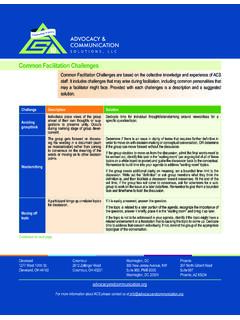
1 Cleveland1277 West 104th , OH 44102 Columbus2612 Zollinger Road Columbus, OH 43221 Washington, DC300 New Jersey Avenue, NWSuite 900, PMB 9005 Washington, DC 20001 Phoenix207 North Gilbert RoadSuite 007 Phoenix, AZ more information about ACS please contact us at Facilitation ChallengesCommon Facilitation Challenges are based on the collective knowledge and experience of ACS staff. It includes Challenges that may arise during Facilitation , including Common personalities that may a facilitator might face. Provided with each Challenges is a description and a suggested groupthinkIndividuals place views of the group ahead of their own thoughts or sug-gestions to preserve unity. Occurs during norming stage of group time for individual thought/brainstorming around views/ideas for a specific group gets focused on discuss-ing the wording in a document (such as mission/vision) rather than coming to consensus on the meaning of the words or moving on to other decision if there is an issue in clarity of terms that requires further definition in order to move on with decision-making or conceptual conversation, OR determine if the group can move forward without the discussion.
2 If the group decides to move on from the discussion, admit the final words need to be worked out, identify this task in the waiting room (an ongoing list of all of these topics on a white board or poster) and guide the discussion back to the conceptual. Remember to build time into your agenda to address waiting room the group needs additional clarity on meaning, set a bounded time limit to the discussion. Write out the definition or ask group members what they think the definition is, and then facilitate a discussion toward consensus. At the end of the set time, if the group has not come to consensus, ask for volunteers for a sub-group to work on the issue at a later date/time. Remember to give them a bounded task and timeframe to hold the off topicA participant brings up unrelated topics for it is easily answered, answer the question.
3 If the topic is related to a later portion of the agenda, recognize the importance of the question, answer it briefly, place it in the waiting room and bring it up later. If the topic is not to be addressed in your agenda, identify if the topic might have a related undercurrent or a frustration that is causing the topic to come up. Dedicate time to address that concern individually. If not, remind the group of the appropriate topic/goal of the on next Facilitation ChallengesChallengeDescriptionSolutionMa naging time and staying flexibleKnowing when to move on to the next topic or allow a group to discuss more and share a timed agenda. Remind people if/when the group is close to running out of time or over time. Ask the room and get agreement before spending more than allotted time. This seems to be an important conversation. Do we want to spend 15 more minutes on this?
4 If the discussion is breaking down barriers, or will benefit future activities, it might be worthwhile to continue. When a group is spinning its wheels, bored or rehashing, it is time to move with disagreement, conflict, anger and personal attacksDisagreement: Participants do not agree on approach or next steps. Dis-agreement is confined to content being : Deeper than a disagreement about content, conflict may be about organizational differences or a past disagreement. Anger: An individual is raising his/her voice, and displaying other signs of anger. Personal attacks: An individual personally attacks the character of another participant or someone not in the : Identify the source of disagreement. Facilitate a discussion about the difference in opinion or schedule a separate time to work through differences.
5 Re-phrase the concern/frustration, ask person to indicate if they you are hearing him/her correctly, provide an alternative or corrected frame of the : Take a break and ask the affected participants individually about how to handle the conflict in order to move forward with the group discussion. Additional time may be scheduled to facilitate a conflict resolution attacks: Suggest a break and approach the person individual-ly to address the issue. Remind him/her that personal attacks are breaking the ground rules of the group. Schedule a time for conflict resolution. In rare instanc-es ask individuals to remove side conversationsParticipants are not focused on the discussion at hand. Individual conversations occur that exclude the near the conversing individuals to provide a hint that they are being disrup-tive.
6 Ask one of the individuals if there is a question or if he/she can share thoughts because they are probably important to the entire room (even if it is not). Take a 5-minute break and ask everyone to sit in a new seat when they come back (frame it as a getting to know new people exercise).Ask participants to step out if it is highly when to change directions and throw out your carefully planned agendaThe group is not at the place you thought the members were when you planned your agenda, or an unplanned event altered the overall approach that the group needs to a 5-minute break and discuss your change in approach with fellow facilitators. Review the decision points that you had intended on reaching during your agenda and determine which can still be reached. If an unplanned event has altered the group s goals or approach, discuss those changes with the group.
7 You may need to dedicate more time to defining issues, clarifying items or of engagement/ participating in discussionFew or no volunteers to answer ques-tions, discussions lull. The facilitator is pulling information out of may be time to take a break. Personalize the material by asking the audience specific questions. Ask for specific examples or experiences that relate to the dis-cussion through open-ended harmful non-verbal cuesCrossed arms, attention on the phone/computer, eye rolling, sighs, scowling, in with the individual during a break. Ask if he/she has concerns or questions to identify what the source of the cues are. Continued on next Facilitation ChallengesChallengeDescriptionSolutionTh e conversation does not have a natural conclusion/ decisionThe group goes through brainstorming and discovery, but it is not clear what happens next in order to reach a de-sired what questions need to be answered in order to get to a conclusion and identify when that conversation can take sure that every voice has been heardSome people process information in-ternally, while others process verbally.
8 It is easy for internal thinkers to get lost in the mixAs you get to know the group and build relationships with participants, begin to identify how they process information. Check in with individuals who have not spoken, or those you know process more internally, to see if they have additional thoughts before moving on to a new topic/agenda item. Always build in a Q&A section into the end of presentations. Distribute a feedback form at the end of sessions and address items at the next meeting or between with negativity or resistanceOne or two participants are very nega-tive about the material, direction of the group or approach. They participate through negative statements and do not see how the material/content ap-plies to them. This type of behavior can be toxic to a successful meeting and can prevent group consensus, buy-in and/or meeting preparation will help you deal with this.
9 Working with meeting or-ganizers in advance to understand who is in the audience, their expectations and experiences will help you develop material that is relevant to them. If the negative participants are resistant to change, work with them individually on a break to understand what their Challenges are with the material. Engage in a group exercise to brainstorm the participant is still negative or resistant, address the issue with the meeting organizer/the participant s manager after the meeting to come up with an alternative approach to dealing with negativity prior to the next to do if you (the facilitator) offends someone or crosses a boundaryFacilitators are not always perfect and it is easy to overstep your boundaries or offend someone in the group. When you do cross a boundary, it is important to address the issue a boundary has been crossed, it is important to acknowledge the issue and re-build your relationship with the individual.
10 Once you recognized a boundary might have been crossed, reach out and have an individual conversation to under-stand the issue as soon as possible. Reaching out and acknowledging the issue will help the individual understand that you did not mean to cross the boundary and will work to resolve the issue in the a group over the phoneSometimes it is not possible for the group to meet in person. Other times there might be a few people who have to call in. This presents unique Challenges because you cannot read body language. As a facilitator you must control and guide the conversation and also make sure all voices are prepared is critical. Send a reminder with call-in information and time, as well as any meeting materials the day before the scheduled meeting time. Pre-work should also be done with any co-presenters to be clear on which portions of the meeting will be covered by whom.