Transcription of COMMUNITY-BASED MANAGEMENT
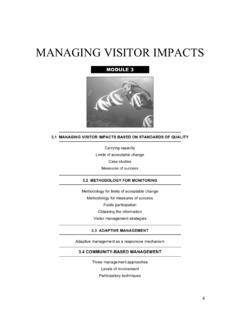
1 COMMUNITY-BASED MANAGEMENT THE ROLE OF COMMUNITIES IN MANAGEMENT MANAGEMENT Approaches Levels of community Involvement FRAMEWORK FOR community PARTICIPATION Major Activities for community Involvement Who is the community ? STAKEHOLDER IDENTIFICATION AND INVOLEMENT Key Participants in MPA MANAGEMENT Building Partnerships community ORGANIZING AND PARTICIPATORY MANAGEMENT APPROACHES Phases in the community Organization Process Participatory Techniques CASE STUDIES Ho Mun Project, Nha Trang, Vietnam Cu Lao Cham MPA, Vietnam Koh Kong Mangrove MPA, Cambodia Cebu MPA, Philippines MODULE 3 Acknowledgements Information included this curriculum was drawn from the following documents: The Philippine Coastal MANAGEMENT Guidebook No. 4, Involving Communities in Coastal MANAGEMENT , 2001; Managing Marine Protected Areas: A TOOLKIT for the Western Indian Ocean.
2 Francis, J., Johnstone, R., van't Hof, T., wan Zwol, C. and Sadacharan, D. (editors). Training for the Sustainable MANAGEMENT of Marine Protected Areas: A Training Manual for MPA Managers. CZMC/WIOMSA. COMMUNITY-BASED MANAGEMENT 3-1 MODULE 3 OVERVIEW community organization and mobilization is a critical process that is required to improve the capacity of the local community to participate in the MPA MANAGEMENT planning and other decision-making processes. Effective MPA MANAGEMENT is best accomplished by a participatory process of planning, implementing, and monitoring sustainable uses of coastal and marine resources through collective action and sound decision-making. COMMUNITY-BASED or co- MANAGEMENT approaches to MPA MANAGEMENT are based on the principles of involving local coastal communities in managing the resources upon which they Module 3 of the MPA MANAGEMENT Capacity Training Program focuses on the importance of community involvement and support in coastal and marine MANAGEMENT efforts.
3 You will learn a number of key strategies for protecting vital resources through a process that addresses, while helping to reverse, the following trends: Deteriorating coastal environments Loss of natural resources Increasing local poverty IMPORTANCE OF COMMUNITY-BASED MANAGEMENT TO MPA MANAGEMENT Unlike land resources, marine resources are not easy to fence off and are often considered common property and available to all. Protection and MANAGEMENT of these resources is extremely difficult without the support and cooperation of the stakeholder community . The MANAGEMENT of marine protected areas (MPAs) will fail without the support and involvement of the local community a participatory approach grounded in COMMUNITY-BASED MANAGEMENT . 1 PH-4, White, , Hale, Y. Renard and L. Cortesi. 1994. Collaborative and COMMUNITY-BASED MANAGEMENT of Coral Reefs: Lessons from Experience.
4 Kumarian Press, West Hartford, Connecticut. 130 p.; PH-4, International Institute of Rural Reconstruction (IIRR). 1998. Participatory Methods in COMMUNITY-BASED Coastal Resource MANAGEMENT . 3 volumes. Silang, Cavite, Philippines. COMMUNITY-BASED MANAGEMENT 3-2 MODULE 3 LEARNING OBJECTIVES Learn why and how communities play an important role in successful resource MANAGEMENT Demonstrate a participatory approach to identifying, involving, and engaging stakeholders in MPA MANAGEMENT LEARNING PRODUCTS Stakeholders Profile Matrix that helps define stakeholder interest in MPA and how to involve them in the MPA development and implementation process A timeline with specific milestones/goals for stakeholder involvement FIELD APPLICATIONS You will learn general skills for securing stakeholder involvement in building your implementation plan and experience real-life examples of how to develop and engage effective teams in MPA MANAGEMENT .
5 This module introduces participants to COMMUNITY-BASED MANAGEMENT in Cu Lao Cham MPA in Vietnam, in Koh Kong Mangrove MPA in Cambodia, and a MPA in the Philippines. We will take an in-depth look at the Hon Mun MPA in Nha Trang, Vietnam one of 15 MPAs that has been designated by Vietnam s Ministries of Fisheries (MOFI). Typical communities living around Hon Mun are small island villages that are completely reliant on fishing for their livelihood. Consequently, the principal threats to Vietnam s coastal and marine environments include: Unsustainable fishing practices ( , overexploitation and dynamiting) and Poor water quality from pollution and sediment loading These disturbing trends are also typically present in Chinese and Cambodian coastal communities that share the Southeast Asia ocean environment. The Hon Mun MPA ultimate project s success in reversing these trends in this community depends on the commitment of the local stakeholders a commitment gained and maintained through an ongoing COMMUNITY-BASED participatory process.
6 COMMUNITY-BASED MANAGEMENT 3-3 MODULE 3 LINKS TO OTHER EFFECTIVE MANAGEMENT AREAS MANAGEMENT Planning community participation in developing a MPA MANAGEMENT plan will help to ensure that the plan not only addresses the full range of biophysical, socioeconomic, and governance categories, but also engages local stakeholder support in implementing site-level activities all of which contribute to successful short- and long-term outcomes. Zonal MANAGEMENT COMMUNITY-BASED MANAGEMENT relies on a participatory process involving the local community s collective agreement on and design of multiple use zoning plans that help to address and resolve resource use conflicts, such as establishing marine reserve (No Take) zones to protect marine and coastal ecosystems, while identifying areas for economic development. Responsible Fishing and Aquaculture Since coastal villages rely almost exclusively on fishing for their livelihood, community involvement is essential in planning, implementing, monitoring and enforcing responsible aquaculture practices that create healthy fisheries with long-term economic viability.
7 Sustainable Tourism The planning of a sustainable tourism program needs to be a COMMUNITY-BASED participatory process that empowers local stakeholders to manage their own resources and cultural heritage, while contributing to marine conservation and providing tangible economic opportunities. Effective Communications To engage local community members in a participatory process and sustain their support MPA initiatives requires effective oral communication and presentation skills whether in small community groups, at large controversial public meetings, or working with the media during the public issues MANAGEMENT process. INDICATORS OF EFFECTIVE COMMUNITY-BASED MANAGEMENT While final and periodic program evaluation is an essential part of every MPA s MANAGEMENT plan, an ongoing assessment of stakeholder involvement is critical to ensuring that the plan is meeting and can continue to meet key goals.
8 In Modules 4, 5 and 6, you will learn how to build a MANAGEMENT plan using a specific planning process. COMMUNITY-BASED MANAGEMENT 3-4 MODULE 3 This approach to developing a MPA MANAGEMENT plan involves a collaborative and participatory planning process with key stakeholders to identify program goals, an implementation strategy, and desired outcomes. Without the appropriate mix of stakeholders and their continued support, the MPA staff will be unable to implement the planned activities necessary to achieve desired outcomes. Indicators should allow MPA staff to measure progress towards completion (or maintenance) of an established goal. Identifying goals, selecting performance measures or indicators, and measuring success related to stakeholder involvement should all be based on a participatory process. Evaluations should occur on a periodic basis and reflect the priorities of the MPA.
9 COMMUNITY-BASED MANAGEMENT 3-5 MODULE 3 LESSON PLAN Exercise Icebreaker Divide into equal-sized teams (four to six people per team and not from your group). Each person writes down four facts about himself/herself, one of which is a lie. Each person takes turns reading his/her list aloud to the group. The rest of the team each writes the one fact he/she believes is a lie. After everyone has read their lists, the first person rereads his/her list and identifies the lie. The team members discuss how successful they were in guessing the lie. Discussion Implementation Plan Progress Each team nominates one person to discuss the team s progress during Day 2 in developing an implementation plan contract. Current conditions of coastal and marine resources in Southeast Asia indicate a high level of degradation primarily from destructive fishing practices, overexploitation, siltation/ sedimentation ( , stream bottom deposits), pollution, and habitat loss.
10 These problems often result from a de facto open access system, lack of an integrated framework for coastal and marine resource protection at the national and local level, low level of public awareness, and economic hardships in coastal communities (Philippine Coastal MANAGEMENT Guidebook Series, Guidebook 1, Coastal MANAGEMENT Orientation and Overview). Effective MPA MANAGEMENT is best accomplished by planning, implementing, and monitoring sustainable uses of coastal resources through collective action and sound decision-making. A COMMUNITY-BASED participatory approach is fundamental to a successful MPA since local community members who are dependent on coastal resources are often the most committed and conscientious trustees of those resources if they receive direct benefits from their efforts. THE ROLE OF COMMUNITIES IN MANAGEMENT COMMUNITY-BASED MANAGEMENT 3-6 MODULE 3 Three MANAGEMENT Approaches All MANAGEMENT strategies consistent of either a top-down, bottom-up or combination approach.