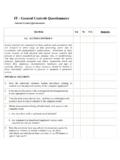
Transcription of Community Integration Questionnaire - Stroke …
1 Community Integration Questionnaire (CIQ) The Community Integration Questionnaire (CIQ) is intended as a brief, reliable measure of an individual s level of Integration into the home and Community following traumatic brain injury. 1. Who usually does shopping for groceries or other necessities in your household? ___ yourself alone ___ yourself and someone else ___ someone else 2. Who usually prepares meals in your household? ___ yourself alone ___ yourself and someone else ___ someone else 3.
2 In your home, who usually does normal everyday housework? ___ yourself alone ___ yourself and someone else ___ someone else 4. Who usually cares for the children in your home? ___ yourself alone ___ yourself and someone else ___ someone else ___ not applicable/ no children under 17 in the home. 5. Who usually plans social arrangements such as get-together's with family and friends? ___ yourself alone ___ yourself and someone else ___ someone else 6.
3 Who usually looks after your personal finances, such as banking or paying bills? ___ yourself alone ___ yourself and someone else ___ someone else Can you tell me approximately how many times a month you now usually participate in the following activities outside your home? 7. Shopping ___ Never ___ 1-4 times ___ 5 or more 8. Leisure activities such as movies, sports, restaurants, etc. ___ Never ___ 1-4 times ___ 5 or more 9.
4 Visiting friends or relatives ___ Never ___ 1-4 times ___ 5 or more 10. When you participate in leisure activities, do you usually do this alone or with others? ___ mostly alone ___ mostly with friends who have head injuries ___ mostly with family members ___ mostly with friends who do not have head injuries ___ with a combination of family and friends 11. Do you have a best friend with whom you confide? ___ yes ___ no 12.
5 How often do you travel outside the home? ___ almost every day ___ almost every week ___ seldom/never (less than once per week) 13. Please choose the answer below that best corresponds to your current (during the past month) work situation: ___ full-time (more than 20 hours per week) ___ part-time (less than or equal to 20 hours per week) ___ not working, but actively looking for work ___ not working, not looking for work ___ not applicable, retired due to age 14.
6 Please choose the answer below that best corresponds to your current (during the past month) school or training program situation: ___ full-time ___ part-time ___ not attending school or training program 15. In the past month, how often did you engage in volunteer activities? ___ Never ___ 1-4 times ___ 5 or more Scoring Guidelines The CIQ consists of a total of 15 questions. The overall score, which represents a summation of the scores from individual questions, can range from 0 to 29.
7 A higher score indicates greater Integration , and a lower score reflects less Integration . The CIQ can be further divided into three subscores, corresponding to Integration in the home, social Integration , and productivity. Procedures for deriving the subscores are outlined on the scoring sheet. The following guidelines provide scoring information for specific items or groups of items. Items 1 to 6: Score: 2 = The activity is performed alone 1 = The activity is performed with someone else 0 = The activity is performed by someone else Note: For item 4, if there are no children under 17 in the home, the average (mean) score for items 1 through 3 and item 5 should be substituted.
8 Items 7 to 9: Score: 2 = The activity was performed 5 or more times in the past month 1 = The activity was performed 1 - 4 times in the past month 0 = The activity was not performed in the past month Item 10 Score: 2 = Mostly with friends without head injury or combination of family and friends 1 = Mostly with friends who have head injuries or with family 0 = Mostly alone Item 11 Score: 2 = Yes response 0 = No response Item 12 Score: 2 = Almost every day 1 = Almost every week 0 = Seldom/never (less than once per week) Items 13 to 15 Although these items are collected individually, they will be combined to form one variable, Productivity.
9 The scoring of this variable is dependent on the combination of answers to questions 13, 14 and 15. On page 4, is a listing of answer sets to these questions and their associated score. Scoring of the Productivity Variable Question#13 Work Question #14 School Question#15 Volunteer Work ScoreNot working/not looking + No school +No Volunteering = 0 Not working/not looking + No school +1-4 times/month = 1 Not working/not looking + No school +5 or more times/month = 1 Not working/looking + No school +No Volunteering = 0 Not working/looking + No school +1-4 times/month = 2 Not working/looking + No school +5 or more times/month = 2 Retired due to age + No school +No Volunteering = 0 Retired due to age + No school +1-4
10 Times/month = 2 Retired due to age + No school +5 or more times/month = 3 Retired due to age + Part-time +No Volunteering = 4 Retired due to age + Part-time +1-4 times/month = 5 Retired due to age + Part-time +5 or more times/month = 5 Retired due to age + Full-time +Any answer = 5 Not working + Full-time +Any answer = 3 Not working + Part-time +Any answer = 4 Part-time + No school +Any answer = 3 Part-time + Part-time +Any answer = 4 Part-time + Full-time +Any answer = 5 Full time + No school +Any answer = 4 Full time + Part-time +Any answer = 5 Subscales Subscales have been developed to allow an analysis of Integration within specific domains of everyday life.