Transcription of Compaction of Fine- Grained Soils Using the Proctor Method
1 Prized Writing 2015-2016214 Compaction of Fine- Grained Soils Using the Proctor MethodCHARUNI KURUMBALAPITIYAWRITER S COMMENT: Writing a technical description for an engi-neering process posed the daunting task of identifying a process that captures the essence of the diverse profession. Having recently taken a course on soil mechanics, I inevitably began to gravitate towards a concept with which most civil engineering students are familiar: the Compaction of Soils . I hoped to capture the minutiae associated with laboratory Compaction processes, and that would also demonstrate the importance of proper Compaction to construction processes and the performance of structures.
2 The technical complexity of this article supplements civil engineering students laboratory and classroom of understanding of the processes governing Compaction . Authoring this article truly tested my own understanding of the subject and encour-aged me to write in a manner that is both engaging and informative for my peers. This article would have been less success without Dr. Katie Rodger s great syntactical tips, which she provided me through-out the drafting process. Finally, I d like to thank my soil mechanics professor, Dr. Arash Khosravifar, for helping me to understand the importance of the recurrent theme of Compaction in civil engineering.
3 INSTRUCTOR S COMMENT: Students in my Professional Science Writing course are often among the most ambitious undergraduates I teach. Many are in the final quarters of their degree programs, and are eager to apply the concepts and theories that they ve studied to professional writing styles and forms that they will need to master as scientists in their respective fields. One of the essential skills we discuss is the abil-ity to clearly write a technical description about a process. For many 215students, this is a far more difficult assignment than they anticipate, but Charuni Kurumbalapitiya rose to the task, and exceeded my expectations with her description aimed at civil engineers.
4 Her Com-paction of Fine- Grained Soils Using the Proctor Method balances the demands of this kind of technical writing providing a clear and logical description of the Method with appropriate and profes-sional details. Charuni is an excellent writer and thinker, and I look forward to following her career in engineering. Katie Rodger, University Writing ProgramScopeThe audience for this technical description is upper division civil engineering students who have demonstrated an interest in soil mechanics and who are currently enrolled in a geotechnical laboratory class. Hence, the reader is assumed to possess a thorough understanding of the core concepts and terminology associated with soil mechanics.
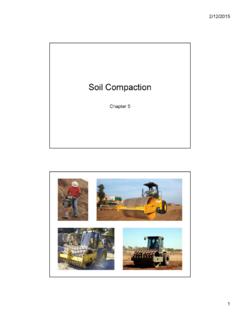
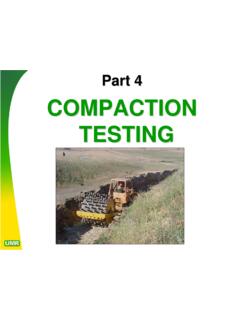
5 The reader will have completed relevant coursework in lower division math and physics and will be familiar with concepts pertaining to density and dimensional analysis. This article demonstrates how Compaction tests are performed in the laboratory to generate Compaction curves for a specific soil type. This document may serve as a supplement to ASTM standards delineating laboratory methods for Compaction . Introduction Fig. 1: Field Compaction Using a Sheepsfoot Compactor. Fig. 2: Field Compaction with smooth steel drum of Fine- Grained Soils Using the Proctor MethodPrized Writing 2015-2016216 Prior to the construction of a structure, it may be necessary to strengthen the engineering properties of the soil present at a site by subjecting it to Compaction .
6 Compaction is the process by which mechanical energy is used to induce the densification and stabilization of a soil matrix. Compaction processes may also alter both the water content and the grain size distributions of the soil . The objectives achieved through Compaction include the following: reduction of settlement in structures, increase in slope stability, increase in the bearing capacity of soil , reduction of hydraulic conductivity of soil , reduction in swelling of the soil matrix, and the creation of uniformity within Soils . The successful Compaction of soil is crucial to the stability and function of modern structures such as retaining walls, pavement subgrades and foundations, as well as dams and other hydraulic of Compaction for Soils Fig.
7 3: Apparatus and specifications for the Standard Proctor Method of CompactionThe principles of Compaction were first developed by Proctor in 1933. Although his concepts were initially used for field Compaction , Proctor s methods led to the creation of two popular standard laboratory Compaction tests : the Standard Proctor and the Modified Proctor tests . Metal CollarMetal MoldDetachable Base Plate217 The primary objective of performing a Proctor test is to determine the maximum dry density ( d,max) and the optimum water content ( opt) at Compaction effort. In the laboratory, both Proctor tests are used for the Compaction of Fine- Grained Soils .
8 The choice of Proctor test is determined by the application: the modified Proctor produces denser soil fabrics than the standard Proctor . A typical Proctor test consists of placing a remolded soil sample within a ring mold and hammering the sample with a dropped weight to induce Compaction (see Fig. 3 & 5). However, the tests differ with respect to the weight and drop height of the hammer, as well as the number of soil layers placed in the ring mold. Typically, any Compaction process is governed by four main parameters unique to a soil sample. These parameters include type of soil (clayey or sandy), dry density ( d), water content ( ), and compactive effort ( ).
9 The (measured in N-m/m3) is a measure of the mechanical energy required for Compaction and is a function of the following experimental parameters: volume of the mold, mass of the mold, height of the hammer drop, number of drops and the number of soil layers used. By determining the parameters governing a Compaction procedure with the aid of both the Standard and Modified Proctor tests , a civil engineer can find the optimum conditions at which Compaction should be performed at a site. These optimum conditions are interpolated from the peaks of Compaction curves (plots of d vs. ), which are graphed Using the data obtained from the standard and modified Proctor Compaction tests (Fig.)
10 4).Conducting Proctor Methods of CompactionHaving established the significance of the Proctor Methods, it is possible to distinguish how standard and modified Proctor tests are conducted in the lab. However, note that both Proctor Methods are preceded by a stage of soil preparation (discussed below). Here Yolo Loam, a soil typical to the area, is used. Preparation of soil Sample and the Determination of nAcquire ten separate kg samples of Yolo Loam; participants may obtain one sample at a time, as needed. Sieve these ten soil samples Compaction of Fine- Grained Soils Using the Proctor MethodPrized Writing 2015-2016218using a #4 sieve and include all soil particles that pass through the sieve.