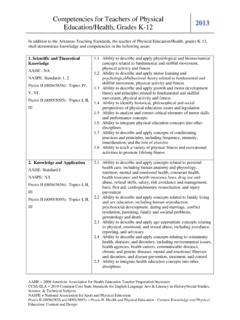
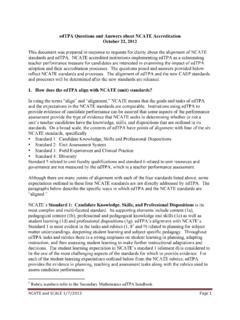
Transcription of Competencies for Secondary Teachers: …
1 Competencies for Secondary Teachers: english / language arts , Grades 7-12 2014 ATS (InTASC) = 2011 Arkansas Teaching standards (Interstate teacher Assessment and Support consortium) CCSS = Common Core State standards ncte = 2012 National Council of english Teachers Praxis II(5039) = Praxis II: english language arts : Content and Analysis Revised 8/7/2014 In addition to the Arkansas Teaching standards , the teacher of english , grades 7-12, shall demonstrate knowledge and Competencies in the following areas: 1. Reading Foundational Skills CCSS-ELA: R ncte : : I .2 Knowledge of how students learn to read and how explicit and systematic instruction in each of these areas produces successful readers, including Organization and features o f print Knowing and applying and wor d analysis skills in decodi ng wor ds Reading with sufficient accur acy and fluency to support compr ehension Ability to identify the differentiated needs of Secondary level readers and strategically address them Understanding of the methods of diagnosis of reading difficulties Knowledge of intervention strategies for struggling readers 2.
2 Reading - Literature (define d as stories, d rama and poetry) CCSS-ELA: R ncte : ; I .2 Knowledge of developmentally appropriate literary texts across genres, cultures, and centuries by Knowing the historical, cultural, and literary contexts of major works and authors of United States, British, World Literature, and young adult literature Knowing the defining characteristics of major forms within each primary literary genre ( poetry, ballad, haiku, sonnet, blank verse) Ability to select developmentally appropriate literary texts, using all measures of text complexity: qualitative, quantitative, and reader and task Ability to read literary texts closely and critically to analyze the key ideas and details as well as craft and structure with the purpose of integrating knowledge and ideas both within and across texts by Developing text-based questions to elicit both literal and inferential understanding of texts that is accurately supported by quoting several pieces of textual evidence that most strongly support the analysis Analyzing a text to understand how a particular sentence, chapter, scene, or stanza fits into the overall structure of a text and contributes to the development of the individual literary elements such as plot, setting, characters, theme.
3 And/or point of v iew Analyzing how a drama s or poem s f orm or s truc tur e contribu tes t o its meaning Describing how a particular s tory s or d rama s plot unfol ds in a series of episodes as well as how the characters respond or c hange as the plot m ov es toward a resolution Describing in depth a character, setting , or event i n a story or drama, drawing on specific details in the text Competencies for Secondary Teachers: english / language arts , Grades 7-12 2014 ATS (InTASC) = 2011 Arkansas Teaching standards (Interstate teacher Assessment and Support consortium) CCSS = Common Core State standards ncte = 2012 National Council of english Teachers Praxis II(5039) = Praxis II: english language arts : Content and Analysis Revised 8/7/2014 Comparing and contrasting two or more characters, setting s, or e vents i n a stor y or d rama, drawing on specific details in the text Analyzing the relationships among the elements of a text to understand how one impacts others and contributes to the development of the theme and/or plot throughout the text Analyzing how particular l ines of d ialog ue or inc idents in a story or drama prop el t he action, reveal a spects of a character, or pr ov ok e a decision Paraphr asing and pr ov iding of objective summaries of t exts and differentiating the characteristics of these skills Determining the meaning of w or ds and phrases inc luding figur ative and connotative meaning s and analyzing the impact of s pe cific word choi ce on meaning and tone.
4 Inc lud ing analog ies or a llusions to other t exts, i nclud ing words with mul tiple meanings or language t hat is particularly fresh, engaging, or beautiful. (Include Shakespeare as well as othe r a uthors) Interpreting figurative language in context and analysis of its role in the text Recognizing rhetorical strategies ( , satire, irony, understatement, hyperbole) Ability to analyze multiple interpretations of a story, drama, or poem, evaluating how each version interprets the source text Ability to analyze how an author s choices concerning how to structure specific parts of a text ( , the choice of where to begin or end a story, the choice to provide a comedic or tragic resolution) contribute to its overall structure and meaning as well as its aesthetic impact Ability to analyze how an author develops and contrasts the points of view of different characters or narrators in a text by Analyzing a case in which grasping point of view requires distinguishing what is directly stated in a text from what is really meant ( , satire, sarcasm, irony, or understatement)
5 Ability to analyze how differences in the points of view of the characters and the audience or reader create such effects as suspense or humor by Comparing and contrasting the experience of reading a literary text to listening to or viewing an audio, filmed, staged, or multimedia version, analyzing the effects of techniques unique to each medium, including contrasting what is seen and heard when reading the text as to what is perceived when listening or watching Competencies for Secondary Teachers: english / language arts , Grades 7-12 2014 ATS (InTASC) = 2011 Arkansas Teaching standards (Interstate teacher Assessment and Support consortium) CCSS = Common Core State standards ncte = 2012 National Council of english Teachers Praxis II(5039) = Praxis II: english language arts : Content and Analysis Revised 8/7/2014 Evaluating how each version interprets the source text Ability to analyze multiple interpretations of a story, drama, or poem ( , recorded or live production of a play or recorded novel or poetry)
6 Abi lity to compare and contrast m ultiple literary text s with similar themes or topics across genres, cultures, and centuries Abi lity to compare and contrast a fictional portrayal o f a time, pl ace, or character and a histor ical a ccount o f t he same period as a means of understanding how authors of f iction use or a lter hi stor y Abi lity to analyze how a wor k of f iction draws on source material by using themes, patterns of events, or c haracter t ypes from myths, tradition al s tories, o r religious works such as the Bibl e, includ ing describi ng how t he material i s rendered new Ability to understand various literary theories ( , reader-response, feminist criticism) for interpreting and critiquing literary texts by Recognizing ways literary theories are used to interpret and critique texts 3.
7 Reading - Informational Text CCSS-ELA: R ncte : ; I .2 Ability to understand developmentally appropriate informational texts across genres, cultures, and centuries by Recognizing rhetorical strategies ( , satire, irony, understatement, hyperbole) Identifying methods of appeal or persuasion ( , expert opinion, generalization, testimonial) Ability to select developmentally appropriate informational texts, using all measures of text complexity: qualitative, quantitative, and reader and task Ability to read informational texts closely and critically to analyze the key ideas and details as well as craft and structure with the purpose of integrating knowledge and ideas both within and across texts by Distinguishing between what the text says explicitly and what may be inferred from the text Determining a central idea of a text and analyzing its development over the course of the text, including its relationship to supporting ideas and providing an objective summary of the text Analyzing how a text makes connections among and distinctions between individuals, ideas, or events ( , through comparisons, analogies, or categories)
8 Determining the meaning of words and phrases as they are used in a text, including figurative, connotative, and technical meanings Analyzing the impact of specific word choices on meaning and tone, including analogies or allusions to other texts Analyzing and evaluating the effectiveness of the Competencies for Secondary Teachers: english / language arts , Grades 7-12 2014 ATS (InTASC) = 2011 Arkansas Teaching standards (Interstate teacher Assessment and Support consortium) CCSS = Common Core State standards ncte = 2012 National Council of english Teachers Praxis II(5039) = Praxis II: english language arts : Content and Analysis Revised 8/7/2014 structure an author uses in his or her exposition or argument, including whether the structure makes points clear, convincing, and engaging Determini ng an author s point o f v iew or purpose in a text in whi ch the rhetor ic is particul arly effective, analyzing how style and content c ontribu te to the power, persuasiveness, or beauty of the text Evaluating whether evidence is relevant, factual, and or sufficient Identifying false statements and fallacious reasoning ( , slippery slope, red herring, straw man, post hoc ergo propter hoc) Identifying how text features ( , index, glossary, headings, footnotes, visuals)
9 Contribute to the central idea of an informational text Ability to integrate and evaluate multiple sources of information presented in different media or formats ( , visually, quantitatively) as well as in words in order to address a question or solve a problem by Evaluating the advantages and disadvantages of using different mediums to present a particular topic or idea Delineating and evaluating the argument and spe cific claims i n print and non-print text, assessing whe ther the reasoning is sou nd and the evidence is relevant a nd sufficient; r ecogni ze when irrelevant e vide nce is int roduced Ability to delineate and evaluate the reasoning in seminal texts, including the application of constitutional principles and use of legal reasoning ( , in Supreme Court majority opinions and dissents) and the premises, purposes, and arguments in works of public advocacy ( , The Federalist, presidential addresses) Ability to analyze seventeenth-, eighteenth-, and nineteenth- century foundational documents of historical and literary significance (including The Declaration of Independence, the Preamble to the Constitution, the Bill of Rights, and Lincoln s Second Inaugural Address) for their themes, purposes, and rhetorical features 4.
10 Writing CCSS-ELA: ncte : ; Knowledge of the learning progression of writing in a variety of forms for various audiences and purposes by Identifying how the task, purpose, or intended audience affects a piece of writing Choosing the most appropriate type of writing for a task, purpose, and audience Evaluating the effectiveness of a piece of writing for a specific task, purpose, and audience Writing argument s to support c laims i n an analysis of substantive topics or texts, using valid reasoning and Competencies for Secondary Teachers: english / language arts , Grades 7-12 2014 ATS (InTASC) = 2011 Arkansas Teaching standards (Interstate teacher Assessment and Support consortium) CCSS = Common Core State standards ncte = 2012 National Council of english Teachers Praxis II(5039) = Praxis II: english language arts .