Transcription of Complete IDDSI Framework Detailed definitions 2.0 | 2019
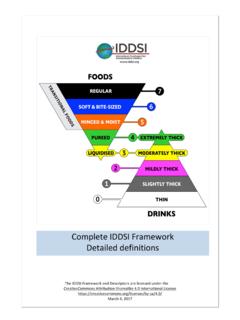
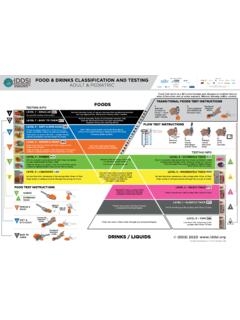
1 The IDDSI Framework and Descriptors are licensed under the CreativeCommons Attribution-Sharealike International License IDDSI | July, 2019 Complete IDDSI Framework Detailed definitions | 2019 The IDDSI Framework and Descriptors are licensed under the CreativeCommons Attribution-Sharealike International License IDDSI | July, 2019 2 INTRODUCTION The International Dysphagia Diet Standardisation Initiative ( IDDSI ) was founded in 2013 with the goal of developing new international standardised terminology and definitions to describe texture modified foods and thickened liquids used for individuals with dysphagia of all ages, in all care settings, and all cultures. Three years of work by the International Dysphagia Diet Standardisation Committee culminated in the 2016 release and 2017 publication of the IDDSI Framework consisting of a continuum of 8 levels (0-7). Levels are identified by numbers, text labels and colour codes.
2 [Reference: Cichero JAY, Lam P, Steele CM, Hanson B, Chen J, Dantas RO, Duivestein J, Kayashita J, Lecko C, Murray J, Pillay M, Riquelme L, Stanschus S. (2017) Development of international terminology and definitions for texture-modified foods and thickened fluids used in dysphagia management: The IDDSI Framework . Dysphagia, 32:293-314. ] The Complete IDDSI Framework Detailed definitions 2019 is an update to the 2016 document. The Complete IDDSI Framework Detailed definitions document provides Detailed descriptors for all levels of the IDDSI Framework . Descriptors are supported by simple measurement methods that can be used by people with dysphagia or by caregivers, clinicians, food service professionals or industry to confirm the level a food or drink fits into. This document is to be read in conjunction with IDDSI Testing Methods 2019, IDDSI Evidence 2016 and IDDSI Frequently Asked Questions (FAQs) documents ( ).
3 The IDDSI Framework provides a common terminology to describe food textures and drink thickness. IDDSI tests are intended to confirm the flow or textural characteristics of a particular product at the time of testing. Testing should be done on foods and drinks under the intended serving conditions (especially temperature). The clinician has the responsibility to make recommendations for foods or drinks for a particular patient based on their comprehensive clinical assessment. IDDSI would like to acknowledge the interest and participation of the global community including patients, caregivers, health professionals, industry, professional associations and researchers. We would also like to thank our sponsors for their generous support. Please visit for further information. The IDDSI Board: The IDDSI Board are a group of volunteers who do not draw a salary from IDDSI . They offer their knowledge, expertise and time for the benefit of the international community.
4 Co-Chairs: Peter Lam (CAN) & Julie Cichero (AUS); Board Members: Jianshe Chen (CHN), Roberto Dantas (BRA), Janice Duivestein (CAN), Ben Hanson (UK), Jun Kayashita (JPN), Mershen Pillay (ZAF), Luis Riquelme (USA), Catriona Steele (CAN), Jan Vanderwegen (BE). Past Board Members: Joseph Murray (USA), Caroline Lecko (UK), Soenke Stanschus (GER) The International Dysphagia Diet Standardisation Initiative Inc. ( IDDSI ) is independent and operates as a not-for-profit entity. IDDSI is grateful to a large number of agencies, organizations and industry partners for financial and other support. Sponsors have not been involved with the design or development of the IDDSI Framework . Implementation of the IDDSI Framework is in progress. IDDSI is extremely grateful to all sponsors supporting implementation The IDDSI Framework and Descriptors are licensed under the CreativeCommons Attribution-Sharealike International License IDDSI | July, 2019 3 Description/ Characteristics Flows like water Fast flow Can drink through any type of teat/nipple, cup or straw as appropriate for age and skills Physiological rationale for this level of thickness Functional ability to safely manage liquids of all types Although descriptions are provided, use IDDSI Testing methods to decide if the liquid meets IDDSI Level 0.
5 TESTING METHOD See also IDDSI Testing Methods document or IDDSI Flow Test* Less than 1 mL remaining in the 10 mL slip tip syringe# after 10 seconds of flow (see IDDSI Flow Test instructions*) IDDSI FLOW TEST INSTRUCTIONS #Before you You must check your syringe length because there are differences in syringe lengths. Your syringe should look like this The IDDSI Framework and Descriptors are licensed under the CreativeCommons Attribution-Sharealike International License IDDSI | July, 2019 4 Description/ Characteristics Thicker than water Requires a little more effort to drink than thin liquids Flows through a straw, syringe, teat/nipple Similar to the thickness of most commercially available Anti-regurgitation (AR) infant formulas Physiological rationale for this level of thickness Often used in the paediatric population as a thickened drink that reduces speed of flow yet is still able to flow through an infant teat/nipple.
6 Consideration to flow through a teat/nipple should be determined on a case-by-case basis. Also used in adult populations where thin drinks flow too fast to be controlled safely. These slightly thick liquids will flow at a slightly slower rate. Although descriptions are provided, use IDDSI Testing methods to decide if the liquid meets IDDSI Level 1. TESTING METHOD See also IDDSI Testing Methods document or IDDSI Flow Test* Test liquid flows through a 10 mL slip tip syringe# leaving 1-4 mL in the syringe after 10 seconds (see IDDSI Flow Test instructions*) IDDSI FLOW TEST INSTRUCTIONS #Before you You must check your syringe length because there are differences in syringe lengths. Your syringe should look like this The IDDSI Framework and Descriptors are licensed under the CreativeCommons Attribution-Sharealike International License IDDSI | July, 2019 5 Description/ Characteristics Flows off a spoon Sippable, pours quickly from a spoon, but slower than thin drinks Mild effort is required to drink this thickness through standard bore straw (standard bore straw = inch or mm diameter) Physiological rationale for this level of thickness If thin drinks flow too fast to be controlled safely, these Mildly Thick liquids will flow at a slightly slower rate May be suitable if tongue control is slightly reduced.
7 Although descriptions are provided, use IDDSI Testing methods to decide if the liquid meets IDDSI Level 2. TESTING METHOD See also IDDSI Testing Methods document or IDDSI Flow Test* Test liquid flows through a 10 mL slip tip syringe leaving 4 to 8 ml in the syringe after 10 seconds (see IDDSI Flow Test instructions*) IDDSI FLOW TEST INSTRUCTIONS #Before you You must check your syringe length because there are differences in syringe lengths. Your syringe should look like this The IDDSI Framework and Descriptors are licensed under the CreativeCommons Attribution-Sharealike International License IDDSI | July, 2019 6 Description/characteristics Can be drunk from a cup Moderate effort is required to suck through a standard bore or wide bore straw (wide bore straw = inch or mm) Cannot be piped, layered or molded on a plate because it will not retain its shape Cannot be eaten with a fork because it drips slowly in dollops through the prongs Can be eaten with a spoon No oral processing or chewing required can be swallowed directly Smooth texture with no bits (lumps, fibers, bits of shell or skin, husk, particles of gristle or bone) Physiological rationale for this level of thickness If tongue control is insufficient to manage Mildly Thick drinks (Level 2)
8 , this Liquidised/Moderately thick level may be suitable Allows more time for oral control Needs some tongue propulsion effort Pain on swallowing Although descriptions are provided, use IDDSI Testing methods to decide if the food/liquid meets IDDSI Level 3. TESTING METHODS See also IDDSI Testing Methods document or and IDDSI Flow Test* Test liquid flows through a 10 ml slip tip syringe leaving > 8 ml in the syringe after 10 seconds (see IDDSI Flow Test Guide*) Fork Drip Test Drips slowly in dollops through the prongs of a fork When a fork is pressed on the surface of Level 3 Moderately Thick Liquid/Liquidised food, the tines/prongs of a fork do not leave a clear pattern on the surface Spreads out if spilled onto a flat surface Spoon Tilt Test Easily pours from spoon when tilted; does not stick to spoon Where forks are not available Chopstick Test Chopsticks are not suitable for this texture Where forks are not available Finger Test It is not possible to hold a sample of this food texture using fingers, however, this texture slides smoothly and easily between the thumb and fingers, leaving a coating Food specific or Other examples (NB.)
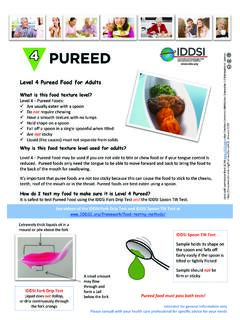
9 This list is not exhaustive) The following items may fit into IDDSI Level 3: Infant first foods (runny rice cereal or runny pureed fruit) Some sauces and gravies, as confirmed by IDDSI Flow Test The IDDSI Framework and Descriptors are licensed under the CreativeCommons Attribution-Sharealike International License IDDSI | July, 2019 7 Some syrups, as confirmed by IDDSI Flow Test Drips slowly or in dollops/strands through the slots of a fork IDDSI FLOW TEST INSTRUCTIONS #Before you You must check your syringe length because there are differences in syringe lengths. Your syringe should look like this The IDDSI Framework and Descriptors are licensed under the CreativeCommons Attribution-Sharealike International License IDDSI | July, 2019 8 Description/characteristics Usually eaten with a spoon (a fork is possible) Cannot be drunk from a cup because it does not flow easily Cannot be sucked through a straw Does not require chewing Can be piped, layered or molded because it retains its shape, but should not require chewing if presented in this form Shows some very slow movement under gravity but cannot be poured Falls off spoon in a single spoonful when tilted and continues to hold shape on a plate No lumps Not sticky Liquid must not separate from solid Physiological rationale for this level of thickness If tongue control is significantly reduced, this category may be easiest to control Requires less propulsion effort than Minced & Moist (level 5), Soft & Bite-Sized (Level 6) and Regular and Regular Easy to Chew (Level 7) but more than Liquidised/Moderately thick (Level 3)
10 No biting or chewing is required Increased oral and/or pharyngeal residue is a risk if too sticky Any food that requires chewing, controlled manipulation or bolus formation are not suitable Pain on chewing or swallowing Missing teeth, poorly fitting dentures Although descriptions are provided, use IDDSI Testing methods to decide if the food/liquid meets IDDSI Level 4. TESTING METHODS See also IDDSI Testing Methods document or IDDSI Flow test n/a. The IDDSI Flow test is not applicable, please use the Fork Drip Test and Spoon Tilt Test Fork Pressure test Smooth with no lumps and minimal granulation When a fork is pressed on the surface of Level 4 Extremely Thick Liquid/Pureed food, the tines/prongs of a fork can make a clear pattern on the surface, and/or the food retains the indentation from the fork Fork Drip test Fork Drip test contd. Sample sits in a mound/pile above the fork; a small amount may flow through and form a short tail below the fork tines/prongs, but it does not flow or drip continuously through the prongs of a fork (see The IDDSI Framework and Descriptors are licensed under the CreativeCommons Attribution-Sharealike International License IDDSI | July, 2019 9 picture below) Spoon Tilt test Cohesive enough to hold its shape on the spoon A full spoonful must plop off the spoon if the spoon is titled or turned sideways; a very gentle flick (using only fingers and wrist) may be necessary to dislodge the sample from the spoon, but the sample should slide off easily with very little food left on the spoon.