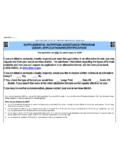
Transcription of complete the online “request for application form
1 Preview of Accreditation application Below are a set of screen shots to help you see what you will need to do when you fill out an application for accreditation. To gain access to your personalized application form, please complete the online request for application form. Accreditation > Instructions The application for accreditation provides information to the Accreditation Committee regarding the applicant's portfolio - her/his combination of education, experience, and expertise that is required to be accredited by the ASA. Applicants are responsible for providing sufficient information through the components of the application form to demonstrate their readiness to be accredited. Thus, great care should be taken to prepare the accreditation application .
2 Nonetheless, the application form is intended to help with evaluation and not to be rigidly bureaucratic. Special note: If you are an accredited member of the Royal Statistical Society (CStat), the Statistical Society of Canada ( ), or the Statistical Society of Australia (AStat), click here. A full application for accreditation consists of the following components: Contact information *A covering letter *A r sum or CV List of degrees earned and courses taken A detailed list of relevant experience *Examples of work product A list of professional development activities Contact information for two referees In addition, you have the option to provide: o Demographic information o Names of committee members who should be excluded from reviewing your application *Items marked by an asterisk (*) will be uploaded as pdf documents.
3 All other items are completed through web forms. Instructions for each of these components are contained within the online application form. Thus, you may begin your application now. You will be able to save your work and come back to it as often as necessary until you are ready to submit your application to the ASA. application fee: $120 Annual maintenance fee: $85 (payable each year on the member s annual membership renewal date) Re- application fee: $40 (Unsuccessful applicants may reapply once within 12 months at this rate.) Appeal fee: $150 (Fee is fully refundable if appeal is successful.) Accreditation > application Overview > Cover Letter Please note: Your cover letter must be uploaded as a pdf file. The covering letter is one of the most important components of the accreditation application .
4 The letter, which should not exceed 1500 words, summarizes for the Accreditation Committee the materials submitted in the application and provides the reasons why the applicant feels she or he has met the criteria for accreditation. The covering letter is the opportunity highlight particular qualifications, and also to note and explain aspects which might be out of the ordinary. The covering letter should also explain the applicant's role in jointly published or produced work that has been submitted in support of the application . The covering letter will help the committee understand how the combination of education, experience, and professional competence required of a professionally accredited statistician is demonstrated in your application materials.
5 It also serves as an indicator of your communication skills, so please write and review it with care. Some accredited members have given us permission to share their cover letters with you as examples. Cover Letter: Upload File Accreditation > application Overview > R sum or CV Please note: Your r sum or CV must be uploaded as a pdf file. A reduced r sum or CV is perfectly acceptable. The committee does not require a lengthy document. The r sum or CV should provide, as usual, a broad overview of your credentials. Please separate peer-reviewed publications from other publications in your r sum or CV, if you have not already done so. R sum or CV: Upload File Return To Overview Accreditation > application Overview > Educational Credentials Before entering data into the online form below, please read these instructions carefully.
6 The basic educational requirement for accreditation is an advanced degree, either in statistics or in a related quantitative field with sufficient concentration in statistics. If you do not explicitly meet this requirement, click here for important information. (In the online form, when you click on this, you will read the Education Info section, below. In the United States, an "advanced degree" means a masters degree or doctoral degree. Professional masters degrees are considered an advanced degree. (Applicants with non-US degrees, please see below.) "Statistics" may include such areas as mathematical or applied statistics, and may extend to major application areas, such as biostatistics. The Accreditation Committee uses its judgment to determine what constitutes a "related quantitative field," and defines this quite broadly.)
7 However, the key consideration is not the field itself, but the statistical education in the degree program. o If the degree in a related field includes a statistics concentration, please indicate this in the text box provided in the form below. o Please include a list of statistics courses completed, if your degree is not in statistics. In situations where a applicant has an advanced degree in an apparently unrelated field, especially when the degree does not have a specific statistics concentration, it will be left to the judgment of the Accreditation Committee to determine if the education criterion is met. Here it will be particularly important for the applicant to demonstrate other ways by which the applicant has achieved the appropriate educational level.
8 The AC has discretion to grant exceptions to these educational requirements, though such exceptions will be granted only in special and well documented circumstances. Applicants without an advanced degree must present compelling evidence of a breadth of knowledge and understanding of both theoretical and applied statistics equivalent to an advanced degree. The burden of proof lies entirely upon the applicant. Note for applicants who earned their degrees outside the US: If the highest degree earned was from an institution not located in the United States, Canada, Australia, or the United Kingdom, the applicant may be asked to submit the relevant university transcript to provide the Accreditation Committee with information to help it understand the equivalence to US advanced degrees described above.
9 The ASA reserves the right to use an independent source to judge the equivalence of such degrees, and reserves the right to charge the applicant for those costs (after duly advising the applicant of the cost). Please fill out the online form below for each college degree earned. Indicate The degree, including the field of the degree (for example, " , statistics," " , biostatistics," etc.) The year the degree was earned and the institution it was earned from (both pieces of information are required so that the Accreditation Committee can confirm the information provided) If the degree is not in a field of statistics, please indicate the statistics courses completed. Existing Entries No Credentials entered yet. Degree: Required Year Earned: Please enter a 4 digit year Institution: Required Courses Completed: Required Save Return To Overview Accreditation > application Overview > Education Info Note for applicants without an advanced degree in statistics If you do not have an advanced degree in statistics (or closely related areas such as mathematical statistics, applied statistics, or biostatistics), it is your obligation to demonstrate to the Accreditation Committee that you have achieved the equivalent education in some other way.
10 In various combinations, the following can be used to demonstrate this achievement: A list of courses taken, showing significant coursework in statistics (for college credit, especially, though continuing education courses are also valuable) Strong examples of your work in using statistics, showing work product of quality that would be expected of an individual with a masters degree in statistics and five years of experience in the field A consistent history of continuing professional development in statistics Strong and detailed references by referees with advanced degrees in statistics Please note that a Black Belt type of certification is not considered in and of itself to be equivalent to an advanced degree in statistics, though it certainly may be used in combination with the listed items above to demonstrate educational level equivalent to an advanced degree in statistics.