Transcription of Completing the square - mathcentre.ac.uk
1 Completing the squaremc-TY-completingsquare2-2009-1In this unit we consider how quadratic expressions can be written in an equivalent form usingthe technique known as Completing the square . This technique has applications in a number ofareas, but we will see an example of its use in solving a quadratic order to master the techniques explained here it is vital that you undertake plenty of practiceexercises so that all this becomes second nature. To help youto achieve this, the unit includesa substantial number of such reading this text, and/or viewing the video tutorial on this topic, you should be able to: write a quadratic expression as a complete square , plus or minus a constant solve a quadratic equation by Completing the simple basic in which the coefficient ofx2is not of the a quadratic equation by Completing the mathcentre 20091.
2 IntroductionIn this unit we look at a process calledcompleting the square . It can be used to write aquadratic expression in an alternative form. Later in the unit we will see how it can be used tosolve a quadratic Some simple equationsExampleConsider the quadratic equationx2= 9. We can solve this by taking the square root of bothsides:x= 3or 3remembering that when we take the square root there will be two possible answers, one positiveand one negative. This is often written in the briefer formx= process for solvingx2= 9is very straightforward, particularly because: 9 is a square number , or complete square . This means thatit is the result of squaringanother number, or term, in this case the result of squaring 3or 3. x2is a complete square - it is the result of simply square -rooting both sides solves the the equationx2= , we can solve this by taking the square root of both sides:x= 5or 5In this example, the right-hand side ofx2= 5, is not a square number.
3 But we can still solvethe equation in the same way. It is usually better to leave your answer in thisexactform, ratherthan use a calculator to give a decimal we wish to solve the equation(x 7)2= 3 Again, we can solve this by taking the square root of both sides. The left-hand side is a completesquare because it results from squaringx 7 = 3or 3By adding 7 to each side we can obtain the values forx:x= 7 + 3or7 3We could write this in the briefer formx= 7 mathcentre 2009 ExampleSuppose we wish to solve(x+ 3)2= 5 Again the left-hand side is a complete square . Taking the square root of both sides:x+ 3 = 5or 5By subtracting 3 from each side we can obtain the values forx:x= 3 + 5or 3 5 Exercises1. Solve the following quadratic equationsa)x2= 25b)x2= 10c)x2= 2d)(x+ 1)2= 9e)(x+ 3)2= 16f)(x 2)2= 100g)(x 1)2= 5h)(x+ 4)2= 23.
4 The basic techniqueNow suppose we wanted to try to apply the method used in the three previous examples tox2+ 6x= 4In each of the previous examples, the left-hand side was acomplete square . This means that ineach case it took the form(x+a)2or(x a)2. This is not the case now and so we cannot justtake the square -root. What we try to do instead is rewrite theexpression so that it becomes acomplete square - hence the namecompleting the that complete squares such as(x+a)2or(x a)2can be expanded as follows:Key Pointcomplete squares:(x+a)2= (x+a)(x+a)=x2+ 2ax+a2(x a)2= (x a)(x a)=x2 2ax+ mathcentre 2009We will use these expansions to help us to complete the squarein the following the quadratic expressionx2+ 6x 4We compare this with the complete squarex2+ 2ax+a2 Clearly the coefficients ofx2in both expressions are the would like to match up the term2axwith the term6x.
5 To do this note that2amust be6,so thata= that(x+a)2=x2+ 2ax+a2 Then witha= 3(x+ 3)2=x2+ 6x+ 9 This means that when trying to complete the square forx2+ 6x 4we can replace the first twoterms,x2+ 6x, by(x+ 3)2 9. Sox2+ 6x 4 = (x+ 3)2 9 4= (x+ 3)2 13We have now written the expressionx2+ 6x 4as a complete square plus or minus a havecompleted the square . It is important to note that the constant term, 3, in bracketsis half the coefficient ofxin the original we wish to complete the square for the quadratic expressionx2 8x+ want to try to rewrite this so that it takes the form of a complete square plus or minus comparex2 8x+ 7with the standard formx2 2ax+a2 The coefficients ofx2are the same. To make the coefficients ofxthe same we must chooseato be 4. Recall that(x a)2=x2 2ax+a2 Then witha= 4(x 4)2=x2 8x+ 16 This means that when trying to complete the square forx2 8x+ 7we can replace the first twoterms,x2 8x, by(x 4)2 8x+ 7 = (x 4)2 16 + 7= (x 4)2 9We have now written the expressionx2 8x+ 7as a complete square plus or minus a have completed the square .
6 Again note that the constant term, 4, in brackets is half thecoefficient ofxin the original mathcentre 2009 ExampleSuppose we wish to complete the square for the quadratic expressionx2+ 5x+ means we want to try to rewrite it so that it has the form ofa complete square plus orminus a constant. In the examples we have just worked throughwe have seen how this can bedone by comparing with the standard forms(x+a)2and(x a)2. We would like to be ableto complete the square without writing down all the working we did in the previous key point to remember is that the number in the bracket of the complete square is half thecoefficient ofxin the quadratic withx2+ 5x+ 3we know that the complete square will be(x+52)2. This has the samex2andxterms as the given quadratic expression but the constant term is different.
7 We mustbalance the constant term by a) subtracting the extra constant that our complete square hasintroduced, that is(52)2, and b) putting in the constant term from our quadratic, thatis this together we havex2+ 5x+ 3 =(x+52)2 (52)2+ 3(1)To finish off we just combine the two constants (52)2+ 3 = 254+124= 134and sox2+ 5x+ 3 =(x+52)2 134We have now written the expressionx2+ 5x+ 3as a complete square plus or minus a have completed the square . Again note that the constant term,52, in brackets is half thecoefficient ofxin the original explanation given above is really just an outline of our thought process; when we completethe square in practice we would not write it all down. We wouldprobably go straight to equation(1). The ability to do this will come with Completing the square for the following quadratic expressionsa)x2+ 2x+ 2b)x2+ 2x+ 5c)x2+ 2x 1d)x2+ 6x+ 8e)x2 6x+ 8f)x2+x+ 1g)x2 x 1h)x2+ 10x 1i)x2+ 5x+ 4j)x2+ 6x+ 9k)x2 2x+ 6l)x2 3x+ 14.
8 Cases in which the coefficient ofx2is not now know how to complete the square for quadratic expressions for which the coefficient ofx2is 1. When faced with a quadratic expression where the coefficient ofx2is not 1 we can stilluse this technique but we put in an extra step first - we factor out this mathcentre 2009 Suppose we wish to complete the square for the expression3x2 9x+ begin by factoring out the coefficient ofx2, in this case 3. It does not matter that 3 is nota factor of 50; we can still do this by writing the expression as3(x2 3x+503)Now the expression in brackets is a quadratic with coefficientofx2equal to 1 and so we canproceed as before. The number in the complete square will be half the coefficient ofx, so we willuse(x 32)2. Then we must balance up the constant term just as we did before by subtractingthe extra constant we have introduced, that is(32)2, and putting in the constant from thequadratic expression, that {x2 3x+503}= 3{(x 32)2 (32)2+503}The arithmetic to tidy up the constants is a bit messy: (32)2+503= 94+503= 2712+20012=17312So putting all this togetherx2 3x+503=(x 32)2+17312and finally3(x2 3x+503)= 3((x 32)2+17312)and we have completed the is the Completing the square form for a quadratic expression for which the coefficient ofx2is not Completing the square for the following quadratic expressionsa)2x2+ 4x 8b)5x2+ 10x+ 15c)3x2 27x+ 9d)2x2+ 6x+ 1e)3x2 12x+ 2f)15 10x x2g)24 + 12x 2x2h)9 + 6x mathcentre 20095.
9 Summary of the processIt will be useful if you can get used to doing this process automatically. The method can besummarised as follows:Key Point1. factor out the coefficient ofx2- then work with the quadratic expression which has acoefficient ofx2equal to 12. check the coefficient ofxin the new quadratic expression and take half of it - this is thenumber that goes into the complete square bracket3. balance the constant term by subtracting the square of thenumber from step 2, andputting in the constant from the quadratic expression4. the rest is arithmetic that may often involve fractions6. Solving a quadratic equation by Completing the squareLet us return now to a problem posed earlier. We want to solve the equationx2+ 6x= write this asx2+ 6x 4 = 0. Note that the coefficient ofx2is 1 so there is no need to takeout any common the square for quadratic expression on the left-hand side:x2+ 6x 4 = 0(x+ 3)2 9 4 = 0(1)(x+ 3)2 13 = 0(2)(x+ 3)2= 13x+ 3 = 13x= 3 13We have solved the quadratic equation by Completing the produce equation (1) we have noted that the coefficient ofxin the quadratic expression is 6so the number in the complete square bracket must be 3; thenwe have balanced the constantby subtracting the square of this number,32, and putting in the constant from the quadratic, 4.
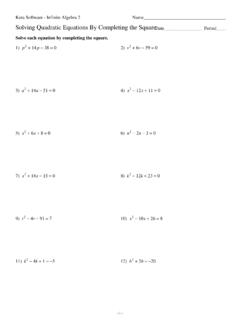
10 To get equation (2) we just do the arithmetic which in this example is quite mathcentre 2009 Exercises4 Use Completing the square to solve the following quadraticequationsa)x2+ 4x 12 = 0b)x2+ 5x 6 = 0c)10x2+ 7x 12 = 0d)x2+ 4x 8 = 0e)10 + 6x x2= 0f)2x2+ 8x 25 = 0 Give your answers either as fractions or in the formp ) 5b) 10c) 2d) 2, -4e) 1, -7 f) 12, -8 g)1 5h) 4 )(x+ 1)2+ 1b)(x+ 1)2+ 4c)(x+ 1)2 2d)(x+ 3)2 1e)(x 3)2 1f)(x+12)2+34g)(x 12)2 54h)(x+ 5)2 26i)(x+52)2 94j)(x+ 3)2k)(x 1)2+ 5l)(x 32)2 )2[(x+ 1)2 5]b)5[(x+ 1)2+ 2]c)3[(x 92)2 694]d)2[(x+32)2 74]e)3[(x 2)2 103]f) [(x+ 5)2 40]g) 2[(x 3)2 21]h) 3[(x 1)2 4] ) 2, 6b) 1, 6c) 32,45d) 2 12e)3 19f) 2 mathcentre 2009