Transcription of COMPLEX NUMBERS - Stewart Calculus
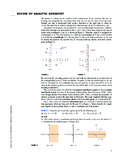
1 COMPLEX NUMBERSA COMPLEX numbercan be represented by an expression of the form , where andare real NUMBERS and is a symbol with the property that . The COMPLEX num-ber can also be represented by the ordered pair and plotted as a point in aplane (called the Argand plane) as in Figure 1. Thus, the COMPLEX number isidentified with the point .The real partof the COMPLEX number is the real number and the imaginarypartis the real number . Thus, the real part of is and the imaginary part is .Two COMPLEX NUMBERS and are equalif and , that is, their realparts are equal and their imaginary parts are equal. In the Argand plane the horizontal axisis called the real axis and the vertical axis is called the imaginary sum and difference of two COMPLEX NUMBERS are defined by adding or subtractingtheir real parts and their imaginary parts:For instance,The product of COMPLEX NUMBERS is defined so that the usual commutative and distributivelaws hold:Since , this becomesEXAMPLE 1 EXAMPLE 2 Express the number in the form.
2 SOLUTIONWe multiply numerator and denominator by the COMPLEX conjugate of ,namely , and we take advantage of the result of Example 1:The geometric interpretation of the COMPLEX conjugate is shown in Figure 2:is thereflection of in the real axis. We list some of the properties of the COMPLEX conjugate inthe following box. The proofs follow from the definition and are requested in Exercise of Conjugateszn znzw z wz w z wzz 1 3i2 5i 1 3i2 5i 2 5i2 5i 13 11i22 52 1329 1129 i2 5i2 5ia bi 1 3i2 5i 2 5i 6i 15 1 13 11i 1 3i 2 5i 1 2 5i 3i 2 5i a bi c di ac bd ad bc ii2 1 ac adi bci bdi2 a bi c di a c di bi c di 1 i 4 7i 1 4 1 7 i 5 6i a bi c di a c b d i a bi c di a c b d ib da cc dia bi 344 3ibaa bi 0, 1 i 0 1 i a, b a bii2 1ibaa bi1 FIGURE 1 COMPLEX NUMBERS as points inthe Argand planeReIm0i_2-2i_i3-2i2+3i_4+2i1 ReIm0i_iz=a-bi z=a+biFIGURE 2 Division of COMPLEX NUMBERS is much like rationalizing the denominator of a rationalexpression.
3 For the COMPLEX number , we define its COMPLEX conjugateto be. To find the quotient of two COMPLEX NUMBERS we multiply numerator anddenominator by the COMPLEX conjugate of the a biz a biThomson Brooks-Cole copyright 2007 The modulus, or absolute value,of a COMPLEX number is its distancefrom the origin. From Figure 3 we see that if , thenNotice thatand soThis explains why the division procedure in Example 2 works in general:Since , we can think of as a square root of . But notice that we also haveand so is also a square root of . We say that is the principalsquare rootof and write . In general, if is any positive number , we writeWith this convention, the usual derivation and formula for the roots of the quadratic equa-tion are valid even when :EXAMPLE 3 Find the roots of the equation.
4 SOLUTIONU sing the quadratic formula, we haveWe observe that the solutions of the equation in Example 3 are COMPLEX conjugates ofeach other. In general, the solutions of any quadratic equation with realcoefficients , , and are always COMPLEX conjugates. (If is real,, so is its ownconjugate.)We have seen that if we allow COMPLEX NUMBERS as solutions, then every quadratic equa-tion has a solution. More generally, it is true that every polynomial equationof degree at least one has a solution among the COMPLEX NUMBERS . This fact is known asthe Fundamental Theorem of Algebra and was proved by FORMWe know that any COMPLEX number can be considered as a point and thatany such point can be represented by polar coordinates with.
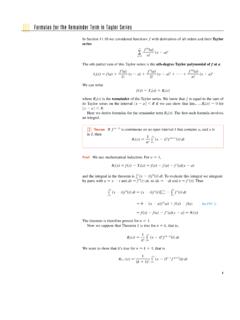
5 In fact,as in Figure 4. Therefore, we havez a bi rcos rsin ib rsin a rcos r 0 r, a, b z a bianxn an 1xn 1 a1x a0 0zz zzcbaax2 bx c 0x 1 s12 4 12 1 s 3 2 1 s3 i2x2 x 1 0x b sb2 4ac 2ab2 4ac 0ax2 bx c 0s c sc ics 1 i 1i 1 i i 2 i2 1 1ii2 1zw zwww zw w 2zz z 2zz a bi a bi a2 abi abi b2i2 a2 b2 z sa2 b2 z a biz a bi z ReIm0a+bib raFIGURE 42 COMPLEX NUMBERSFIGURE 3 ReIm0biabz=a+bi|z|= a@+b@ Thomson Brooks-Cole copyright 2007 Thus, we can write any COMPLEX number in the formwhereThe angle is called the argumentof and we write . Note that is notunique; any two arguments of differ by an integer multiple of .EXAMPLE 4 Write the following NUMBERS in polar form.
6 (a)(b)SOLUTION(a)We have and , so we can take .Therefore, the polar form is(b) Here we have and . Since lies in thefourth quadrant, we take andThe NUMBERS and are shown in Figure polar form of COMPLEX NUMBERS gives insight into multiplication and division. Letbe two COMPLEX NUMBERS written in polar form. ThenTherefore, using the addition formulas for cosine and sine, we haveThis formula says that to multiply two COMPLEX NUMBERS we multiply the moduli and addthe arguments.(See Figure 6.)A similar argument using the subtraction formulas for sine and cosine shows that todivide two COMPLEX NUMBERS we divide the moduli and subtract the particular, taking and , (and therefore and ), we have the fol-lowing, which is illustrated in Figure 1r cos isin.
7 Thenz r cos isin ,If 2 1 0z2 zz1 1z2 0z1z2 r1r2 cos 1 2 isin 1 2 z1z2 r1r2 cos 1 2 i sin 1 2 1 r1r2 cos 1 cos 2 sin 1 sin 2 i sin 1 cos 2 cos 1 sin 2 z1z2 r1r2 cos 1 isin 1 cos 2 isin 2 z2 r2 cos 2 isin 2 z1 r1 cos 1 isin 1 wzw 2 cos 6 isin 6 6wtan 1 s3 r w s3 1 2z s2 cos 4 isin 4 4tan 1r z s12 12 s2 w s3 iz 1 i2 zarg z arg z z tan baandr z sa2 b2 z r cos isin zReIm0 3-i21+i 2 4_ 6 FIGURE 5z FIGURE 6 ReImz z + z ReIm0rz _ 1r1zFIGURE 7 COMPLEX NUMBERS 3 Thomson Brooks-Cole copyright 2007 EXAMPLE 5 Find the product of the COMPLEX NUMBERS and in polar Example 4 we haveandSo, by Equation 1,This is illustrated in Figure use of Formula 1 shows how to compute powers of a COMPLEX number .
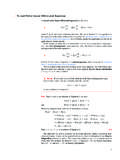
8 IfthenandIn general, we obtain the following result, which is named after the French mathematicianAbraham De Moivre (1667 1754).De Moivre s TheoremIf and is a positive integer, thenThis says that to take the nth power of a COMPLEX number we take the nth power of themodulus and multiply the argument by 6 Find .SOLUTIONS ince , it follows from Example 4(a) that has the polarformSo by De Moivre s Theorem,De Moivre s Theorem can also be used to find the th roots of COMPLEX NUMBERS . An th root of the COMPLEX number is a COMPLEX number such thatwn zwznn 25210 cos 5 2 isin 5 2 132 i 12 12 i 10 s22 10 cos 10 4 isin 10 4 12 12 i s22 cos 4 isin 4 12 12i12 12i 12 1 i (12 12i)10zn r cos isin n rn cos n isin n nz r cos isin 2 z3 zz2 r3 cos 3 i sin 3 z2 r2 cos 2 i sin 2 z r cos isin 2s2 cos 12 isin 12 1 i (s3 i)
9 2s2 cos 4 6 isin 4 6 s3 i 2 cos 6 i sin 6 1 i s2 cos 4 isin 4 s3 i1 i4 COMPLEX NUMBERS02z=1+iw= 3-izw2 2 2 FIGURE 8 ReIm 12 Thomson Brooks-Cole copyright 2007 Writing these two NUMBERS in trigonometric form asand using De Moivre s Theorem, we getThe equality of these two COMPLEX NUMBERS shows thatandFrom the fact that sine and cosine have period it follows thatThusSince this expression gives a different value of for , 1, 2,..,,we have of a COMPLEX NumberLet and let be a positive inte-ger. Then has the distinct th rootswhere ,1,2,..,.Notice that each of the th roots of has modulus . Thus, all the th rootsof lie on the circle of radius in the COMPLEX plane.
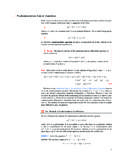
10 Also, since the argument of eachsuccessive th root exceeds the argument of the previous root by , we see that the th roots of are equally spaced on this 7 Find the six sixth roots of and graph these roots in the trigonometric form,. Applying Equation 3 with ,we getWe get the six sixth roots of by taking in this formula: w2 81 6 cos 5 6 isin 5 6 s2 s32 12 i w1 81 6 cos 2 isin 2 s2 i w0 81 6 cos 6 isin 6 s2 s32 12 i k 0, 1, 2, 3, 4, 5 8wk 81 6 cos 2k 6 isin 2k 6 n 6z 8 cos isin z 8zn2 nnr1 nzn wk r1 nznn 1k 0wk r1 n cos 2k n isin 2k n nnznz r cos isin 3n 1k 0ww r1 n cos 2k n isin 2k n 2k norn 2k 2 sin n sin andcos n cos s r1 norsn rsn cos n isin n r cos isin z r cos isin andw s cos isin COMPLEX NUMBERS 5 Thomson Brooks-Cole copyright 20076 COMPLEX NUMBERSAll these points lie on the circle of radius as shown in Figure EXPONENTIALSWe also need to give a meaning to the expression when is a COMPLEX num-ber.