Transcription of COMPREHENSIVE MEDICATION THERAPY MANAGEMENT …
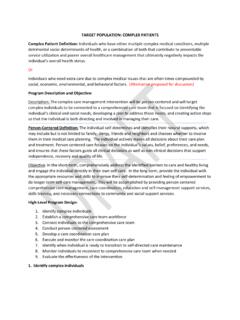
1 COMPREHENSIVE MEDICATION THERAPY MANAGEMENT PROCESS AND GUIDELINES Developed under guidance from the Practice Transformation Task Force (PTTF) as part of the Connecticut State Innovation Model Initiative Program Description and Objective: Description: The MEDICATION THERAPY MANAGEMENT (MTM) intervention will be an elective CCIP capability for patients with complex therapeutic needs who would benefit from a COMPREHENSIVE personalized MEDICATION MANAGEMENT plan. MTM is a system-level, person-centered process of care provided by pharmacists to optimize the complete drug THERAPY regimen for a patient s given medical and socio-economic condition. The MTM evidence-based model, according to 11 national pharmacy organizations, is dependent upon pharmacists working collaboratively with physicians and other healthcare professionals to optimize MEDICATION use in accordance with evidence-based guidelines.
2 1 In the context of CCIP, this intervention will be relevant for all patients who are experiencing adverse effects due to difficulty managing their pharmacy regimen, who have complicated or multiple drug regimens, or who are not experiencing optimal therapeutic outcomes; this includes patients enrolled in CCIP with complex conditions and patients experiencing equity gaps. Objective: To assess, resolve, and prevent MEDICATION mismanagement by engaging patients and their caregivers in better therapeutic MANAGEMENT techniques in order to reduce the overall burden of pharmacy MANAGEMENT and the risk of adverse outcomes. High-Level Program Design: 1. Identify patients requiring COMPREHENSIVE MEDICATION THERAPY MANAGEMENT ; 2. Pharmacist consult with patient and caregiver in coordination with PCP/care team; 3. Develop a person-centered MEDICATION plan; and 4.
3 Implement person-centered MEDICATION action plan. Detailed Program Design: Guidelines 1. Identification of patients requiring COMPREHENSIVE MTM The network defines criteria to identify patients with complex and intensive needs related to their pharmacy regimen that would be conducive to pharmacist intervention2; The network develops a process for the responsible professional and/or care team to assess patient MEDICATION THERAPY MANAGEMENT needs3 1 American Pharmacists Association, and National Association of Chain Drug Stores Foundation. MEDICATION THERAPY MANAGEMENT in Pharmacy Practice: Core Elements of a MTM Service Model Version March 2008. 2 Characteristics of patients with these needs could include patients with: multiple chronic conditions, complicated or multiple MEDICATION regimens, failure to achieve treatment goals, high risk for adverse reactions, preventable utilizations due to pharmacy mismanagement ( hospital admissions, readmissions, emergency department, urgent care, and/or physician office visits), health equity gaps, multiple providers, functional deficits ( swallowing, vision, and mobility problems), and multiple care transitions 3 This assessment should occur at the time of the person-centered assessment for patients who are part of the CCIP Complex Care population.
4 Other patients in need of additional MEDICATION MANAGEMENT who are not part of 2. Pharmacist consult with patient and, if applicable, caregiver in coordination with PCP or COMPREHENSIVE care team The Advanced Network or FQHC picks a pharmacist integration model that aligns with their current network needs/current o Regardless of the model, the pharmacist receives training to interact directly with the patient and/or caregiver in a person-centered way and to understand their goals of care in order to provide MTM as part of a clinical team. Training includes5: 1. Clinical training to support one-on-one patient interactions 2. Valid credentials 3. Interdisciplinary team work training (should be aligned with team based training for COMPREHENSIVE care team) The pharmacist conducts the initial consult in person6.
5 3. Develop a person-centered MEDICATION action plan The pharmacist develops an action plan during the initial patient consultation in partnership with the patient and/or caregivers as needed or requested by the patient To develop the person-centered MEDICATION action plan the pharmacist will: o Create a COMPREHENSIVE list of all patient medications including currently prescribed medications and any nonprescription nutritional supplements, vitamins, and over-the-counter medications o Assess each MEDICATION for appropriateness, efficacy, safety, compatibility, ease of use, and adherence for a patient s medical condition and co-morbidities. o This assessment will be person-centered and also take into account the individual s cultural traditions, personal preferences and values, home or family situation, social circumstances, age, functional deficits, health literacy, MEDICATION concerns, lifestyle, and financial concerns including affordability of medications compared to other regimens that achieve the same medical goals.
6 The person-centered MEDICATION action plan includes: o An updated and reconciled MEDICATION list with information about MEDICATION use, allergies, and immunizations o Process to engage patients and their caregivers on better therapeutic MANAGEMENT techniques in line with reported self- MANAGEMENT goals CCIP can be identified/referred by other members of the care team or through automated triggers based on EHR-programmed alert claims or EHR-based analytic reports. 4 Possible models include: (1) pharmacist is a clinician staff member of the practice; (2) pharmacist is embedded in the practice site through a partnership between the practice and another entity ( ; hospital, school of pharmacy, etc.); (3) regional model by which the pharmacist works for a health system and serves several practices in a geographic area; and (4) shared resource network model by which the pharmacist is contracted by a provider group, ACO, or payer to provide services to specific patients 5 Pharmacist should have some experience in a direct patient care role, and training should occur at on-boarding with additional team based training as needed ( ; new team members join, protocols change, etc.)
7 And annual validation of credentials. 6 For patients participating in the CCIP Complex Care program, this consult should occur in conjunction with the initial COMPREHENSIVE care team person-centered assessment and/or care planning meeting, while other patients should schedule a consult with the pharmacist within a specified timeframe post identification of the need for MTM. o Documentation of actionable MEDICATION MANAGEMENT recommendations that are communicated to patients, caregivers, and all of their health care providers o The pharmacist s recommendations for avoiding MEDICATION errors and resolving inappropriate MEDICATION selection, omissions, duplications, sub-therapeutic or excessive dosages, drug interactions, adverse reactions and side effects, adherence problems, health literacy challenges, and regimens that are costly for the patient and/or health care system o An outline of the duration of the intervention, frequency of touchpoints throughout the intervention, and instructions on follow-up with the pharmacist, COMPREHENSIVE care team, primary care team, and specialists as needed7.
8 O Specifications of when touchpoints should occur and which members of the care team should be involved The person-centered MEDICATION action plan becomes a part of the patient s medical record o The network develops a process or protocol to make the person-centered MEDICATION plan accessible to all necessary care team members. The process or protocol will include: Identifying who needs to have access to the person-centered MEDICATION action plan, which at a minimum will include the pharmacist and primary care provider but which should also be guided by patient preference and the team needs assessment8. Developing technological capabilities for specified individuals to have access to the person-centered MEDICATION action plan 4. Implementation of person-centered MEDICATION action plan with revisions as necessary The pharmacist and care team initiate touchpoints with the patient and/or caregiver as outlined in the person-centered MEDICATION action plan9 o The pharmacist participates in the COMPREHENSIVE care team meetings if the patient is also participating in the CCIP complex patient intervention The pharmacist and care team define a process to revisit and adjust person-centered MEDICATION action plan as necessary after follow up visits with the care team and referral providers 7 Patient with more complex needs may require more frequent follow-up with the pharmacist and care teams.
9 The plan should identify the format for touch points, which should be guided by patient preference and the team needs assessment. Some formats include in-person, telephonic, and other telehealth mediums. 8 If the patient has a COMPREHENSIVE care team or is working with a Community Health Worker, those individuals should also have access. 9 Other care team members who are part of the implementation plan are identified through the consultation process. The touch points should align with those identified in the person-centered MEDICATION action plan for those patients who are participating in the CCIP complex care MANAGEMENT intervention.