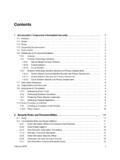
Transcription of Computer and information security standards
1 Computer and information security standards For general practices and other office-based practicesSecond edition and information security standards For general practices and other office-based practicesSecond editionThe Computer and information security standards provide guidance to assist general practices comply with professional and legal obligations and are designed to make compliance with best practice information security Computer and information security standards and accompanying Computer and information security templates (each a publication) is copyright to The Royal Australian College of General Practitioners (RACGP), ABN 34 000 223 807. The information set out in each publication has been sourced from providers believed to be reputable and reliable. The information was current as at the date of first publication, however the RACGP recognises the changing and evolving nature of medicine, and does not warrant these publications are or will remain accurate, current or complete.
2 Nor does the RACGP make any warranties of any kind, expressed or implied, including as to fitness of purpose or otherwise. Instead, the information is intended for use as a guide of a general nature only and may or may not be relevant to particular patients, conditions or circumstances. Acting in accordance with the information in the publications cannot and does not guarantee discharge of any duty of care owed. Persons acting on information contained in the publications must at all times exercise their own independent skill and judgement, and seek appropriate professional advice where relevant and necessary. Whilst the text is primarily directed to health professionals, it is not to be regarded as professional advice and must not be considered a substitute for seeking that professional advice relevant to a person s circumstances, nor can it be regarded as a full consideration of particular circumstances faced by the user based on then current knowledge and accepted practices.
3 The RACGP accepts no liability to anyone in relation to the publications, for any loss or damage (including indirect, special or consequential damages), cost or expense incurred or arising by reason of any person using or relying on the information contained in the publications, whether caused by reason of any error, any act or omission (whether negligent or not), or any inaccuracy or misrepresentation in the information in each byThe Royal Australian College of General Practitioners 100 Wellington Parade East Melbourne VIC 3002 AustraliaTel 03 8699 0414 Fax 03 8699 0400 : 978-0-86906-349-1 First published 2011. Second edition 2013. 2013 The Royal Australian College of General Profession. Healthy and information security standards For general practices and other office-based practicesAcknowledgementsThis edition of The Royal Australian College General Practitioners (RACGP) Computer and information security standards (CISS) and the accompanying Computer and information security templates have been developed by the RACGP.
4 The RACGP gratefully acknowledges the following people, who were involved in the development, review and writing of this version of CISS: Dr Patricia Williams PhD, eHealth Research Group, School of Computer and security Science, Edith Cowan University, Perth, Western Australia Members of the RACGP Computer and information security standards project has been funded by the Australian Government Department of Health and Ageing. The information security compliance indicators for each Standard have been adapted from the work of Dr Patricia Williams: Capability Maturity Matrix for Medical information security (Williams PAH. A practical application of CMM to medical security capability. information management and Computer security 2008;16:58 73). The intellectual property relating to these capability matrices remains the property of Dr Patricia Williams.
5 IvHealthy Profession. Healthy and information security standards For general practices and other office-based practicesContentsPreamble vHow to use the standards 1 The standards 2 Compliance checklist for Computer and information security 3 Section 1 5 Standard 1: Roles and responsibilities 5 Section 2 10 Standard 2: Risk assessment 10 Section 3 18 Standard 3: information security policies and procedures 18 Section 4 22 Standard 4: Managing access 22 Section 5 31 Standard 5: Business continuity and information recovery 31 Section 6 38 Standard 6: Internet and email usage 38 Section 7 44 Standard 7: information backup 44 Section 8 50 Standard 8: Malware, viruses and email threats 50 Section 9 54 Standard 9: Computer network perimeter controls 54 Section 10 61 Standard 10: Mobile electronic devices 61 Section 11 64 Standard 11: Physical facilities and Computer hardware, software and operating system 64 Section 12 71 Standard 12: security for information sharing 71 Glossary of Computer and information security terms 76 Appendix A List of related standards , principles and legislation 82 Appendix B National eHealth system security requirements 84 Appendix C Data incident/breach report 85vHealthy Profession.
6 Healthy and information security standards For general practices and other office-based practicesPreamble BackgroundIn Australian general practice, the use of clinical desktop systems and the electronic management of information have become vital tools in the delivery of safe and high-quality healthcare and good practice management. Secure Computer and information management systems are essential for the necessary protection of business and clinical information and are therefore critical to the provision of safe, high-quality healthcare and the efficient running of a general practice. Implementing appropriate Computer and information security can be challenging and general practice has specific requirements to consider. Finding the right IT support and a technical service provider with appropriate security expertise who understands the business of delivering healthcare in the general practice environment can be difficult.
7 To help general practices meet these challenges, the RACGP developed the first edition of the Computer and information security standards in 2011. This second edition of the RACGP Computer and information security standards (CISS) takes into account developments such as: increased use of laptops, remote access devices ( personal digital assistants [PDA], tablet devices, USB flash drives and removable hard drives) and wireless (Wi-Fi) connections widespread uptake of broadband internet and secure messaging, and particularly the implementation of the national eHealth record system and the Healthcare Identifier Service, which underpin many of the e-health Computer and information security in your practice requires adapting to an evolving technical environment, fostering awareness of contemporary security issues, and monitoring and improving your security protection and information security is not optional, it is essential.
8 It should be considered a fixed cost of doing business that requires financial and human resources being allocated to ensure the protection of information Profession. Healthy and information security standards For general practices and other office-based practicesThe purpose of the CISSThis second edition of CISS incorporates changes to Australian legislation and the Office of the Australian information Commissioner directives, including legislative requirements for a national eHealth record system (the personally controlled electronic health record [PCEHR] system). The standards are designed to assist general practices and other office-based healthcare organisations to meet their professional and legal obligations in Computer and information security . information security obligationsComputer and information security is not optional: it is an essential professional and legal requirement for using Computer systems in the delivery of healthcare.
9 The standards address the legal and professional obligations in Computer and information security in core management processes Managing the use and ongoing availability of information requires fundamental information security processes, such as: backup procedures that are documented and tested: it is important to ensure that the backup system functions correctly and that data can be restored promptly if there is an incident such as a server failure business continuity and information recovery planning: documented business continuity plans that include information recovery procedures are essential to maintaining information availability so that in the event of an information disaster there is an adequately planned response, and potential loss or corruption of information is minimised. These plans detail how to maintain the critical functions of the business when there is an unexpected system event access control and management: control of who has access to business and clinical information is essential to the protection of all practice data.
10 Access management (password and/or biometrics) ensures accountability; without this it can be difficult to ascertain who has entered or altered data. Without these controls the practice is vulnerable to unauthorised information analysisIt is important to understand the security risks and threats to business and clinical information . This includes the requirement for effective information security practices by identifying gaps in security and implementing strategies to lessen security risks. Ensuring the security of information held in practice systems is essential to the running of a general practice, to maintaining professional responsibilities to patients, and to ensuring that practice information is accurate and available when it is needed. viiHealthy Profession. Healthy and information security standards For general practices and other office-based practicesSecurity governanceGovernance implies accountability, responsibility, monitoring and reporting to demonstrate legal and ethical compliance to sound information security and to ensure that all Computer and information security processes are documented and followed.