Transcription of Computer fundamental UNIT: 1 INTRODUCTION TO …
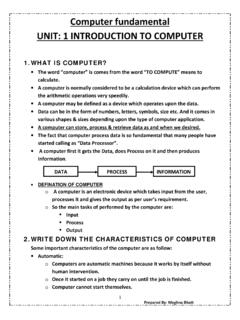
1 1 Prepared By: Meghna BhattComputer fundamentalUNIT: 1 INTRODUCTION TO IS Computer ? The word Computer is comes from the word TO COMPUTE means tocalculate. A Computer is normally considered to be a calculation device which can performthe arithmetic operations very speedily. A Computer may be defined as a device which operates upon the data. Data can be in the form of numbers, letters, symbols, size etc. And it comes invarious shapes & sizes depending upon the type of Computer application. A Computer can store, process & retrieve data as and when we desired. The fact that Computer process data is so fundamental that many people havestarted calling as Data Processor . A Computer first it gets the Data, does Process on it and then producesInformation. DEFINATION OF COMPUTERoA Computer isan electronic device which takes input from the user,processes it and gives the output as per user s the main tasks ofperformed bythe computerare: Input Process DOWN THE CHARACTERISTICS OF COMPUTERSome important characteristics of the Computer are as follow: Automatic:oComputers are automatic machines because it works by itself withouthuman it started on a job they carry on until the job is cannot start By: Meghna BhattoThey can works from the instructions which are stored inside the system inthe form of programs which specify how a particular job is to be done.
2 Accuracy:oThe accuracy of a Computer is very degree of accuracy of a particular Computer depends upon its Errors can occur by the Computer . But these are due to human weakness,due to incorrect data, but not due to the technological weakness. Speed:oComputer is a very fact device. It can perform the amount of work in fewseconds for which a human can take an entire While talking about Computer speed we do not talk in terms of secondsand milliseconds but in powerful computeris capable of performing several billion (109) simplearithmetic operations per second. Diligence:oUnlike human beings, a Computer is free from monotony, tiredness & lackof can continuously work for hours without creating any error & you give ten million calculations to performed, it will perform withexactly the same accuracy & speed as the first one. Versatility:oIt is one of the most wonderful features about the One moment it is preparing the results of a particular examination, thenext moment it is busy with preparing electricity bills and in between itmay be helping an office secretary to trace an important letter in seconds.
3 Power of remembering:oComputer can store and recall any amount of data because of its highstorage capacity of its storage Every piece of information can be retained as long as desired by the userand can be recalled as and when Even after several years, if the information recalled, it will be as accurateas on the day when it was filled to the computers. No Computer is not a magical device; it processes no intelligence of its is By: Meghna BhattoIt has to be told what to do & in what cannot take its own decision. No Fallings:oA Computer has no feelings because they are on our feelings, task, knowledge and experience we often makecertain judgments in our day today But Computer goes exactly the way which we have given the THE DATA PROCESSING CYCLE OFCOMPUTER. The Computer Data Processingis any process that a Computer program does toenter data & summarise, analyse or convert data into useable information. The process may be automated & run on a Computer .
4 It involves recording, analysing, storing, summarising & storing data. Because data are most useful when it is well presented & Data Processing Cycle: Data Processing cycle described all activities which are common to all dataprocessing systems from manual to electronic systems. These activities can be grouped in four functional categories, viz., data input,data processing, data output and storage, constituting what is known as a dataprocessing cycle. The main aim of data processing cycle is to convert the data into meaningfulinformation. Data processing system are often referred to as Information System. The Information System typically take raw Data as Input to produce Informationas OUTPUT The data processing cycle containsmain four functions:oData inputDATAPROCESSINFORMATIONSTORAGE4 Prepared By: Meghna BhattoData processoData storageoData output DATA INPUToThe term input refers to the activities required to record s a process to entered data in to Computer before we input any data, it is necessary to check or verify the datacontext.
5 DATAPROCESSINGoThe term processing includes the activities like classifying, storing,calculating, comparingor summarising the processing means to use techniques to convert the data intomeaningful information. DATAOUTPUToIt s a communication function which transmits the information to theoutside completed the process the data are converted into the meaningful inoSometimes the output also includes the decoding activity which convertsthe electronically generated information into human readable form. DATASTORAGEoIt involves the filling of data & information for future THE CLASSIFICATION OF THE Computer BYDATA PROCESSEDThe computers are divided mainly three types on the based on data computersAnalog computers: In Analog Computers, data is represented as continuously varying voltage andoperate essentially by measuring rather counting. As the data is continuously variable, the results obtained are estimated and notexactly repeatable.
6 It can able to perform multiple tasks simultaneously and also capable to workeffectively with the irrational number. 1/8 = and 1/6= By: Meghna Bhatt Voltage, temperature and pressure are measured using analog devices likevoltmeters, thermometers and Computers The digit Computer is a machine based on digital technology which representsinformation by numerical digit. In Digital Computers data is represented as discrete units of electrical pulses. Thedata is measured in quantities represented as either the on or off state. Therefore, the results obtained from a digital Computer are accurate. Virtually all of today s computers are based on digital Computers It combines the good features of both analog & digital computers. Ithas a speed of analog Computer & accuracy of digital Computer . HybridComputers accept data in analog form and present output also indigitally. The data however is processed digitally. Therefore, hybrid computers require analog-to-digital and digital-to-analogconverters for THE CLASSIFICATION OF THE Computer BYDATA PROCESSING:The computers are classified in four types on the based on data processing.
7 Micro Computer Mini Computer Mainframe Computer Super computerMicro Computer : Micro computers are the computers with having a microprocessor chip as itcentral processing unit. Originated in late 1970s. First micro Computer was built with 8 bit processor. Microcomputer is known as personal Computer . Designed to use by individual whether in the form of pc s, workstation ornotebook computers. Small in size and affordable for general people. Ex:IBM PC, IBM PC/XT, IBM PC/AT6 Prepared By: Meghna BhattMicro Computer : Mini computers are originated in 1960s. Small mainframes that perform limited tasks. Less expensive than mainframe Computer . Mini computers are Lower mainframe in the terms of processing capabilities. Capable of supporting 10 to 100 users simultaneously. In 1970s it contains 8 bit or 12 bit processor. Gradually the architecture requirement is grown and 16 and 32 bit. Minicomputers are invented which are known as supermini computers.
8 Ex: IBM AS400 Mainframe Computer : A very powerful Computer which capable of supporting thousands of usersimultaneously. It contains powerful data processing system. It is capable to run multiple operating systems. It is capable to process 100 million instructions per second. Mainframes are very large & expensive computers with having larger internalstorage capacity & high processing speed. Mainframes are used in the organization that need to process large number oftransaction online & required a Computer system having massive storage &processing capabilities. Mainly used to handle bulk of data & information for processing. Mainframe system is housed in a central location with several user terminalconnected to it. Much bigger in size & needs a large rooms with closely humidity &temperature. IBM & DEC are major vendors of mainframes. Ex : MEDHA, SPERRY, IBM, DEC, HP, HCLS uperComputer: Most powerful & most expensive Computer . Used for complex scientific application that requires hugeprocessing power.
9 Used multiprocessor technology to perform the calculation very speedy. They are special purpose computers that are designed to perform somespecific By: Meghna Bhatt The cost of the super Computer is depended on its processing capabilities &configuration. The speed of modern Computer is measured in gigaflops, teraflops 109 arithmetic operation per arithmetic operation per arithmetic operation per second. Ex: PARAM , EKA, THE GENERATION OF THE Computer language, Generation is a set of Technology. It provides a frameworkfor the growth of the Computer technology. There are totally Five Computer Generationstill today. Discussed as Generation: Duration: 1942-1955 Technology: vacuum tubeoUsed as a calculating calculations in bulky in size & complex large room to place too much heat & continuously hardware much heat so must air-conditioner rooms are production is difficult & to commercial , EDVAC, EDSAC are example of 1st generation Generation: Duration: 1955-1964 Technology: transistoro10 times Smaller in size than 1st generation heat than 1st generation less power than 1st generation were done calculations in is also to configure than 1st generation By: Meghna BhattoMore reliable in commercial & fast primary/secondary storage than 1st generation Generation: Duration: 1965-1975 Technology.
10 IC chipoSmaller in size than 1st & 2nd generation more fast calculations than 2nd generation & fast primary/secondary storage than 2nd generation conditioner is used for commercial purpose level languages like COBOL & FORTAN are allowed to write less heat & consumed less power than 2nd generation Generation: Duration: 1975-1989 Technology: Microprocessor chipoBased on LSI & VLSI microprocessor in faster than previous hardware maintenance is reliable as Computer to previous generation general purpose to to use network concept to connect the Computer requirement of in Generation: Duration: 1989 to Present Technology: ULSI microprocessor chipoMuchsmaller & on the ULSI chip which contains 100 million electronic speed of the operations is less is not user friendly interface with multi-media level languages are allowed to write & faster primary/secondary storage than previous By: Meghna BhattoNotebook computers are the example of 5th generation THE BLOCK DIAGRAM OF COMPUTEROREXPLAIN THE SIMPLE MODEL Computer system comprises the basic components like InputDevices, CPU(Central Processing Unit) and Output Devices as under: Input Devices:oThe devices which are used to entered data in the Computer systems areknown as input , mouse, scanner, mike, light pen etc are example of input OF INPUT DEVICESoAccept the data from the outside that datainto Computer coded this data to CPU for further processing.