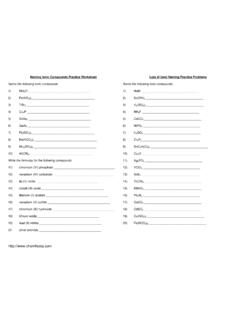
Transcription of Concentration Practice Questions with Answers
1 Practice : Concentration % by mass, % by volume, % m/v, molarity and ppmBy ChemistNATEQ uestions originally from: is a sugar that is found abundantly in nature. What is the percent by mass of a solution made by dissolving 163 g of glucose in 755 g of water? Do you need to know the formula of glucose? Why or why not? is the mass percent sucrose in a solution obtained by mixing 225 g of an aqueous solution that is sucrose by mass with 135 g of an aqueous solution that is sucrose by mass? the volume percent of toluene in a solution made by mixing mL toluene with mL of is the Concentration of Na+, in parts per million by mass, in M Na2SO4?
2 The process you would use in order to prepare kg of an aqueous solution that is NaCl by is the mass percent of solute when g is dissolved in g of water? is the volume percent of g of acetone (d = g/mL) in L of an acetone-water solution? NaCl by mass into parts per million of ppm F- into molarity of fluoride the molarity of a solution prepared by dissolving 125 mL of pure methanol, CH3OH (density = g/mL) into 275 mL of common solution used by EMTs for keeping veins from collapsing in accident victims is 5% (m/v) dextrose (C6H12O6) in )Write a recipe to make 450 mL (one blood unit) of 5% (m/v) dextrose in )Calculate the molarity of 5% (w/v) dextrose (C6H12O6) in is more concentrated, vinegar (5% (m/v) acetic acid), or 1 M acetic acid?
3 (Acetic acid is C2H4O2).13. A Pharmacist adds mL of distilled water to of powdered drug. The final volume of the solution is What is the percent (m/v) of the solution? is a sugar that is found abundantly in nature. What is the percent by mass of a solution made by dissolving 163 g of glucose in 755 g of water? Do you need to know the formula of glucose? Why or why not?%bymass=massofsolutemassofsolution=1 63g163g+755g= need to know the formula of glucose, since % by mass only involves the masses used. The formula is only useful if you need to convert to is the mass percent sucrose in a solution obtained by mixing 225 g of an aqueous solution that is sucrose by mass with 135 g of an aqueous solution that is sucrose by mass?
4 Massofglucoseinsolution1:(225g)( )= :(135g)( )= (sucrose)massofsolution= + +135g= the volume percent of toluene in a solution made by mixing mL toluene with mL of +75mL= is the Concentration of Na+, in parts per million by mass, in M Na2SO4?ppm=massofsolutemassofsolution 106 Suppose we had 1 L of the solution, which will have a mass of about 1 kg (1000 g). This litre will contain mol of Na2SO4 (that's the definition of M = mol/L) This means we have mol of Na ( ) ( )= 106= 106= the process you would use in order to prepare kg of an aqueous solution that is NaCl by of a kg solution is (5 kg)( ) = kg = 400 gSo, we need 400 g of solute, and kg of solvent (since, together, the total mass must be 5 kg)So, I would use a balance to weigh out 400 g of NaCl solid into a big beaker (5 L at least, since we need 5 kg of solution).
5 Then, I would pour water in until the balance read is no set volume for kg of solution, so using a volumetric flask is a bad idea. You must use a balance since you need is the mass percent of solute when g is dissolved in g of water?%bymass=massofsolutemassofsolution = +100g= by this point, you didn't forget to use mass of is the volume percent of g of acetone (d = g/mL) in L of an acetone-water solution? NaCl by mass into parts per million of by mass means g of NaCl per 100 g of solution You can also just prove this to yourself another way.
6 Assume you have 100 g of solution (or any other mass for that matter) and use %bymass=massofsolutemassofsolutionto figure out the mass of soluteppm=massofsolutemassofsolution 106= 106= ppm F- into molarity of fluoride means we have g of F for every 106 g of solution. We can assume that 106 g of solution is 106 mL, which is 103 L (divide by 1000). g of F is 10 the molarity of a solution prepared by dissolving 125 mL of pure methanol, CH3OH (density = g/mL) into 275 mL of (125mL) that the total volume is 125 mL + 275 mL = 400 mL,Molarity=molesofsoluteVolumeofsolutio ninLitres= common solution used by EMTs for keeping veins from collapsing in accident victims is 5% (m/v) dextrose (C6H12O6) in )Write a recipe to make 450 mL (one blood unit) of 5% (m/v) dextrose in m/v means there is 5 g of dextrose in 100 mL of , we need this much dextrose.
7 450mL 5gdextrose100mL= , the steps a balance to mass g of solid this mass of dextrose into a 450 mL volumetric the flask up to the etched line that indicates exactly mLWe use a volumetric flask here because the volume of the solution is )Calculate the molarity of 5% (w/v) dextrose (C6H12O6) in of of dextrose: molesofsolutevolumeofsolutioninlitres= is more concentrated, vinegar (5% (m/v) acetic acid), or 1 M acetic acid? (Acetic acid is C2H4O2).Let's convert the molarity into m/v (since in the previous question we did it the opposite way).
8 You can just replicate 11(b) if you want to convert 5% m/v into molarity)1 M = 1 mol of acetic acid per 1 L of mol of acetic acid is g (this is the definition of molar mass)%m/v=massofsoluteingramsvolumeofsol utioninmL= , the 1 M solution is slightly more A Pharmacist adds mL of distilled water to of powdered drug. The final volume of the solution is What is the percent (m/v) of the solution?%m/v=massofsoluteingramsvolumeo fsolutioninmL= , it is possible to have a mass/volume percent of greater than 100. If you have more than 1 g of solute per mL of solution, this will happen.
9 Just a weird quirk of this particular unit of measurement. This can NOT happen for mass/mass percent or volume/volume percent.