Transcription of Concept-Based Teaching and Learning
1 Getting the Big Idea: Concept-Based Teaching and Learning Transforming Learning Environments through Global and STEM Education August 13, 2013. What is Concept-Based instruction? Concept-Based instruction is driven by big ideas rather than subject-specific content. By leading students to consider the context in which they will use their understanding, Concept-Based Learning brings real world meaning to content knowledge and skills. Students become critical thinkers which is essential to their ability to creatively solve problems in the 21st century.
2 By introducing students to universal themes and engaging them in active Learning , Concept-Based instruction: creates connections to students' prior experience. brings relevance to student Learning . facilitates deeper understanding of content knowledge. acts as a springboard for students to respond to their Learning with action. (Erickson 2008). Why is it worth our time? Concept-Based instruction, by placing the Learning process in the big picture context of a transdisciplinary theme, leads students to think about content and facts at a much deeper level and as a practitioner would in that discipline (Schill & Howell 2011).
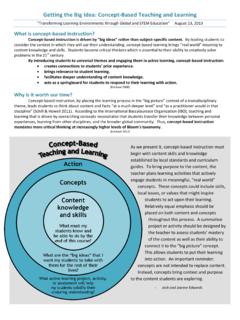
3 According to the International Baccalaureate Organization (IBO), Teaching and Learning that is driven by overarching concepts necessitates that students transfer their knowledge between personal experiences, Learning from other disciplines, and the broader global community. Thus, Concept-Based instruction mandates more critical thinking at increasingly higher levels of Bloom's taxonomy. (Erickson 2012). As we present it, Concept-Based instruction must begin with content skills and knowledge established by local standards and curriculum Action guides.
4 To bring purpose to the content, the teacher plans Learning activities that actively engage students in meaningful, real world . Concepts concepts. These concepts could include skills, local issues, or values that might inspire Content students to act upon their Learning . knowledge Relatively equal emphasis should be placed on both content and concepts and skills throughout this process . A summative What must my project or activity should be designed by students know and the teacher to assess students' mastery be able to do by the end of this course?
5 Of the content as well as their ability to connect it to the big picture concept. This allows students to put their Learning What are the big ideas that I. want my students to take with into action. An important reminder: them for the rest of their concepts are not intended to replace content. lives? Instead, concepts bring context and purpose What active- Learning project, activity, to the content students are exploring. or assessment will help my students solidify their - Josh and Joanne Edwards enduring understanding?
6 What is a concept? (The concept-topic divide). A common problem among teachers who want to bring concepts into their classroom is defining exactly what a concept is and is not. An important distinction to note is the difference the topics that our curriculum mandates we include in our instruction, and the concepts that help connect that set of knowledge and skills to students' lives. According to Lynn Erickson, concepts are universal, timeless, abstract, and move students toward higher levels of thinking.
7 Concepts are broad ideas that transcend the perspectives and limits of any specific subject-area. A concept is something that can be taught in any classroom, no matter what the content includes. Topics Concepts Topics Concepts The Human Body Systems Surrealism Symbolism Slavery Oppression Percussive Rhythms Pattern Author's Purpose Perspective Stage Combat Conflict Geometrical Translations Change Team Sports Communities Verb Conjugation Relationships Sewing Aesthetics Desktop Publishing Communication Horticulture Sustainability (Bray 2012 and Erickson 2007, 2008, and 2011).
8 How do I choose concepts that are right for my Teaching ? The concepts a teacher chooses to utilize will heavily depend on his or her content, the age, experiences, and diversity among the students, and personal goals and values for Teaching . What is most important is that you, the teacher, are invested in helping students explore the big ideas you choose, and that the concepts you choose are relevant for your students. There is also a variety of options you can consider in the kind of concepts you choose to use with your students.
9 For example, you might choose content-specific concepts (still broader than topics) that easily connect to the information students are Learning . This might be a great place to start, especially if you feel this approach to instruction will require some getting used to. Or, you might choose a set of thinking or Learning skills that you want your students to master by the time they leave your class, like intercultural awareness or persisting. Another approach could be choosing broad, universal concepts that transcend all subject-areas.
10 These universal concepts often have complex social implications that can lead to critical and reflective thinking among your students. (See the chart below for some specific examples.). Whatever type of concepts you choose, consider ways that you can make them visible in your class's physical space as well as the Learning activities you plan. Content-centric concepts Skill-centric concepts Universal concepts Course-long themes In a Social Studies classroom, At the beginning of each week, In each unit, use one of IBO's Developing the long-term theme use the Five Themes of introduce and discuss one of newly published 16 MYP Key of Global issues, connect each Geography as ongoing concepts Costa and Kallick's 16 Habits of concepts to consider the unit's content with a specific that show up in each unit and Mind.