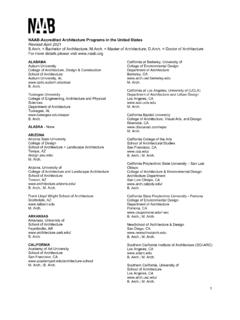
Transcription of Conditions for Accreditation
1 Conditions for Accreditation 2020 Edition February 10, 2020 2020 by the National Architectural Accrediting Board. All Rights Reserved. National Architectural Accrediting Board, Inc. Contents Introduction .. ii 1 Context and Mission .. 1 2 Shared Values of the Discipline and Profession .. 1 3 Program and Student Criteria .. 2 Program Criteria .. 2 Career Paths .. 2 Design .. 2 Ecological Literacy and Responsibility.
2 2 History and Theory .. 2 Research and Innovation .. 2 Leadership and Collaboration .. 2 Learning and Teaching Culture .. 2 Social Equity and Inclusion .. 2 Student Criteria: Student Learning Objectives and Outcomes .. 3 Health, Safety, and Welfare in the Built Environment .. 3 Professional Practice .. 3 Regulatory Context .. 3 Technical Knowledge .. 3 Design Synthesis .. 4 Building Integration .. 4 4 Curricular Framework.
3 5 Institutional Accreditation .. 5 Professional Degrees and Curriculum .. 5 Evaluation of Preparatory Education .. 6 5 Resources .. 7 Structure and Governance .. 7 Planning and assessment .. 7 Curricular Development .. 7 Human Resources and Human Resource 7 Social Equity, Diversity, and Inclusion .. 8 Physical Resources.
4 8 Financial Resources .. 8 Information Resources .. 8 6 Public Information .. 9 Statement on NAAB-Accredited Degrees .. 9 Access to NAAB Conditions and Procedures .. 9 Access to Career Development Information .. 9 Public Access to Accreditation Reports and Related Documents .. 9 Admissions and Advising .. 10 Student Financial Information .. 10 Appendix 1. Statement on Changes to the NAAB Conditions and Procedures for Accreditation .
5 11 Appendix 2. Statement on NAAB-Accredited Degrees .. 12 NAAB Conditions for Accreditation , 2020 Edition February 10, 2020 ii Introduction Accreditation in architecture is a voluntary quality-assurance process by which services and operations are evaluated by a third party against a set of standards established by the third party, with input and collaboration from peers in the field. Accreditation is evidence that a collegiate architecture program has met standards essential to produce graduates who have a solid educational foundation and are capable of leading the way in innovation, emerging technologies, and in anticipating the health, safety, and welfare needs of the public.
6 Since1975, the National Architectural Accrediting Board (NAAB) has accredited professional degree programs rather than schools or universities, and it only accredits first professional architecture degree programs. As such, the NAAB does not accredit pre-professional degrees or other preparatory education that may serve as a prerequisite for admission to a professional architecture degree program. The NAAB is the only agency recognized by registration boards in U. S. jurisdictions to accredit professional degree programs in architecture.
7 Because most registration boards require an applicant for licensure to hold a NAAB-accredited degree, obtaining such a degree is an essential part of gaining access to the licensed practice of architecture. The NAAB requires a self- assessment by the accredited-degree program and an evaluation of that assessment by the NAAB, along with a site visit by a NAAB team of trained volunteers who report their observations. The NAAB Board of Directors makes the decision regarding the term of Accreditation . While the NAAB stipulates the Conditions and Accreditation criteria that must be met, it specifies neither the education format nor the type of work that may serve as evidence of having met these criteria.
8 The NAAB encourages programs to develop unique learning and teaching strategies as well as innovative methods and materials to satisfy these criteria, provided the program has a formal evaluation process for assessing student achievement and documenting the results. Specific areas and levels of excellence will vary among accredited degree programs as will approaches to meeting the Conditions and reporting requirements. Regardless, academic units must demonstrate control over the accredited program(s) to ensure compliance with all Accreditation criteria and policies.
9 Positive aspects of a degree program in one area cannot override deficiencies in another. In preparing for this edition of the Conditions and Procedures, the NAAB initiated a two-year dialogue with the collateral organizations to advance an Accreditation process that ensures minimum competency of graduates based on the following goals: Promote excellence and innovation in architecture education Allow program flexibility that adapts to a dynamic context Encourage distinctiveness among programs Support equity, diversity.
10 And inclusion in architecture education and the profession Increase access to the profession of architecture Stimulate the generation of new knowledge Protect the public interest The two major Accreditation documents are the NAAB Conditions for Accreditation and the NAAB Procedures for Accreditation . The Conditions for Accreditation define the standards that professional degree programs in architecture are expected to meet. The NAAB Procedures for Accreditation outline the procedures that programs and visiting teams must follow in order to ensure a uniform accrediting process.