Transcription of Confidence Intervals
1 1 Chapter 7 1 Confidence IntervalsInference 2 We are in the fourth and final part of the course -statistical inference, where we draw conclusions about the population based on the data obtained from a sample chosen from Goal in InferenceIf ALL the populations, whatever we are interested in, would be manageable in size, we would just figure out the population parameter. Then there would be no need for Intervals (CI) The goal: to give a range of plausible values for the The goal: to give a range of plausible values for the The goal: to give a range of plausible values for the The goal: to give a range of plausible values for the estimate of the unknown population parameter estimate of the unknown population parameter estimate of the unknown population parameter estimate of the unknown population parameter the the the the population mean, population mean, population mean, population mean, , , , , the the the the population proportion, population proportion, population proportion, population proportion, pppp tttthe population standard deviation, he population standard deviation, he population standard deviation, he population standard deviation, We start with our best guess: the sample statistic We start with our best guess: the sample statistic We start with our best guess: the sample statistic We start with our best guess.
2 The sample statistic the the the the sample mean , sample mean , sample mean , sample mean , the the the the sample proportion sample proportion sample proportion sample proportion the sample standard deviation, sthe sample standard deviation, sthe sample standard deviation, sthe sample standard deviation, s Sample statistic = point estimateSample statistic = point estimateSample statistic = point estimateSample statistic = point estimate 4x$pConfidence Intervals (CI) to estimate ..Population MEANP oint estimate:Population PROPORTIONP oint estimate:Population STANDARD DEVIATIONP oint estimate: 5x$psConfidence Intervals (CI) 6CI = point estimate CI = point estimate CI = point estimate CI = point estimate margin of errormargin of errormargin of errormargin of errorMargin of errorMargin of error2 Margin of errorMargin of errorMargin of errorMargin of errorMargin of errorMargin of errorMargin of errorMargin of error Shows how accurate we believe our estimate is The smaller the margin of error, the more precise our estimate of the true parameter Formula.
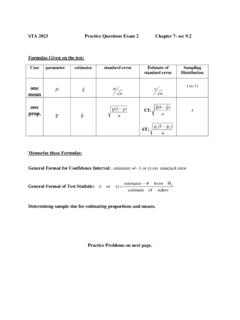
3 =statistic theofdeviation standard value criticalEConfidence Intervals (CI) for a MeanMeanMeanMean Suppose a random sample of size Suppose a random sample of size Suppose a random sample of size Suppose a random sample of size nnnnis taken from a normal is taken from a normal is taken from a normal is taken from a normal population of values for a quantitative variable whose population of values for a quantitative variable whose population of values for a quantitative variable whose population of values for a quantitative variable whose mean mean mean mean is unknownis unknownis unknownis unknown, when the population s , when the population s , when the population s , when the population s standard deviation standard deviation standard deviation standard deviation is is is is A Confidence interval (CI) for is.
4 Xzn * 8 Point estimatePoint estimatePoint estimatePoint estimateMargin of error (m or E)Margin of error (m or E)Margin of error (m or E)Margin of error (m or E)CI = point estimate CI = point estimate CI = point estimate CI = point estimate margin of errormargin of errormargin of errormargin of errorSo what s z*??? 9 A Confidence interval is associated with a Confidence level. We will say: the 95% Confidence interval for the population mean is .. The most common choices for a Confidence level are 90% :z* = 95% : z* = , 99% : z* = : Statement: Statement: Statement: Statement: Statement: Statement: Statement: (memorize!!)(memorize!!)(memorize!!)(mem orize!!)(memorize!!)(memorize!!)(memoriz e!!)(memorize!!)We are _____% confident that the true mean contextlies within the interval _____ and the calculator 11x Calculator: STAT TESTS 7 Inpt.
5 Data StatsUse this when you have data in one of your listsUse this when you know and The Trade-off 12 There is a tradeThere is a tradeThere is a tradeThere is a trade----off between the level of Confidence and off between the level of Confidence and off between the level of Confidence and off between the level of Confidence and precision in which the parameter is estimatedprecision in which the parameter is estimatedprecision in which the parameter is estimatedprecision in which the parameter is higher higher higher higher level of Confidence level of Confidence level of Confidence level of Confidence -------- wider wider wider wider Confidence Confidence Confidence Confidence intervalintervalintervalinterval lower level of Confidence lower level of Confidence lower level of Confidence lower level of Confidence narrower Confidence intervalnarrower Confidence intervalnarrower Confidence intervalnarrower Confidence interval395% confident means:95% confident means:95% confident means:95% confident means:In 95% of all possible samples of this size n, will indeed fall in our Confidence only 5% of samples would miss.
6 NThe Margin of Error The width (or length) of the CI is exactly twice the margin of error (E): The margin of error is therefore "in charge" of the width of the Confidence interval . 14 EEEC omment The margin of error (E ) isand since n, the sample size, appears in the denominator, increasing increasing increasing increasing nnnnwill reduce the will reduce the will reduce the will reduce the margin of errormargin of errormargin of errormargin of errorfor a fixed z*. Ezn= * 15 How can you make the margin of error How can you make the margin of error How can you make the margin of error How can you make the margin of error How can you make the margin of error How can you make the margin of error How can you make the margin of error How can you make the margin of error smaller?smaller?
7 Smaller?smaller?smaller?smaller?smaller? smaller? z* smaller (lower Confidence level) smaller(less variation in the population) n larger(to cut the margin of error in half, n must be 4 times as big) Really cannot change!Margin of Error and the Sample Size 17 In situations where a researcher has some flexibility as to the sample size, the researcher researcher researcher researcher can calculate in advance what the sample size is can calculate in advance what the sample size is can calculate in advance what the sample size is can calculate in advance what the sample size is that he/she needs in order to be able to report a that he/she needs in order to be able to report a that he/she needs in order to be able to report a that he/she needs in order to be able to report a Confidence interval with a certain level of Confidence interval with a certain level of Confidence interval with a certain level of Confidence interval with a certain level of Confidence and a certain margin of and a certain margin of and a certain margin of and a certain margin of the Sample Size 18 Ezn= * nzE= * 2 Clearly.
8 The sample size nmust be an integer. Calculation may give us a non-integer result. In these cases, we should always round round round round up to the next highest integerup to the next highest integerup to the next highest integerup to the next highest IQ scores are known to vary normally with standard deviation 15. How many students should be sampled if we want to estimate population mean IQ at 99% Confidence with a margin of error equal to 2? nzEn= = = =*.. 222 576152373 26374 19 They should take a sample of 374 students. They should take a sample of 374 students. They should take a sample of 374 students. They should take a sample of 374 students. Assumptions for the validity of The sample must be random The standard deviation, , is known and either the sample size must be large (n 30) or for smaller sample the variable of interest must be normally distributed in the * 20 Steps to follow conditionsCheck conditionsCheck conditionsCheck conditions: SRS, is known, and either n 30 or the population distribution is the CI for the given Confidence the CIExample 1 22 A college admissions director wishes to estimate the mean age of all students currently enrolled.
9 In a random sample of 20 students, the mean age is found to be years. Form past studies, the standard deviation is known to be years and the population is normally distributed. Construct a 90% Confidence interval of the population mean 1: Check conditions 23 A college admissions director wishes to estimate the mean age of all students currently enrolled. In a random samplerandom samplerandom samplerandom sample of 20 students, the mean age is found to be years. Form past studies, the standard deviation is knownstandard deviation is knownstandard deviation is knownstandard deviation is known to be years and the population is normally distributednormally distributednormally distributednormally distributed. SRS is known The population is normally distributedStep 2: Calculate the 90% CI using the formula 24xzn = = =*.
10 ( . , . ) 22 9 1 645152022 9 0 622 3 23 5xnz==== * 5 Step 2: Calculate the 90% CI using the calculator 25 Calculator: Calculator: Calculator: Calculator: STAT TESTS 7 Inpt: Data Stats = = n = 20 C-Level: .90 CalculateZIntervalZIntervalZIntervalZInt erval : ( , ): ( , ): ( , ): ( , )xStep 3: Interpretation 26 We are 90% confident that the mean We are 90% confident that the mean We are 90% confident that the mean We are 90% confident that the mean age of age of age of age of allallallallstudents at that college is students at that college is students at that college is students at that college is between and and and and 1 27 How many students should he ask if he wants the margin of error to be no more than years with 99% Confidence ?