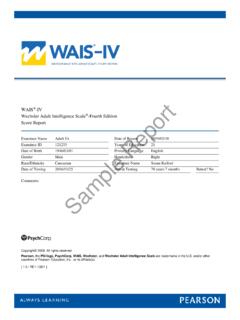
Transcription of Confidential Completion Date: DATE
1 PHONE WEB Cognitive Assessment report 01795590307 Occupational Services to Industry Independent Assessment Partners Delivering Excellence wais IV IQ report SAMPLE Confidential Completion Date: DATE Mike Crimes (HONS) AFBPsS Principal Occupational Psychologist Cognitive Assessment report 2 Participant Details Name: Date of Birth: Date(s) of Assessment: Age: Examiner s Name: Mike Crimes Date of report : Cognitive Assessment report 3 Introduction to wais The wais 4th Edition was used to assess the Intelligent Quotient (IQ) of M. X, age .. The model of assessment is shown below. Individual Administration and Caveat Assessment of cognitive functioning in Adults Aged 16 90 Years. Any interpretation of psychometric instruments should be treated cautiously and, where possible, further validated with other psychological/behavioural evaluations/observations.
2 Scale Composition 10 Subtests to Obtain IQ Scores 10 Subtests to Obtain Index Scores Indices and Scales Summary There are four index scores: Verbal Comprehension Index (VCI) Perceptual Reasoning Index (PRI) Working Memory Index (WMI) Processing Speed Index (PSI) Supplemental subtests may be used to provide additional psychological information or may be used as acceptable substitutes for core subtests. Where these subtests have been used, this will be referenced in analysis with full rationale. Overall, two broad scores are also generated, which can be used to summarise general intellectual abilities: Full Scale IQ (FSIQ), based on the total combined performance of the VCI, PRI, WMI, and PSI. General Ability Index (GAI), based only on the six subtests that the VCI and PRI comprise. The GAI provides an estimate of general intellectual ability, with reduced emphasis on working memory and processing speed relative to the FSIQ this scale is optional.
3 Cognitive Assessment report 4 wais IV Test Structure Verbal Comprehension Scale Similarities This subtest measures verbal concept formation and reasoning. Vocabulary This subtest measures word knowledge and verbal concept formation. Information This subtest measures the ability to acquire, retain, and retrieve information. Supplemental Subtests Comprehension This subtest measures verbal reasoning and conceptualization, verbal comprehension and expression, the ability to evaluate and use past experience, and the ability to demonstrate practical knowledge and judgment. Perceptual Reasoning Scale Block Design - This subtest measures the ability to analyse and synthesise abstract visual stimuli. Matrix Reasoning - This subtest measures fluid intelligence, broad visual intelligence, classification and spatial ability, knowledge of part-whole relationships, simultaneous processing, and perceptual organisation.
4 Visual Puzzles - This subtest measures nonverbal reasoning, and the ability to analyse and synthesise abstract visual stimuli. Supplemental Subtests Picture Completion - This subtest measures visual perception and organisation, concentration, and visual recognition of essential details of objects. Figure Weights - This subtest measures quantitative and analogical reasoning. Working Memory Scale Digit Span - This subtest measures working memory, mental manipulation, cognitive flexibility, rote memory and learning, attention, and encoding. Arithmetic - This subtest measures mental manipulation, concentration, attention, short- and long-term memory, numerical reasoning ability, and mental alertness. Supplemental Subtests Letter-Number Sequencing - This subtest measures sequential processing, mental manipulation, attention, concentration, memory span, and short-term auditory memory.
5 Processing Speed Symbol Search - This subtest measures processing speed, short-term visual memory, visual-motor coordination, cognitive flexibility, visual discrimination, psychomotor speed, and speed of mental operation. Coding - This subtest measures processing speed, short-term visual memory, learning ability, psychomotor speed, visual perception, visual-motor coordination, and visual scanning ability. Supplemental Subtests Cancellation - This subtest measures processing speed, visual selective attention, vigilance, perceptual speed, and visual-motor ability. Cognitive Assessment report 5 Index Definitions Verbal Comprehension: The Verbal Comprehension Index (VCI) is a measure of general verbal skills, such as verbal fluency, ability to understand and use verbal reasoning, and verbal knowledge. Perceptual Reasoning: The Perceptual Reasoning Index (PRI) is a measure of non-verbal and in-the-moment reasoning.
6 It assesses ability to examine a problem, draw upon visual-spatial skills, organise thoughts, create solutions, and then test them. Working Memory: The Working Memory Index (WMI) assesses ability to memorise new information, hold it in short-term memory, concentrate, and manipulate that information to produce some result or reasoning processes. It is important in learning, and achievement. It is important for cognitive flexibility and planning ability, as well as learning and ability to self-monitor. Processing Speed: Processing Speed Index (PSI) assesses skills focusing attention and quickly scanning, discriminating between, and sequentially ordering visual information. It requires persistence and planning ability, but is sensitive to motivation, difficulty working under a time pressure, and motor coordination. Cognitive Assessment report 6 Comparison and Interpretation Verbal Comprehension Superior Verbal Comprehension 1.
7 The ability to work with abstract symbols. 2. The amount & degree of benefit a person has gathered from their education. 3. Memory: verbal ability. 4. Verbal fluency. 1. The person has a high degree of education. 2. Psychomotor slowing due to depression. 3. The person may have a tendency to overachieve. 4. The person may have difficulty working with practical tasks. 5. Poor visual-motor integration. 6. A slow, deliberate work style. This will produce higher scores of the verbal tests than the perceptual tests. Perceptual Reasoning Superior Perceptual Reasoning 1. The degree and quality to which an individual makes non-verbal contact with the surrounding environment. 2. The capacity to integrate perceptual stimuli. 3. The ability to work quickly in concrete situations. 4. The ability to interpret visual-spatial stimuli. 1. Superior perceptual organisation abilities. 2. Very good at working under time constraints.
8 3. A tendency toward low academic achievement ( a doer and not a thinker). 4. The presence of a language deficit ( learning disability). Assessment Appearance and Behaviour During Assessment M. X arrived promptly to undertake the cognitive assessment. S/he was casually dressed. S/he maintained assertive eye contact, answering questions clearly and confidently. Her/his mood and effect were calm and jovial. During the assessment s/he remained concentrated and compliant, so rapport was established easily. S/he maintained motivation throughout the assessment. The testing environment was conducive to effective performance in the various tasks, there were no distractions such as outside noise and there were no interruptions to the assessment. There were no barriers to the assessment in terms of language, English is her/his first language. Cognitive Assessment report 7 Cognitive Assessment (IQ) Numerical Results Since chance factors such as variations in a person s performance over time can influence any cognitive assessment, it is more accurate to speak in terms of a range of scores when assessing a person s level of cognitive functioning (see Confidence Interval column below).
9 Taking these factors into account, the probability that M. X s true IQ score falls within the ranges stated below is approximately 95 out of 100. Score IQ 95% Confidence Interval Percentile Classification Full Scale IQ 1. M. X s Full Scale IQ is at the .. percentile; meaning .. of her/his norm group, .. year olds would score above this score. Index Assessment Verbal Comprehension Perceptual Reasoning Working Memory Processing Speed IQ/Index Score Percentiles Confidence Intervals 1. M. X s Verbal Comprehension Index is at the .. percentile; meaning .. of her/his norm group, .. year olds would score above this score. 2. M. X s Perceptual Reasoning Index is at the .. percentile; meaning .. of her/his norm group, .. year olds would score above this score. 3. M. X s Working Memory Index is at the .. percentile; meaning .. of her/his norm group, .. year olds would score above this score.
10 4. M. X s Processing Speed Index is at the .. percentile; meaning .. of her/his norm group, .. year olds would score above this score. Score IQ Classification Verbal Comprehension Perceptual Reasoning Working Memory Processing Speed Cognitive Assessment report 8 Working With M. X Verbal Comprehension Summary M. X verbal comprehension is .. The primary factor in poor comprehension for most adults is inadequate word identification skills. It is very likely this will impact M. X s interpretation of sentences. Research indicates that individuals who have adequate word identification skills but poor comprehension usually have some impairment in language comprehension that includes listening as well as reading comprehension. M. X may exhibit problems in relation to: Letter and word recognition. Relating some words and ideas. Reading speed and fluency. General vocabulary skills.