Transcription of CONFIDENTIAL PSYCHOLOGICAL REPORT
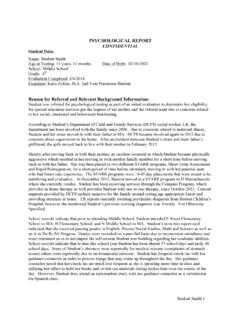
1 CONFIDENTIAL . PSYCHOLOGICAL REPORT . Name: School: County School Date of Birth: Evaluation Date: 3/ 15/2012. Age: 15 years Examiner: MS, Ed. S. Grade: 9th REASON FOR REFERRAL. was referred for an evaluation by the Response to Intervention Team at County School for a re-evaluation to gain information about his current Individual Educational Plan and school placement. BACKGROUND INFORMATION. Developmental History: mother received poor prenatal care during pregnancy and only gained 6 to 8 pounds. She was reported to have smoked cigarettes and drank caffeinated beverages during the pregnancy. was born three weeks early and weighed 6 pounds, 10 ounces. His developmental milestones were delayed. Medical History: has suffered from multiple ear infections, asthma, and constipation.
2 Additionally, he has undergone surgeries to correct strabismus. He has worn glasses since he was 11 months old. According to his adoptive mother, has some type of chromosome or enzyme abnormality that causes him to have unusual reactions to certain medications. Psychiatric History: received a psychiatric evaluation in February of 2006 from - RN, CNS. The diagnostic impressions were Attention Deficit Hyerpactivity Disorder-Combined Type, Oppositional Defiant Disorder, Mood Disorder-NOS, and RIO Pervasive Developmental Disorder. He has been tried on medications including Trileptal, Seroquel, Metadate CD, Adderall, Concerta, and Tenex. Educational History: is in the 9th grade at County School. He has an Individualized Education Program under the category of Autism Spectrum Disorder (ASD) and receives full time Exceptional Student Education Services.
3 TESTS ADMINISTERED. Woodcock-Johnson Tests of Achievement -Third Edition (WJA-III) (Form A). Woodcock-Johnson Tests of Cognitive Abilities-Third Edition (WJ-III COG). Stanford-Binet Intelligence Scales- Fifth Edition (SB-V). Vineland Adaptive Scales- Second Edition- Parent & Teacher Page 2. BEHAVIORAL OBSERVATIONS. During the course of this evaluation, was observed to be very friendly and enthusiastic. He often told jokes through sarcasm and wit. was easily distracted and had to be redirected several times to focus and concentrate. Overall, was easy to work with and it is in the opinion of the examiner that these assessments are a true and reliable measure of academic functioning. Stanford-Binet Intelligence Scales -Fifth Edition (SB-Vl IQ and Factor Index Description Full Scale IQ.)
4 The Full Scale IQ (FSIQ) is derived from the sum of all the tasks in the SB5. It covers both the Verbal and Nonverbal domains of cognitive ability in a balanced design and taps the five underlying factor index scales ofthe SB5. The FSIQ provides a global summary of the current general level of intellectual functioning as measured by the SB5. The FSIQ. is considered a reliable measure of g or the general ability to reason, solve problems, and adapt to the cognitive demands of the environment. The FSIQ measures more than acquired knowledge from schooling; it also measures the sum of five major facets of intelligence, including reasoning, stored information, memory, visualization, and the ability to solve novel problems.
5 In research, global scores such as the FSIQ have been found to be the most effective predictors of long-term educational attainment, school- based achievement, and vocational advancement. When Nonverbal IQ (NVIQ) and Verbal IQ (VIQ) scores are not significantly different, the FSIQ typically will be the most prominent score in the SB5 interpretation. Nonverbal IQ. The SB5 Nonverbal IQ is based on the nonverbal subtests of the five factor index scales. It measures skills in solving abstract, picture-oriented problems; recalling facts and figures; solving quantitative problems shown in picture form; assembling designs; and recalling tapping sequences. The NVIQ measures the general ability to reason, solve problems, visualize, and recall information presented in pictorial, figural, and symbolic form, as opposed to information presented in the form of words and sentences (printed or spoken).
6 The NVIQ does require a small degree of auditory skill to understand brief examiner-spoken directions. Verbal IQ. The SB5 Verbal IQ provides a composite of all the cognitive skills required to solve the items in the five verbal subtests. The VIQ measures general ability to reason, solve problems, visualize, and recall important information presented in words and sentences (printed or spoken). Additionally, the VIQ reflects the examinee's ability to explain verbal responses clearly, present rationale for response choices, create stories, and explain spatial directions. The VIQ subtests require the examinee to understand the . Page 3. examiner's spoken directions and then clearly vocalize responses to questions.
7 General verbal ability, measured by VIQ, is one of the most powerful predictors of academic success in Western cultures, because of the heavy reliance on reading and writing in formal school programs. Abbreviated Battery IQ. The Abbreviated Battery IQ (ABIQ) is based on two routing subtests - one nonverbal (Object Series/Matrices) and one verbal (Vocabulary). The ABIQ provides a quick estimate of two major cognitive factors - fluid reasoning and crystallized ability. Object Series/Matrices requires the examinee to identify patterns or series of objects and pictures, and to solve novel, pictorial problems presented in the matrix-analogy format. Vocabulary requires examinees to use their verbal knowledge, acquired and stored in memory from years of exposure to printed and spoken English, in school, at home, or at work.
8 The ABIQ can be used for assessments such as neuropsychological examinations in which a battery of tests supplements the SB5 or for quick, yet reliable assessments to verify the general cognitive status of an individual. The ABIQ measures the areas of Nonverbal Fluid Reasoning and Verbal Knowledge and includes two of the most important abilities predictive of academic and vocational advancement. Fluid Reasoning Fluid Reasoning (FR) is the ability to solve verbal and nonverbal problems using inductive or deductive reasoning. Classic activities such as Matrices require the individual to determine the underlying rules or relationships among pieces of information (such as visual objects) that are novel to the individual.
9 The ability to reason inductively (as in the Matrices or Verbal Analogies activities) requires the examinee to reason from the part to the whole, from the specific to the general, or from the individual instance to the universal principle. In deductive reasoning activities, the examinee is given general information and is required to infer a conclusion, implication, or specific example. In the SB5, the Early Reasoning activity items require the examinee to inspect pictures depicting human activities and deduce the underlying problem or situation by telling a story. Knowledge Knowledge (KN) is a person's accumulated fund of general information acquired at home, school, or work. In research, this factor has been called crystallized ability, because it involves learned material, such as vocabulary, that has been acquired and stored in long-term memory.
10 Therefore the first two factor indexes represent the widely verified fluid and crystallized (knowledge) dimensions of intelligence. Page 4. Quantitative Reasoning Quantitative Reasoning (QR) is an individual's facility with numbers and numerical problem solving, whether with word problems or with pictured relationships. Activities in the SB5 emphasize applied problem solving more than specific mathematical knowledge acquired through school learning. Visual-Spatial Processing Visual-Spatial Processing (VS) measures an individual's ability to see patterns, relationships, spatial orientations, or the gestalt whole among diverse pieces of a visual display. Activities in the SB5 include Form Board and Form Patterns, where pieces are moved to complete the whole puzzle, and a collection of position and direction items.