Transcription of Conners Comprehensive Behavior Rating Scales™
1 conner s Comprehensive Behavior Rating Scales Created in response to a growing demand for an assessment that identifies a multitude of disorders and concerns, the conner s CBRS aids psychology professionals in obtaining a Comprehensive assessment of children and adolescents via a multi-informant Rating process. The instrument assists with the diagnostic process through direct links to the DSM-IV-TR and the IDEA 2004 and identifies and qualifies students for inclusion in special education/research studies. In addition, the conner s CBRS assists in the development of intervention treatment plans, monitors the individual's response to intervention/treatment, and evaluates the effectiveness of intervention/treatment. Adolescents from 8-18 years can complete the Self-Report Forms. The instrument includes DSM-IV-TR symptom scales that assess the following disorders: Generalized anxiety disorder Autistic disorder Separation anxiety disorder Asperger's disorder Social phobia Attention-deficit/hyperactivity disorder Major depressive episode Oppositional defiant disorder Manic episode Conduct disorder The conner s CBRS is composed of: 12 conner s CBRS scales--Emotional Distress, Aggressive Behaviors, Academic Difficulties: Total, Academic Difficulties: Language, Academic Difficulties: Math, Hyperactivity, Hyperactivity/Impulsivity, Social Problems, Separation Fears, Perfectionistic and Compulsive Behaviors, Violence Potential, and Physical Symptoms.
2 14 DSM-IV-TR Symptom scales--ADHD Hyperactive/Impulsive, ADHD Inattentive, ADHD Combined, Conduct Disorder, Oppositional Defiant Disorder, Major Depressive Disorder, Manic Episode, Mixed Episode, Generalized Anxiety Disorder, Separation Anxiety Disorder, Social Phobia, Obsessive-Compulsive Disorder, Autistic Disorder, and Asperger's Disorder. 3 Validity scales--Positive Impression, Negative Impression, and Inconsistency Index. 11 Other Clinical Indicator scales--Bullying Perpetration, Bullying Victimization, Enuresis/Encopresis, Panic Attack, Pervasive Developmental Disorder, Pica, Post Traumatic Stress Disorder, Specific Phobia, Substance Use, Tics, and Trichotillomania. 3 Impairment Item scales--Schoolwork/Grades, Friendships/Relationships, and Home Life. 2 Critical Item scales--Severe Conduct and Self-Harm.
3 2 Additional Question scales--Other Concerns and Strengths. The conner s Comprehensive Behavior Rating Scales ( conner s CBRS ) is an instrument designed to provide a complete overview of child and adolescent disorders and concerns. The age range suitable for this assessment is 6 to 18 years for parent and teacher forms and 8 to 18 years for self-report forms. conner s CBRS is a Comprehensive multi-informant tool that: - Assists in the diagnostic process - Identifies and qualifies students for inclusion or exclusion in special education/research studies - Assists in the development of intervention treatment plans - Monitors your child s response to intervention/treatment - Evaluates the effectiveness of intervention/treatment plans Key areas measured: - Emotional distress: total, upsetting thoughts, worrying, social problem s, upsetting thoughts/physical symptoms, separation fears, social anxiety - Aggressive behaviors - Academic Difficulties: total - Academic Difficulties: language - Academic Difficulties.
4 Math s - Hyperactivity/Impulsivity - Separation Fears - Social Problems - Perfectionistic and Compulsive Behaviors conner s CBRS Parent Rating Scales conner s CBRS parent forms assess behaviors, concerns and academic proble m s in children between the ages of 6 and 18 years and are reported by parents. The form is available in one Comprehensive length ( conner s CBRS P) and is recommended for initial evaluations if time allows. When used in conjunction with teacher ratings, differences between home and school are highlighted. conner s CBRS teacher Rating Scales conner s CBRS teacher forms assess behaviors, concerns and academic proble m s in children between 6 and 18 years old and are reported by teachers. This version provides Comprehensive results, and is recommended for initial evaluations if time allows ( conner s CBRS T).
5 When used with the parent scale differences between home and school are highlighted. conner s CBRS Clinical Index The conner s CBRS offers a 25-item conner s CBRS Clinical Index which is available for parents, teachers and youth. The brief index works well when screening a large group of children and adolescents to see if further assessment of a number of disorders such as social phobia, Asperger s disorder and manic episode is warranted. The Clinical Index is a useful tool which can help build support for whether a child is likely to have a clinical diagnosis, or is more similar to youth who do not have a clinical diagnosis. Additionally, this form can be used to monitor the effectiveness of treatment plans, and measure the patient s response to intervention. Conners CBRS Self-ReportBy C.
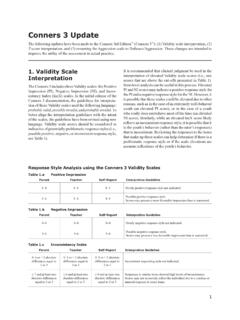
6 Keith Conners , 2008 Multi-Health Systems Inc. All rights Box 950, North Tonawanda, NY 14120-09503770 Victoria Park Ave., Toronto, ON M2H 3M6 This Assessment report is intended for use by qualified assessors only, and is not to be shown or presentedto the respondent or any other unqualified ReportSAMPLEI ntroductionThe following section provides Emily s scores for the Positive and Negative Impression scales and theInconsistency of ValidityRaw score = 0 (Probably valid)The Positive Impression score does not suggest an overly positive response ImpressionRaw score = 1 (Probably valid)The Negative Impression score does not suggest an overly negative response ImpressionRaw score = 3, Number of absolute differences 2 = 0 (Probably valid)The responses to similar items are consistent with one IndexConners Comprehensive Behavior Rating Scale Self-Report ( Conners CBRS SR) is an assessment tool that prompts the youth to provide valuable information about herself.
7 This instrument is helpful when information regarding a number of childhood disorders and problem behaviors is required. When used in combination with other information, results from the Conners CBRS SR can provide valuable information to guide assessment decisions. This report provides information about the youth s score, how she compares to other youth, and which scales are elevated. See the Conners CBRS Manual (published by MHS) for more information. This computerized report is an interpretive aid and should not be given to clients or used as the sole criterion for clinical diagnosis or intervention. Administrators are cautioned against drawing unsupported interpretations. Combining information from this with information gathered from other psychometric measures, as well as from interviews and discussions with the youth, will give the practitioner or service provider a more Comprehensive view of the youth than might be obtained from any one source.
8 This report is based on an algorithm that produces the most common interpretations for the scores that have been obtained. Administrators should review the client s responses to specific items to ensure that these typical interpretations apply. Conners CBRS SR Assessment Report for EmilyAdmin Date: 10/23/2007 Page 2 Copyright 2008 Multi-Health Systems Inc. All rights CBRS SR Assessment Report for EmilyAdmin Date: 10/23/2007 The following graph provides T-scores for each of the Conners CBRS SR Content scales and subscales. The error bars on each bar represent Standard Error of Measurement (SEM) for each scale score. For information on SEM, see the Conners CBRS CBRS SR Content Scales: T-scoresPage 3 Copyright 2008 Multi-Health Systems Inc. All rights CBRS SR Assessment Report for EmilyAdmin Date: 10/23/2007 Conners CBRS SR Content Scales: Detailed ScoresThe following table summarizes the results of Emily s self assessment and provides general information about how she compares to the normative group.
9 Please refer to the Conners CBRS Manual for more information on the interpretation of these results. Caution: please note that T-score cutoffs are guidelines only and may vary depending on the context of assessment. T-scores from 57 63 should be considered borderline and of special note since the assessor must decide (based on other information and knowledge of the youth) whether or not the concerns in the associated area warrant clinical intervention. Common Characteristics of HighScorersGuidelineRawScoreScaleT-score SEM(Percentile)Elevated Score (More concernsthan are typically reported)63 (89)34 EmotionalDistressWorries a lot (including possible socialanxieties); may feel nervous. Lowself-confidence. May show signs ofdepression. May have physicalcomplaints (aches, pains, difficultysleeping); may have repetitive thoughts Score (Typical levelsof concern)45 (39)2 AggressiveBehaviorsPhysically and/or verbally aggressive; mayshow violence, bullying, destructivetendencies; may be argumentative; mayhave poor control of anger/aggression.
10 May seem uncaring. May have Elevated Score (Manymore concerns than aretypically reported)75 (97)20 AcademicDifficultiesStruggles with reading, writing, spelling,and/or arithmetic. May have difficultykeeping up in Score (More concernsthan are typically reported)62 (88)11 Hyperactivity/ImpulsivityHigh activity levels, may be restless, mayhave difficulty being quiet. May haveproblems with impulse control; mayinterrupt others or have difficulty waitingfor his/her Score (Typical levelsof concern)58 (78)7 Separation FearsFears being separated Score (Typical levelsof concern)52 (62)7 Violence PotentialAt risk for acting Score (Typical levelsof concern)55 (82)9 PhysicalSymptomsMay complain about aches, pains, orfeeling sick. May have sleeping or : SEM = Standard Error of MeasurementPage 4 Copyright 2008 Multi-Health Systems Inc. All rights CBRS SR Assessment Report for EmilyAdmin Date: 10/23/2007 DSM-IV-TR OverviewThis section of the report provides the following information for each DSM-IV-TR diagnosis on the Conners CBRS SR: 1.