Transcription of Constructed-Response Scoring -- Doing it Right
1 Do we standardize the Scoring of responses to performance assessment tasks which assessment people often refer to as Constructed-Response (CR) items1 so that the scores are reliable and so that they have the same valid meaning for all test takers?We expect scores from standardized tests to be comparable over time and over different administrations and forms of the test. For assessments composed of multiple-choice items, there are a number of techniques to accomplish this, such as fixed timing, machine- scored answer sheets, equating different forms, and scores reported on a scale rather than number or percent correct.
2 For such tests, it should not matter to the examinee which form of a test he or she takes on which what about tests composed, in part or in full, of questions requiring examinees to write essay responses, show the steps in solving a math problem, create pieces of art, perform dances, or record spoken language in short, anything that requires an examinee to construct a response (hence the name constructed response ), rather than select one provided on the test? These so-called CR items are usually scored by people, and standardizing people s judgments and actions is not a simple matter. But in testing, lack of standardization can lead to all sorts of bad Elements of Standardized TestingTwo essential properties for tests are validity and reliability.
3 Reliability is whether the measure gives a consistent picture of performance for each examinee (American Educational Research Association [AERA], American Psychological Association [APA], & National Council on Measurement in Education [NCME], 1999; haertel, 2006). Validity is whether the decisions we make using the test scores lead to the intended outcomes (AERA, APA, & NCME, 1999; Kane, 2006). 1 The terms prompt and item are used in this article to describe tasks that elicit a constructed response from a test taker; often, the prompt or item does not come in the form of a s note: Catherine A. McClellan is the director of human Constructed-Response Scoring in the Research Applications & Development area of ETS s Research & Development Scoring Doing It Rightby Catherine A.
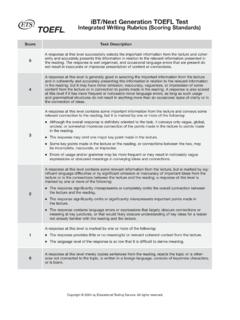
4 McClellanNo. 13 February 2010 What is involved?These are some important components in performance testing: Constructed-Response items (often known as performance tasks) A task that requires test takers to construct answers rather than select from predetermined multiple-choice options; examples include essays, works of art or speeches. Rubric The set of Scoring standards that describes the criteria for each score level. If we aren t measuring something consistently, we cannot use that measurement to make an appropriate decision about the examinee. R&D Connections No. 13 February two properties are related: If we aren t measuring something consistently, we cannot use that measurement to make an appropriate decision about the examinee.
5 A test can be reliable without being valid: For example, we could measure examinees height very reliably, but this likely is not a valid indicator of the same examinees writing proficiency. The opposite, on the other hand, is not true: An unreliable test cannot be imagine the human beings who we refer to as raters hired to score standardized writing tests. Obviously, they have to know something about good writing. This is a necessary, but not a sufficient, condition for their scores to be valid. In addition to this expertise, these raters also have to be able to give similar scores to similar examinee responses, and their scores have to be similar to those of other raters, as if we select people with knowledge of writing to rate essay tests perhaps they have college degrees in English how would we know if the scores they assign to the essays are reliable?
6 Is one rater s judgment of writing quality different from another rater s? how do we know? how do we assure that the scores assigned to the essays are comparable to each other? If they aren t, then the scores on the test are no longer comparable to each other either. Two examinees with precisely the same responses could receive different scores on a test due solely to what different raters think the response deserves. If decisions about the examinees are made based on flawed scores such as this, the decisions will be flawed as well. To have a truly standardized test, it must not matter which rater scores an examinee s responses any more than it matters which test form is taken on which Rating QualityWithout well-written prompts that elicit a broad variety of responses and a Scoring rubric that clearly defines each distinct score level, high-quality Scoring will not occur.
7 Even given those conditions, some methods of ensuring standardization of raters are obvious; some less so. Credentials are an obvious criterion: Raters must have knowledge of the content area in which they are Scoring responses. how to assure this may be less obvious, although in practice, this typically is established through educational or professional content knowledge alone is not sufficient a rater must be trained in the specific procedures needed to score the responses to the particular test or item he or she will be Scoring . CR items on standardized tests typically have a fixed set of score levels to which responses will be assigned, and detailed descriptions of the performance that qualifies a response for each level.
8 This information is described in a document called a Scoring rubric. See Lane & Stone (2006) for a summary description of CR Scoring order to have consistent and reliable CR Scoring , each rater must understand and apply the Scoring rubric to the examinee responses in the same way every time. Who is involved?Other than the test takers, these are some important people in the process of Constructed-Response Scoring : Raters People hired to score Constructed-Response tests. Scoring leader An experienced rater who has shown consistently strong Scoring performance and who has the interpersonal qualities of a good mentor.
9 Content knowledge alone is not sufficient a rater must be trained in the specific procedures needed to score the responses to the particular test or item he or she will be Scoring . R&D Connections No. 13 February receive extensive training on the Scoring rubric for the item to be scored . This training may come from an instructor or from a self-paced online next is a common set of steps leading up to live Scoring . As part of the training, raters receive sample responses with the score level pre-assigned. Training focuses on the reasons each response received the score level it did. Next, raters may receive responses to discuss and assign scores to, either individually or as a group.
10 Once the raters are comfortable with the Scoring rubric, each rater individually assigns scores to a set of responses that have previously received a score from content experts. After everyone completes this Scoring , the training leader will poll the raters for their scores on each response and discuss the pre-assigned score and the rationale for assigning it. If the rater training is online, the discussion is managed through the use of extensive commentaries and descriptions instead of a culminating exercise to verify that each rater has understood the Scoring rubric and can apply it effectively, a set of responses is given to test the rater s skills so raters themselves are tested before they are allowed to score tests.