Transcription of Control Systems Engineer - Automation Federation
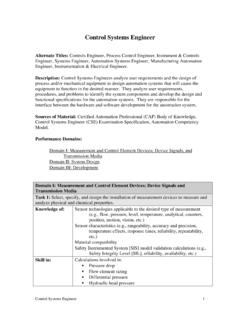
1 Control Systems Engineer Alternate Titles: Controls Engineer , Process Control Engineer , Instrument & Controls Engineer , Systems Engineer , Automation Systems Engineer , Manufacturing Automation Engineer , Instrumentation & Electrical Engineer . Description: Control Systems Engineers analyze user requirements and the design of process and/or mechanical equipment to design Automation Systems that will cause the equipment to function in the desired manner. They analyze user requirements , procedures, and problems to identify the system components and develop the design and functional specifications for the Automation Systems .
2 They are responsible for the interface between the hardware and software development for the Automation system . Sources of Material: Certified Automation Professional (CAP) Body of Knowledge, Control Systems Engineer (CSE) Examination specification , Automation Competency Model. Performance Domains: Domain I: Measurement and Control Element Devices; Device Signals, and Transmission MediaDomain II: system DesignDomain III: Development Domain I: Measurement and Control Element Devices; Device Signals and Transmission Media Task 1: Select, specify, and design the installation of measurement devices to measure and analyze physical and chemical properties.
3 Knowledge of: Sensor technologies applicable to the desired type of measurement ( , flow, pressure, level, temperature, analytical, counters, position, motion, vision, etc.) Sensor characteristics ( , rangeability, accuracy and precision, temperature effects, response times, reliability, repeatability, etc.) Material compatibility Safety Instrumented system [SIS] model validation calculations ( , Safety Integrity Level [SIL], reliability, availability, etc.) Skill in: Calculations involved in: Pressure drop Flow element sizing Differential pressure Hydraulic head pressure Control Systems Engineer 1 Velocity, area, volumetric, density, and mass relationships Velocity, acceleration, mass, work energy Unit conversions Linearization Task 2: Select, specify, and design the installation of Control element devices to manipulate flows, energy, positions, speeds, and other variables.
4 Knowledge of: Control Element devices Pressure Relieving Devices Types ( , conventional spring, balanced bellows, pilot operated, etc.) Characteristics ( , modulating, pop action, etc.) Calculations ( , sizing considering inlet pressure drop, back pressure, multiple valves, etc.) Material selection based on process characteristics Installation practices ( , linking valves, sparing the valves, accessibility for testing, car sealing inlet valves, piping installation, etc.) Rupture discs (types, characteristics, application, calculations, etc.) Control Valves Types ( , globe, ball, butterfly, etc.)
5 Characteristics ( , pneumatic or electric actuation, on/off, modulating, linear, low noise, equal percentage, shutoff class, etc.) Calculation ( , body and trim sizing, split range, noise, actuator sizing, speed, pressure drop, air/gas consumption, etc.) Applications of fluid dynamics ( , cavitation, flashing, choked flow, Joule-Thompson effects, two-phase flow, etc.) Material selection based on process characteristics ( , erosion, corrosion, plugged, extreme pressure, temperature, etc.) Accessories ( , limit switches, solenoid valves, positioners, transducers, air regulators, etc.) Environmental constraints ( , fugitive emissions, packing, special sealing, etc.)
6 Installation practices ( , vertical, horizontal, bypasses, troubleshooting, etc.) Motor Driven Control Elements Types of Motors ( Single and Polyphase Alternating Current (AC) Motors, Direct Current (DC) Motors, Stepper Motors, Servo Motors, linear, etc) Types of Motor Controllers or Drives ( full voltage, reduced voltage, reversing, variable frequency, adjustable DC, servo, stepper, etc.) Control Systems Engineer 2 Drive and/or Motor Characteristics ( solid state, constant torque AC, variable torque AC, vector AC, shunt wound DC, etc.) Calculations ( horse power, torque, speed ranges, reduction ratios, etc.)
7 Accessories ( speed sensors, encoders, etc.) Fluid powered actuators Pneumatic pistons Hydraulic pistons Sizing actuators and Control devices. Other Control Elements Solenoid valves On-off devices/relays Self-regulating devices Safety Instrumented system [SIS] model validation calculations ( , Safety Integrity Level [SIL], reliability, availability, etc.) Skill in: Installation Design ( , process, fluid power Systems , electrical, etc.) Calculations for: Valve sizing Power requirements Heat load, cooling, heating and space conditioning. Horsepower and torque Linear actuation force Etc.
8 Task 3: Design and install wiring to reliably communicate information between measurement and Control element devices and Control equipment. Knowledge of: Control Signals Pneumatic, hydraulic, electronic, optical, discrete voltage, analog, digital, digital bus, etc. Transducers ( , analog/digital [A/D], digital/analog [D/A], current/pneumatic [I/P] conversion, etc.) Electrical hazardous area classifications and required wiring and protection methods ( Intrinsic Safety, explosion proof, non-incendive, etc.) Grounding, shielding, segregation, AC coupling Basic signal circuit design ( , two-wire, four-wire, isolated inputs/outputs, loop or external powering, etc.)
9 Signal Transmission Signal communications system architecture physical layers ( , fiber optics, coaxial cable, wireless, paired conductors, fieldbus, industrial networks, etc.) Signal Communications protocols ( foundation fieldbus, profibus, DeviceNet, ASi, Ethernet/IP, CAN, LonWorks, BACnet, etc.) Control Systems Engineer 3 Physical installation considerations versus transmission medium type Media types and specifications Voltage drop or signal attenuation Signal distortion due to media length or network structure Active and passive network components ( taps, splitters, repeaters/amplifiers, terminators, etc.)
10 Grounding & shielding Skill in: Electrical Installations Use of design standards and practices Determination of applicable codes. Calculations: circuit (voltage, current, impedance) Calculations: unit conversions Task 4: Calibrate, troubleshoot, test, repair, and improve sensing, measurement, and actuation devices. Knowledge of: Installation requirements ( , grounding, shielding, constructability, input/output termination, environmental, heat load calculations, power load requirements , purging, etc.) Functionality and performance of measurement and Control element devices Skill in: Commissioning ( , performance tuning, loop checkout, etc.)