Transcription of corn, and Roundup Ready - CDMS
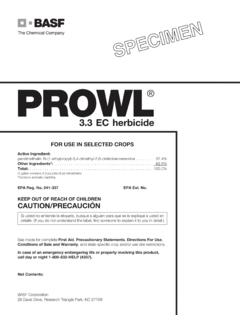
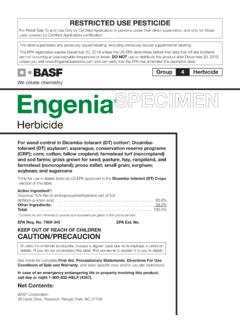
1 For use in soybeans, Clearfield corn , and Roundup Ready alfalfa Active Ingredients: imazethapyr: ( )-2-[4,5-dihydro-4-methyl-4-(1-methyleth yl)-5-oxo- 1H-imidazol-2-yl]-5-ethyl-3-pyridinecarb oxylic acid .. glyphosate: N-(phosphonomethyl)glycine, in the form of its isopropylamine salt* .. Other Ingredients: .. Total: .. Contains pounds of active ingredient per gallon ( pound acid equivalent of imazethapyr and 2 pounds of glyphosate as the isopropylamine salt). * lbs glyphosate acid per gallon EPA Reg. No. 241-405 EPA Est. No. KEEP OUT OF REACH OF CHILDREN. WARNING/AVISO. Si usted no entiende la etiqueta, busque a alguien para que se la explique a usted en detalle. (If you do not understand this label, find someone to explain it to you in detail.). See inside for complete First Aid, Precautionary Statements, Directions For Use, Conditions of Sale and Warranty, and state-specific crop and/or use site restrictions.
2 In case of an emergency endangering life or property involving this product, call day or night 1-800-832-HELP (4357). Net Contents: BASF Corporation 26 Davis Drive, Research Triangle Park, NC 27709. FIRST AID. Hold eyes open and rinse slowly and gently with water for 15 to 20 minutes. If in eyes Remove contact lenses, if present, after the first 5 minutes; then continue rinsing eyes. Call a poison control center or doctor for treatment advice. Take off contaminated clothing. If on skin or clothing Rinse skin immediately with plenty of water for 15 to 20 minutes. Call a poison control center or doctor for treatment advice. Call a poison control center or doctor immediately for treatment advice. If swallowed Have person sip a glass of water if able to swallow. DO NOT induce vomiting unless told to by a poison control center or doctor. Note to Physician: Probable mucosal damage may contraindicate the use of gastric lavage.
3 HOTLINE NUMBER. Have the product container or label with you when calling a poison control center or doctor or going for treatment. You may also contact BASF Corporation for emergency medical treatment information: 1-800-832-HELP (4357). Precautionary Statements Groundwater Advisory and Proper Handling Instructions Hazards to Humans and Domestic Animals This chemical has properties and characteristics associat- WARNING. Causes substantial but temporary eye injury. ed with chemicals detected in groundwater. The use of this DO NOT get in eyes or on clothing. Harmful if absorbed chemical in areas where soils are permeable, particularly through skin. Avoid contact with skin. where the water table is shallow, may result in groundwater contamination. Personal Protective Equipment (PPE) This product may not be mixed or loaded within 50 feet of Some materials that are chemically resistant to this product any wells (including abandoned wells and drainage wells), are listed below.
4 If you want more options, follow the sinkholes, perennial or intermittent streams and rivers, and instructions for Category A on an EPA chemical-resistance natural or impounded lakes or reservoirs. This setback category selection chart. does not apply to properly capped or plugged abandoned wells and does not apply to impervious pad or properly Applicators and other handlers must wear: diked mixing/loading areas. Long-sleeved shirt and long pants Operations that involve mixing, loading, rinsing, or washing Chemical-resistant gloves, such as butyl rubber 14 mils, of this product into or from pesticide handling or applica- or natural rubber 14 mils, or neoprene rubber 14 mils, tion equipment or containers within 50 feet of any well are or nitrile rubber 14 mils prohibited unless conducted on an impervious pad Shoes plus socks constructed to withstand the weight of the heaviest load Protective eyewear that may be positioned on or moved across the pad.
5 Such Discard clothing and other absorbent materials that have a pad shall be designed and maintained to contain any been drenched or heavily contaminated with this product's product spills or equipment leaks, container or equipment concentrate. DO NOT reuse them. Follow manufacturer's rinse or washwater, and rainwater that may fall on the pad. instructions for cleaning and maintaining PPE. If no such Surface water shall not be allowed to either flow over or instructions for washables exist, use detergent and hot from the pad, which means the pad must be self- water. Keep and wash PPE separately from other laundry. contained. The pad shall be sloped to facilitate material removal. An unroofed pad shall be of sufficient capacity to USER SAFETY RECOMMENDATIONS contain at a minimum 110% of the capacity of the largest pesticide container or application equipment on the pad. A. Users should: pad that is covered by a roof of sufficient size to completely Wash hands before eating, drinking, chewing gum, exclude precipitation from contact with the pad shall have a using tobacco, or using the toilet.
6 Minimum containment capacity of 100% of the capacity of Remove clothing/PPE immediately if pesticide gets the largest pesticide container or application equipment on inside. Then wash thoroughly and put on clean clothing. the pad. Containment capacities as described above shall be maintained at all times. Environmental Hazards The above specific minimum containment capacities do DO NOT apply directly to water, or to areas where surface not apply to vehicles when delivering pesticide shipments water is present, or to intertidal areas below the mean high to the mixing/loading site. States may have in effect addi- water mark. DO NOT contaminate water when disposing tional requirements regarding wellhead setbacks and of equipment washwater or rinsate. operational containment. 2. DO NOT apply this product through any type of irrigation system. STORAGE AND DISPOSAL (continued). Product must be used in a manner which will prevent Pesticide Disposal back-siphoning in wells, spills or improper disposal of Wastes resulting from the use of this product must be dis- excess pesticide spray mixture.
7 Posed of on-site or at an approved disposal facility. Container Handling Directions For Use Nonrefillable Container. DO NOT reuse or refill this container. Triple rinse or pressure rinse container (or It is a violation of federal law to use this product in a man- equivalent) promptly after emptying; then offer for ner inconsistent with its labeling. recycling, if available, or reconditioning, if appropriate, or DO NOT apply this product in a way that will contact work- puncture and dispose of in a sanitary landfill, or by inciner- ers or other persons, either directly or through drift. Only ation, or by other procedures approved by state and local protected handlers may be in the area during application. authorities. For any requirements specific to your state or tribe, consult Triple rinse containers small enough to shake the agency responsible for pesticide regulation. (capacity 5 gallons) as follows: Empty the remaining This label must be in the possession of the user at the time contents into application equipment or a mix tank and of herbicide application.
8 Drain for 10 seconds after the flow begins to drip. Fill the container 1/4 full with water and recap. Shake for 10 sec- Not for sale or use on Long Island, New York. onds. Pour rinsate into application equipment or a mix tank, or store rinsate for later use or disposal. Drain for AGRICULTURAL USE REQUIREMENTS. 10 seconds after the flow begins to drip. Repeat this pro- Use this product only in accordance with its labeling and cedure two more times. with the Worker Protection Standard, 40 CFR part 170. This standard contains requirements for the protection of Triple rinse containers too large to shake agricultural workers on farms, forests, nurseries, and (capacity > 5 gallons) as follows: Empty the remaining greenhouses, and handlers of agricultural pesticides. It contents into application equipment or a mix tank. Fill the contains requirements for training, decontamination, noti- container 1/4 full with water.
9 Replace and tighten fication, and emergency assistance. It also contains closures. Tip container on its side and roll it back and specific instructions and exceptions pertaining to the forth, ensuring at least one complete revolution, for statements on this label about personal protective equip- 30 seconds. Stand the container on its end and tip it back ment (PPE) and restricted-entry interval. The requirements and forth several times. Turn the container over onto its in this box only apply to uses of this product that are cov- other end and tip it back and forth several times. Empty ered by the Worker Protection Standard. the rinsate into application equipment or a mix tank, or store rinsate for later use or disposal. Repeat this proce- DO NOT enter or allow worker entry into treated areas dure two more times. during the restricted-entry interval (REI) of 48 hours. Pressure rinse as follows: Empty the remaining con- PPE required for early entry to treated areas that is per- tents into application equipment or mix tank and continue mitted under the Worker Protection Standard and that to drain for 10 seconds after the flow begins to drip.
10 Hold involves contact with anything that has been treated, container upside down over application equipment or mix such as plant, soil, or water, is: tank, or collect rinsate for later use or disposal. Insert Coveralls pressure rinsing nozzle in the side of the container and Protective eyewear rinse at about 40 PSI for at least 30 seconds. Drain for Chemical-resistant gloves, such as butyl rubber 10 seconds after the flow begins to drip. 14 mils, or natural rubber 14 mils, or neoprene Refillable Container. Refill this container with pesticide rubber 14 mils, or nitrile rubber 14 mils only. DO NOT reuse this container for any other purpose. Shoes plus socks Triple rinsing the container before final disposal is the responsibility of the person disposing of the container. Cleaning before refilling is the responsibility of the refiller. STORAGE AND DISPOSAL. DO NOT contaminate water, food, or feed by storage or Triple rinse as follows: To clean the container before disposal.