Transcription of COURSE AUTHOR SERIES EDITOR
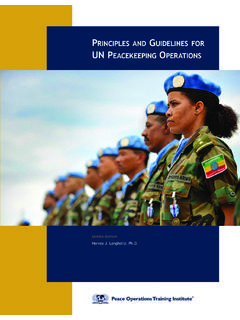
1 Peace Operations Tr aining Institute Security for Peace oPerationS Per SonnelCOURSE AUTHORM arshall Wm. Conley, EDITORH arvey J. Langholtz, AUTHORM arshall Wm. Conley, SERIES EDITORH arvey J. Langholtz, Operations Tr aining Institute Security for Peace oPerationS Per Sonnel 2014 Peace Operations Training Institute. All rights Operations Training Institute1309 Jamestown Road, Suite 202 Williamsburg, VA 23185 edition: February 2014 Cover: UN Photo #511095 by Neeraj SinghThe material contained herein does not necessarily reflect the views of the Peace Operations Training Institute (POTI), the COURSE AUTHOR (s), or any United Nations organs or affiliated organizations. The Peace Operations Training Institute is an international not-for-profit NGO registered as a 501(c)(3) with the Internal Revenue Service of the United States of America. The Peace Operations Training Institute is a separate legal entity from the United Nations.
2 Although every effort has been made to verify the contents of this COURSE , the Peace Operations Training Institute and the COURSE AUTHOR (s) disclaim any and all responsibility for facts and opinions contained in the text, which have been assimilated largely from open media and other independent sources. This COURSE was written to be a pedagogical and teaching document, consistent with existing UN policy and doctrine, but this COURSE does not establish or promulgate doctrine. Only officially vetted and approved UN documents may establish or promulgate UN policy or doctrine. Information with diametrically opposing views is sometimes provided on given topics, in order to stimulate scholarly interest, and is in keeping with the norms of pure and free academic for Peace oPerationS Per SonnelLESSON 1: THE UNITED NATIONS SECURITY SYSTEM .. The United Nations Security System .. Agencies Related to UN Security .. The Department of Peacekeeping Operations (DPKO).
3 16 LESSON 2: UNITED NATIONS SECURITY MECHANISMS .. What is in Place? .. What are the Gaps? .. Warden System ..34 LESSON 3: MISSION TYPES .. Roles of Civilians, Military, and Police .. Motivation for Peacekeeping Intervention .. UN Mandates ..47 LESSON 4: THREAT ASSESSMENT ANALYSIS .. Risk Assessment .. Problem Solving .. Critical Thinking ..68 LESSON 5: PHYSICAL SECURITY ISSUES .. Basic Security Issues .. Personal Security ..79 FOREWORD ..viiiMETHOD OF STUDY .. Awareness .. Abductions, Roadblock, and Ambush ..89 LESSON 6: SKILLS .. Communications .. Basic Negotiations .. Hostage Survival .. Cultural Awareness ..113 LESSON 7: HOME AND WORKPLACE .. Residential Security .. Workplace Security ..126 Annex A: Residential & Workplace Security ..132 LESSON 8: CROSS-CUTTING ISSUES .. Gender .. Children and Youth .. DDR .. Participants in the Peace Process ..157 LESSON 9: RESPONSE ACTIONS IN CRISIS.
4 Crisis Management/Response .. Natural Disasters .. Mass Casualty Disasters .. Protests and Public Demonstrations ..174 LESSON 10: MEDICAL ISSUES .. Stress .. First Aid .. First Response ..196 LESSON 11: DOCUMENT AND INFORMATION SECURITY .. Procedures for Handling Classified and Sensitive Information .. Definition of Classified Information .. Defining Access Levels for Classified Information .. Information Systems Management Security Component .. Internet Security Passwords and Viruses ..213 LESSON 12: GUARDING AGAINST SUICIDE BOMBERS .. Knowledge of Terrorism Philosophy and Motivation .. Methods and Types of Terrorist Attacks .. Awareness of Improvised Explosive Devices .. Secure Establishment Layout .. Protecting UN Establishments ..230 APPENDIX A: TABLE OF ACRONYMS ..234 APPENDIX B: LIST OF UN PEACEKEEPING OPERATIONS ..238 END-OF- COURSE EXAM INSTRUCTIONS ..241 ABOUT THE AUTHOR ..242viii | PEACE OPERATIONS TRAINING INSTITUTEF orewordTo view a video introduction of this COURSE by the COURSE AUTHOR , Dr.
5 Marshall Wm. Conley, you can either log in to your virtual classroom, go to , or use your mobile device to scan the QR code to the more than 116,000 people deployed in 15 missions worldwide, the need for UN peacekeeping continues to rank high. New studies of UN Peacekeeping Operations suggest a rising demand for peacekeeping forces to counter growing political and security instability internationally, from conflicts rooted in threats like environmental changes, economic shock, and transnational crime. Today, the nature of peacekeeping operations is varied and complex, requiring far more sophisticated training for all personnel. Many more countries contribute to these operations, with uniformed personnel from 114 Member States currently. Planning and organization is not only more complex but also difficult with such a multicultural and multilingual Security and protection issues for UN peacekeeping personnel have changed dramatically since the first armed peacekeeping operation was deployed to the Suez crisis in Even prior to this, in 1948, when the United Nations Truce Supervision Organization (UNTSO) was created, fatalities were limited (a total of 50 at UNSTO and 2970 for all missions between 1948 and 2011).
6 3 Almost 70 per cent of fatalities since 1948 can be attributed to accidents or COURSE deals with all forms of security that affect the peacekeeper. An examination of the table of contents indicates that we will cover a wide variety of issues that peacekeepers whether military, police, or civilian will face during their time on mission. Being able to undertake a proper risk assessment analysis will assist in critical thinking and problem solving and may save your life. Understanding security issues at home and in the workplace will allow you to avoid the various pitfalls that many suffer because they were inattentive. Developing a set of skills from communications to being culturally aware will assist you in the performance of your role as a peacekeeper. Too often peacekeepers get into difficult circumstances because they did not adequately develop an appropriate set of skills before and during their peacekeeping missions are fundamentally different than those prior to 1990.
7 Traditional notions of peacekeeping have been supplanted by aspects of post-conflict reconstruction and peacebuilding related to improving security conditions in the country of the mission. Coupled with this is the United Nations vital role of protecting women and children as part of its mandated task of protecting civilians. As we have seen in a number of recent peacekeeping missions a new element is receiving important attention. We now see that sexual violence challenges conventional notions of what constitutes a security threat. 5 This COURSE does not replace either Basic Security in the Field (BSIF II) or Advanced Security in the Field (ASIF). Basic Security in the Field II is required by all UN staff. Advanced Security in the Field is required to be taken by all United Nations personnel assigned to or travelling to a location that is in Security Phase I or above. Please see Lesson 2 for an examination of the new security level system.
8 For those of you going on your first Mission, it is important to identify and meet with your Security Officer as soon as you arrive. Marshall Wm. Conley, November 20131 See UN Emergency Force (UNEF 1), 19563 For more information: < >.4 See the statistics at 5 An Analytical Inventory of Peacekeeping Practice (United Nations, New York, June 2010), p. 14 SECURITY FOR PEACE OPERATIONS PERSONNEL | ixMethod of StudyThe following are suggestions for how to proceed with this COURSE . Though the student may have alternate approaches that are effective, the following hints have worked for many. Before you begin actual studies, first browse through the overall COURSE material. Notice the lesson outlines, which give you an idea of what will be involved as you proceed. The material should be logical and straightforward. Instead of memorizing individual details, strive to understand concepts and overall perspectives in regard to the United Nations system.
9 Set up guidelines regarding how you want to schedule your time. Study the lesson content and the learning objectives. At the beginning of each lesson, orient yourself to the main points. If you are able to, read the material twice to ensure maximum understanding and retention, and let time elapse between readings. When you finish a lesson, take the End-of-Lesson Quiz. For any error, go back to the lesson section and re-read it. Before you go on, be aware of the discrepancy in your understanding that led to the error. After you complete all of the lessons, take time to review the main points of each lesson. Then, while the material is fresh in your mind, take the End-of- COURSE Examination in one sitting. Your exam will be scored, and if you acheive a passing grade of 75 per cent or higher, you will be awarded a Certificate of Completion. If you score below 75 per cent, you will be given one opportunity to take a second version of the End-of- COURSE Examination.
10 One note about spelling is in order. This COURSE was written in English as it is used in the United features of your COURSE classroom: Access to all of your courses; A secure testing environment in which to complete your training; Access to additional training resources, including Multimedia COURSE supplements; The ability to download your Certificate of Completion for any completed COURSE ; and Student fora where you can communicate with other students about any number of your COURSE classroom here: 1 THE UNITED NATIONS SECURITY The United Nations Security Agencies Related to UN The Department of Peacekeeping OperationsLESSON OBJECTIVESBy the end of Lesson 1, the student should be able to meet the following objectives: Explain the main bodies involved in United Nations peacekeeping; List the types of peace and security activities used by the UN Security Council; Explain the differences and change in types of peacekeeping operations.