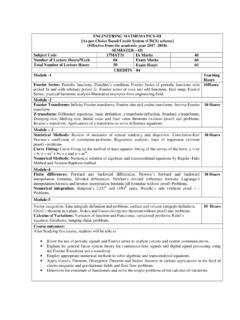
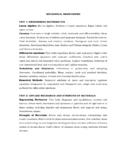
Transcription of Course Objectives: Module-1 - VTU
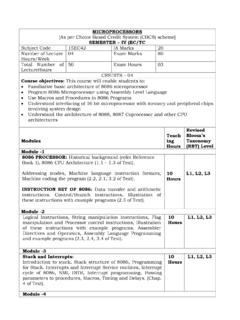
1 ELECTRICAL AND ELECTRONICS ENGINEERING (EEE) CHOICE BASED CREDIT SYSTEM (CBCS) SEMESTER - IV ENGINEERING MATHEMATICS IV (Core Subject) Subject Code 15 MAT41 IA Marks 20 Number of Lecture Hours/Week 04 Exam Hours 03 Total Number of Lecture Hours 50 Exam Marks 80 Credits - 04 Course objectives : Module-1 Teaching Hours 10 Revised Bloom s Taxonomy Level module -2 10 Revised Bloom s Taxonomy Level module -3 10 Revised Bloom s Taxonomy Level IVEEE (2015 -16) - 2 15 MAT41 ENGINEERING MATHEMATICS IV (Core Subject) CHOICE BASED CREDIT SYSTEM (CBCS)
2 module -4 Teaching Hours 10 Revised Bloom s Taxonomy Level module -5 10 Revised Bloom s Taxonomy Level Course outcomes: Graduate Attributes (As per NBA) Question paper pattern: Text/Reference Books: 1 Title Authors Publisher Edition Year 2 3 4 5 IVEEE (2015 -16) - 3 ELECTRICAL AND ELECTRONICS ENGINEERING (EEE) CHOICE BASED CREDIT SYSTEM (CBCS) SEMESTER - III POWER GENERATION AND ECONOMICS (Core Subject) Subject Code 15EE42 IA Marks 20 Number of Lecture Hours/Week 04 Exam Hours 03 Total Number of Lecture Hours 50 Exam Marks 80 Credits - 04 Course objectives .
3 Explain the arrangement and operation of hydroelectric, steam, diesel, gas turbine and nuclear power plants and working of major equipment in the plants. Classification of substation and explain the operation of different substation equipment. Explain the importance of grounding and different grounding methods used in practice. Explain the economics of power generation and importance of power factor. Module-1 Teaching Hours Hydroelectric Power Plants: Hydrology, Run off and stream flow, Hydrograph, Flow duration curve, Mass curve, Reservoir capacity, Dam storage.
4 Hydrological cycle, Merits and demerits of hydroelectric power plants, Selection of site. General arrangement of hydel plant, Elements of the plant, Classification of the plants based on water flow regulation, Water head and type of load the plant has to supply. Water turbines Pelton wheel, Francis, Kaplan and propeller turbines. Characteristic of water turbines Governing of turbines, Selection of water turbines. Underground, Small hydro and pumped storage plants. Choice of size and number of units, Plant layout and auxiliaries.
5 10 Revised Bloom s Taxonomy Level L1 Remembering, L2 Understanding. module -2 Steam Power Plants: Introduction, Efficiency of steam plants, Merits and demerits of plants, Selection of site. Working of steam plant, Power plant equipment and layout, Steam turbines, Fuels and fuel handling, Fuel combustion and combustion equipment, Coal burners, Fluidized bed combustion, Combustion control, Ash handling, Dust collection, Draught systems, Feed water, Steam power plant controls, Plant auxiliaries. Diesel Power Plant: Introduction, Merits and demerits, Selection site, Elements of diesel power plant, Applications.
6 Gas Turbine Power Plant: Introduction, Merits and demerits, Selection site, Fuels for gas turbines, Elements of simple gas turbine power plant, Methods of improving thermal efficiency of a simple steam power plant, Closed cycle gas turbine power plants. Comparison of gas power plant with steam and diesel power plants. 10 Revised Bloom s Taxonomy Level L1 Remembering, L2 Understanding. module -3 Nuclear Power Plants: Introduction, Economics of nuclear plants, Merits and demerits, selection of site, Nuclear reaction, Nuclear fission process, Nuclear chain reaction, Nuclear energy, Nuclear fuels, Nuclear plant and layout, Nuclear reactor and its control, Classification of reactors, Power reactors in use, Effects of nuclear plants, Disposal of nuclear waste and effluent, Shielding.
7 10 Revised Bloom s Taxonomy Level L1 Remembering, L2 Understanding. IVEEE (2015 -16) - 4 15EE42 POWER GENERATION AND ECONOMICS (Core Subject) (continued) CHOICE BASED CREDIT SYSTEM (CBCS) module -4 Teaching Hours Substations: Introduction to Substation equipment; Transformers, High Voltage Fuses, High Voltage Circuit Breakers and Protective Relaying, High Voltage Disconnect Switches, Lightning Arresters, High Voltage Insulators and Conductors, Voltage Regulators, Storage Batteries, Reactors, Capacitors, Measuring Instruments and power line carrier communication equipment.
8 Classification of substations indoor and outdoor, Selection of site for substation, Busbar arrangement schemes and single line diagrams of substations. Interconnection of power stations. Introduction to gas insulated substation, Advantages and economics of Gas insulated substation. Grounding: Introduction, Difference between grounded and ungrounded system. System grounding ungrounded, Solid grounding, Resistance grounding, Reactance grounding and resonant grounding. Earthing transformer. Neutral grounding and neutral grounding transformer.
9 10 Revised Bloom s Taxonomy Level L1 Remembering, L2 Understanding. module -5 Economics: Introduction, Effect of variable load on power system, classification of costs, Cost analysis. Interest and Depreciation, Methods of determination of depreciation, Economics of Power generation, different terms considered for power plants and their significance, load sharing. Choice of size and number of generating plants. Tariffs, objective, factors affecting the tariff, types. Types of consumers and their tariff.
10 Power factor, Disadvantages and causes of low power factor, Methods of improving power factor, Economics of power factor improvement and comparison of methods of improving the power factor. Choice of equipment. 10 Revised Bloom s Taxonomy Level L1 Remembering, L2 Understanding, L3 Applying, L4 Analysing. Course outcomes: At the end of the Course the student will be able to: Describe the working of hydroelectric, steam, nuclear power plants and state functions of major equipment of the power plants Classify various substations and explain the importance of grounding.