Transcription of Course Syllabus: Child Growth and Development
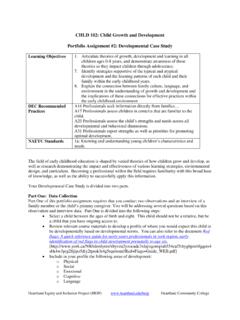
1 Course Syllabus: Child Growth and DevelopmentCourse Prefix and Number: CHLD 102 Course Title: Child Growth and DevelopmentCredit Hours: 3 Lecture Hours: 3 Laboratory Hours: 0 Course Description: This Course provides an overview of the theory and principles of human Growth and Development from conception through adolescence. Content includes an in-depth study of the inter-relatedness of physical, cognitive, social and emotional aspects of Development . Development is studied in the context of family, gender, culture, language, ability, socioeconomics, diversity, and society. Special emphasis will be on the theories of Piaget, Vygotsky, Erikson, and Gardner. Four field observations are required outside of class time in addition to at least two during class and Research in Child of and Toddlerhood: The First Two Childhood: Two to Six Childhood: Six to Eleven YearsRelationship to Academic Development Programs and Transfer:CHLD 102 fulfills 3 semester hours of elective credit for the and degrees.
2 It should transfer to most colleges and universities as an elective Course . However, since this Course is not part of either the General Education Core Curriculum or a baccalaureate major program described in the Illinois Articulation Initiative, students should check with an academic advisor for information about its transferability to other institutions. This Course is a part of the Illinois Gateways Infant and Toddler and ECE Textbook(s): Berk, L. (2012). Infants, children and adolescents (7th ed.). Boston, MA: Allyn & Bacon Suggested Resources:Centers for Disease Control and Prevention. (2012). Developmental Milestones. Available from Equity and Inclusion Project (HEIP) Funded by OSEP Heartland Community CollegeCenters for Disease Control and Prevention.
3 (2012). Fetal Alcohol Spectrum Disorders. Available from: , C., & Bredekamp, S. (Eds.). (2009). Developmentally appropriate practice in early childhood programs serving children from birth through age 8. Washington, DC: National Association for the Education of Young Children. Available from Family (2008). Gathering Your Family Stories. Available from , (2008). Challenging Common Myths about Young English Language Learners. Foundation for Child Development Policy Brief 8. Available from: Equity and Inclusion Project (HEIP). (2012). Family Story: NF Video. Available from Center. ( ). Star Legacy Modules. Teaching English Language Learners: Effective Instructional Practices. Available from , B. (2008). The changing face of the United States: The influence of culture on early childhood Development .
4 Washington, DC: ZERO TO THREE. Available from , B., Hallam, R., Turnbull, A., Buysse, V., & Winton, P., (2010). CONNECT Module 2: Transition. Chapel Hill: University of North Carolina, FPG Child Development Institute, CONNECT: The Center to Mobilize Early Childhood Knowledge. Available from Information and Education Council of the United States (SIECUS) Public Policy Office. (2007). On Our Side: Public Support for Comprehensive Sexuality Education. Available from Sexuality Information and Education Council of the United States (SIECUS), National Guidelines Task Force. (2004). Guidelines for Comprehensive Sexuality Education, 3rd ed. Available from Equity and Inclusion Project (HEIP) Funded by OSEP Heartland Community CollegeYork Region Red Flags Task Group.
5 (2011). Red flags: A quick reference guide for early years professionals in york region, early identification of red flags in Child Development prenatally to age six. Ontario, Canada: York Region. Available from +flags+ Learning Outcomes: Upon completion of this Course , the student will be able to: theories of Growth , Development and learning in all children ages 0-8 years, and demonstrate awareness of these theories as they impact children through the inter-relatedness of developmental areas and milestones: physical/motor, social/emotional, language/cognitive, adaptive/living skills, and how developmental needs influence the relationship between biology, maturation, environment, and culture in terms of their impact on typical and atypical Growth , Development .
6 And the impact of early experiences--including the spectrum of Child and family diversity--on healthy Development and the characteristics of potential developmental delays and disabilities and the procedures for appropriate screening and the characteristics and processes of first and second language acquisition of young children including those from linguistically and culturally diverse strategies supportive of the typical and atypical Development and the learning patterns of each Child and their family within the early childhood the connection between self and family culture, language, and environment in the understanding of Growth and Development and the implications of these connections for effective evidence-based practices within the early childhood of Evaluation (Tests/Exams, Grading System):Each instructor will use a combination of evaluation methods to determine the grade of each student.
7 They may use a variety of forms of assessment methods including exams, application activities, and discussion / class 20% - 60%Activities 20% - 60%Discussion / Participation 5% - 25%Grading Scale: 90-100% A 80-89% B 70-79% C 60-69% D Below 60% FHeartland Equity and Inclusion Project (HEIP) Funded by OSEP Heartland Community Colleg