Transcription of COVID-19
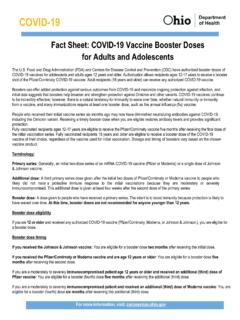
1 COVID-19 . COVID-19 Vaccine Program Guidance for Vaccine Providers for Administering Booster Doses The Food and Drug Administration (FDA) and Centers for Disease Control and Prevention (CDC) have authorized a single COVID-19 booster dose for people age 12 and older. Booster doses strengthen protection against serious outcomes from COVID-19 and/or against COVID-19 infection. Eligibility, dosage, and timing of booster shots vary by COVID-19 vaccine product. Please read eligibility information by product in the guidance below. Fully vaccinated individuals ages 12-17 are now eligible to receive a booster dose of the Pfizer vaccine, as it is the only COVID-19 vaccine authorized for people younger than 18 years, at least five months after the last dose. Fully vaccinated individuals 18 years old and older are eligible to receive a booster dose of the COVID-19 vaccine of their choice (Pfizer/Comirnaty, Moderna, or Johnson & Johnson).
2 O Johnson & Johnson vaccine recipients can receive a booster two months following their original dose. o Pfizer vaccine recipients can receive a booster five months following their last dose. o Moderna vaccine recipients can receive a booster six months following their last dose. o NOTE: The Centers for Disease Control and Prevention (CDC) has endorsed the COVID-19 mRNA vaccines developed by Pfizer and Moderna over the Johnson & Johnson vaccine. The recommendation followed a thorough review of the latest evidence on vaccine effectiveness and safety. Most patients should now consider an mRNA primary vaccine series or booster dose due to the remarkable safety and efficacy of these vaccines. It's important to note the top priority for vaccine providers remains continued vaccination of unvaccinated individuals to protect against severe illness and death from COVID-19 .
3 PROOF OF ELIGIBILITY. BOOSTER DOSE ELIGIBILITY REQUIREMENTS. Fully vaccinated people who are 12 years old and older are eligible for a booster dose. Children ages 11 years and younger are not eligible to receive a booster dose at this time; however, children ages 5-11 years who have a moderate to severe immunocompromising condition are eligible to receive an additional/third dose of the Pfizer vaccine at least four weeks after their second dose to strengthen protection. The timing of booster doses varies by vaccine product (see below). Pfizer-BioNTech/Comirnaty Eligibility: If an individual received the Pfizer/Comirnaty vaccine for the primary series, booster doses can be given to fully vaccinated people age 12 years and older at least five months after the last dose. Dosage: The Pfizer/Comirnaty booster dose is the same dosage given for the primary series.
4 Mix-and-match booster: People ages 12-17 years who received the Pfizer vaccine may get a booster dose of only the Pfizer 1|P a g e vaccine, as it is the only COVID-19 vaccine available for people younger than 18. People age 18 or older who received the Pfizer vaccine may receive a single booster dose of the vaccine product of their choosing at least five months after the last primary dose administered. It does not have to match the primary series. An mRNA COVID-19 vaccine is preferred over the Johnson & Johnson/Janssen COVID-19 vaccine for booster vaccination. However, recipients of an mRNA vaccine primary series age 18 years and older who are unable to receive an mRNA booster dose can be offered a Johnson & Johnson/Janssen vaccine booster dose, after discussion of the benefits and risks. Booster doses for people who are immunocompromised: Pfizer vaccine recipients 5 years and older who are moderately to severely immunocompromised can receive a third dose for the primary vaccine series at least 28 days following the second dose.
5 Those 12 years and older also are eligible for a single COVID-19 booster dose (Pfizer/Comirnaty, Moderna or Janssen) at least five months after completing the third mRNA vaccine dose. More info: Pfizer-BioNTech COVID-19 Vaccine Fact Sheet for Healthcare Providers (must dilute purple cap formulation for 12+);. NEW - Pfizer BioNTech COVID-19 Vaccine Face Sheet for Healthcare Providers (no dilution gray cap formulation for 12+ now available for orders). Moderna Eligibility: If an individual received the Moderna vaccine for the primary series, booster doses can be given to fully vaccinated people age 18 years and older at least six months after the last dose. Dosage: The Moderna booster dose is NOT the same dosage given for the primary series ( mL). The booster dose is a half- dose ( mL). Moderna booster doses will not be packaged or distributed separately.
6 Primary series doses ( mL) or booster doses ( mL) may be extracted from a vial, preferentially using low dead- volume syringes and/or needles. When extracting only primary series doses, depending on the syringes and needles used, a maximum of 11 doses (range: 10-11 doses) may be extracted from the vial containing mL or a maximum of 15 doses (range: 13-15. doses) may be extracted from the vial containing mL. When extracting only booster doses or a combination of primary series and booster doses, the maximum number of doses that may be extracted from either vial presentation should not exceed 20 doses. Do not puncture the vial stopper more than 20 times. If the amount of vaccine remaining in the vial cannot provide a full dose of mL or mL, discard the vial and contents. Do not pool excess vaccine from multiple vials.
7 Ancillary kits will be doubled to ensure adequate supply. Mix-and-match booster: Recipients of the Moderna primary series should receive a single booster dose at least six months after the last dose administered. The booster dose does not have to match the primary series, and can be the vaccine product of the vaccine recipient's choosing. An mRNA COVID-19 vaccine is preferred over the Johnson & Johnson/Janssen COVID-19 . vaccine for booster vaccination. However, recipients of an mRNA vaccine primary series aged 18 years and older who are unable to receive an mRNA booster dose can be offered a Johnson & Johnson/Janssen vaccine booster dose at least six months later, after discussion of the benefits and risks. Booster doses for people who are immunocompromised: Moderna vaccine recipients who are moderately to severely immunocompromised can add a third dose to their primary vaccine series at least 28 days following the second dose.
8 These individuals also will be eligible for a single COVID-19 booster dose (Pfizer/Comirnaty, Moderna, or Johnson &. Johnson/Janssen) at least six months after completing their third mRNA vaccine dose. More info: Moderna COVID-19 Vaccine Fact Sheet for Healthcare Providers Johnson & Johnson/Janssen Booster doses are authorized for all recipients of the single-dose Johnson & Johnson/Janssen COVID-19 vaccine. Anyone age 18 years or older who received a Johnson & Johnson vaccine can get a booster dose at least two months following the 2|P a g e initial dose. Dosage: The Johnson & Johnson booster dose is the same formulation and dosage given for the first dose. Mix-and-match booster: Recipients of the single-dose Janssen COVID-19 vaccine for primary vaccination should receive a single COVID-19 vaccine booster dose at least two months after the primary dose.
9 The booster dose does not have to match the primary series, and can be the vaccine product of the vaccine recipient's choosing. An mRNA COVID-19 vaccine is now preferred over the Janssen COVID-19 vaccine for booster vaccination, according to updated CDC guidance. Those who are unable to receive an mRNA booster dose can be offered a Janssen vaccine booster, after discussion of the benefits and risks. More info: Johnson & Johnson/Janssen COVID-19 Vaccine Fact Sheet for Healthcare Providers IDENTIFICATION REQUIREMENTS. Providers should ask to see identification that proves name, age, and identity. o Ask for identification to verify only the patient's identity, name, and age. Patients do not need to show proof of citizenship or residency status. Identification should still be accepted if it is expired or from another state or country.
10 O Acceptable forms of identification are listed below: Driver's license or any photo ID, regardless of expiration date or place of origin. Active/retired military ID. Physician statement (including shot records). Census records. Adoption records. Naturalization certificate. Birth certificate: Birth record, either original or certified copy. Consulate ID or matricula consular. Passport or a passport card. Certificate of citizenship. Permanent resident card. Application for replacement naturalization/citizenship document. Department of State forms. Military service records (DD-214). Certification of Birth Abroad of a Citizen of the United States (FS-545). Certification of Report of Birth Abroad of a United States Citizen (DS-1350). Consular Report of Birth Abroad of a Citizen of the United States of America (FS-240).