Transcription of Crafting and Executing Strategy - GBV
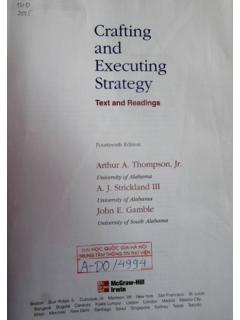
1 Arthur A. Thompson, of Alabama1. J. mmmm mUniversity of AlabamaUniversity of South AlabamaCrafting andExecuting StrategyThe Quest forCompetitiveAdvantageConcepts and Cases17TH EDITIONMcGraw-HillIrwinBoston Burr Ridge, IL Dubuque, IA New York San Francisco St. LouisBangkok Bogota Caracas Kuala Lumpur Lisbon London Madrid Mexico CityMilan Montreal New Delhi Santiago Seoul Singapore Sydney Taipei TorontoIrfbfl (fPart One Concepts and Techniques for Crafting andExecuting Strategy 3 Section A: Introduction and Overview1.)
2 What Is Strategy and Why Is It Important? 4 What Do We Mean by Strategy ? 6 Strategy and the Quest for Competitive Advantage 7 Identifying a Company s Strategy 10 Why a Company's Strategy Evolves over Time 11A Company s Strategy Is Partly Proactive and Partly Reactive 11 Strategy and Ethics: Passing the Test of Moral Scrutiny 13 The Relationship between a Company's Strategy and Its Business Model 14 What Makes a Strategy a Winner? 15 Why Are Crafting and Executing Strategy Important? 17 Good Strategy + Good Strategy Execution = Good Management 17 Illustration Starbucks' Strategy in the Specialty Coffee Industry Microsoft and Red Hat: Two Contrasting Business Models 162.
3 Leading the Process of Crafting andExecuting Strategy 22 What Does the Strategy -Making, Strategy - Executing Process Entail? 24 Phase 1: Developing a Strategic Vision 24 How a Strategic Vision Differs from a Mission Statement 28 Linking the Vision/Mission with Company Values 29 Communicating the Strategic Vision 30 Phase 2: Setting Objectives 33 The Imperative of Setting Stretch Objectives 33 What Kinds of Objectives to Set The Need for a Balanced Scorecard 33 Phase 3: Crafting a Strategy 37 Strategy Making Involves Managers at All Organizational Levels 37A Company's Strategy -Making Hierarchy 38A Strategic Vision + Objectives + Strategy = A Strategic Plan 41xxxivTable of ContentsPhase 4: Implementing and Executing the Strategy 41 Phase 5.
4 Evaluating Performance and Initiating Corrective Adjustments 43 Leading the Strategic Management Process 43 Staying on Top of How Well Things Are Going 44 Making Sure a Company Has a Good Strategic Plan 45 Putting Constructive Pressure on Organizational Units to AchieveGood Results and Operating Excellence 4 7 Pushing Corrective Actions to Improve Both the Company's Strategyand How Well It Is Being Executed 4 7 Leading the Development of Better Competencies and Capabilities 48 Displaying Ethical Integrity and Undertaking Social Responsibility Initiatives 48 Corporate Governance: The Role of the Board of Directors in the Strategy -Making, Strategy - Executing Process 49 Illustration Examples of Strategic Visions How Well Do They Measure Up?
5 Yahoo's Core Values Examples of Company Objectives 35 Section B: Core Concepts and Analytical Tools3. Evaluating a Company's External Environment 54 The Strategically Relevant Components of a Company's ExternalEnvironment 56 Thinking Strategically about a Company's Industry and CompetitiveEnvironment 58 /Question 1: What Are the Industry's Dominant Economic Features? 58 Question 2: How Strong Are Competitive Forces? 60 Competitive Pressures Created by the Rivalry among Competing Sellers 61 Competitive Pressures Associated with the Threat of New Entrants 66 Competitive Pressures from the Sellers of Substitute Products 69 Competitive Pressures Stemming from Supplier Bargaining Powerand Supplier-Seller Collaboration 70 Competitive Pressures Stemming from Buyer Bargaining Powerand Seller Buyer Collaboration 74Is the Collective Strength of the Five Competitive Forces Conduciveto Profitability?
6 78 Question 3: What Factors Are Driving Industry Change and What ImpactsWill They Have? 79 The Concept of Driving Forces 79 Identifying an Industry s Driving Forces 80 Assessing the Impact of the Driving Forces 85 Making Strategy Adjustments to Take the Impact of the Driving Forces intoAccount 85 Table of ContentsQuestion 4: What Market Positions Do Rivals Occupy Who Is StronglyPositioned and Who Is Not? 86 Using Strategic Group Maps to Assess the Market Positionsof Key Competitors 86 What Can Be Learned from Strategic Group Maps? 87 Question 5: What Strategic Moves Are Rivals Likely to Make Next?
7 89 Identifying Competitors' Strategies and Resource Strengthsand Weaknesses 90 Predicting Rivals'Next Moves 91 Question 6: What Are the Key Factors for Future CompetitiveSuccess? 92 Question 7: Does the Outlook for the Industry Offer the Companya Good Opportunity to Earn Attractive Profits? 94 Illustration Comparative Market Positions of Selected Automobile Manufacturers:A Strategic Group Map Application 884. Evaluating a Company's Resources and CompetitivePosition 100 Question 1: How Well Is the Company's Present Strategy Working? 102 Question 2: What Are the Company's Resource Strengths and Weaknesses,and Its External Opportunities and Threats?
8 106 Identifying Company Resource Strengths, Competencies, and CompetitiveCapabilities 106 Identifying Company Resource Weaknesses, Missing Capabilities, and CompetitiveDeficiencies HIIdentifying a Company s External Market Opportunities 111 Identifying the External Threats to Profitability 113 What Can Be Learned from a SWOT Analysis? 113 Question 3: Are the Company's Prices and Costs Competitive? 116 The Concept of a Company Value Chain 116 Why the Value Chains of Rival Companies Often Differ 117 The Value Chain System for an Entire Industry 119 Activity-Based Cost Accounting: A Tool for Determining the Costs of ValueChain Activities 121 Benchmarking: A Tool for Assessing Whether a Company's Value ChainActivities Are Competitive 122 Strategic Options for Remedying a Cost Disadvantage 124 Translating Proficient Performance of Value Chain Activities intoCompetitive Advantage 126 Question 4.
9 Is the Company Competitively Stronger or Weaker ThanKey Rivals? 128 Interpreting the Competitive Strength Assessments 130 Table of ContentsQuestion 5: What Strategic Issues and Problems Merit Front-BurnerManagerial Attention? 131illustration Estimated Value Chain Costs for Recording and Distributing Music CDsthrough Traditional Music Retailers Benchmarking and Ethical Conduct 124 Section C: Crafting a Strategy5. The Five Generic Competitive Strategies:Which One to Employ? 138 The Five Generic Competitive Strategies 140 Low-Cost Provider Strategies 140 The Two Major Avenues for Achieving a Cost Advantage 141 The Keys to Success in Achieving Low-Cost Leadership 147 When a Low-Cost Provider Strategy Works Best 148 The Pitfalls of a Low-Cost Provider Strategy 148 Broad Differentiation Strategies 149 Types of Differentiation Themes 149 Where along the Value Chain to Create the Differentiating Attributes 150 The Four Best Routes to Competitive Advantage via a Broad DifferentiationStrategy
10 151 The Importance of Perceived Value and Signaling Value 152 When a Differentiation Strategy Works Best 152 The Pitfalls of a Differentiation Strategy 153 Best-Cost Provider Strategies 154 When a Best-Cost Provider Strategy Is Appealing 155 The Big Risk of a Best-Cost Provider Strategy 155 Focused (or Market Niche) Strategies 156A Focused Low-Cost Strategy 157A Focused Differentiation Strategy 157 When a Focused Low-Cost or Focused Differentiation StrategyIs Attractive 158 The Risks of a Focused Low-Cost or Focused Differentiation Strategy 159 The Contrasting Features of the Five Generic Competitive Strategies.