Transcription of CREDIT ACCUMULATION, GRADE POINT AVERAGE AND …
1 1 THE UNIVERSITY OF ZAMBIA QUALITY ASSURANCE DIRECTORATE CREDIT ACCUMULATION, GRADE POINT AVERAGE AND DEGREE CLASSIFICATION 1. CREDIT ACCUMULATION A course CREDIT (CC) is a numerical value that represents the estimated time needed for a learner to achieve required specific learning outcomes of a course. One CREDIT is equivalent to 10 notional hours of study (including lectures, seminars, tutorials, assignments, practical training and independent study). For example, a half course of 150 notional hours is worth 15 course credits while and a full course of 300 notional hours is worth 30 course credits. A full academic year is generally worth 120 credits. Note that courses may have different credits from the two examples given, depending on the course structure. Please refer to the publication Course Credits available from the Directorate of Quality Assurance for more details on course credits. CREDIT accumulation is used to monitor, record and reward passage through a programme of study at the University of Zambia.
2 A students who passes a course will earn the credits of that course. The total number of credits accumulated is the summation of all credits from the courses that the student has passed during their study at the University. A student who passes all courses in an academic year will accumulate about 120 credits in most programmes at the University. A typical four-year degree programme will have 480 credits; a typical five-year degree programme has 600 credits; etc., and generally students need to accumulate this minimum number of credits to be able to graduate from the programme. 2. GRADE POINT VALUES The GRADE POINT value (GPV) is used by the University to allocate points to various grades awarded after a course assessment. The GPV represents numerically a student's standard of performance. Repeated courses are do not count toward the earned points required for classification of degrees. Table 1 shows the typical GPVs for various grades awarded.
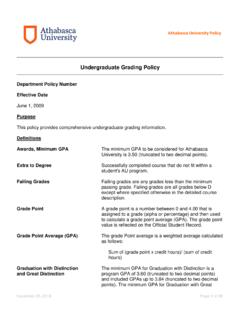
3 2 Table 1: GRADE POINT values for various grades TYPE GRADE GRADE - POINT VALUE (GPV) DESCRIPTION pass GRADES A+ Distinction A Distinction B+ Meritorious B CREDIT C+ CREDIT C pass S Satisfactory FAIL GRADES D+ Fail D Fail LT Fail (Left without permission) NE Fail (Not examined) TEMPORARY GRADES DF Deferred examination WP Left with permission) IN Incomplete assessment 3. GRADE POINT AVERAGE A GRADE POINT AVERAGE (GPA) is a number representing the AVERAGE value of the accumulated grades earned in courses in one academic year and over the full length of the programme of study. For a given study period, an academic year, a student s GPA is calculated using the following steps: (a) calculate the product of the course credits and the GRADE - POINT values earned in each course ( CCs x GPV); (b) obtain the sum of the products calculated in (a), ( (CCs x GPV); (c) calculate the maximum course credits that a student may accumulate in the study period under consideration (TCs); and (d) calculate the GPA by using the following formula: = ( ) GPA = GRADE - POINT AVERAGE CCs = Course credits for each course taken by the student GPV = GRADE - POINT value earned for course taken by the student TCs = Total course credits that may be accumulated over the study period by the student 3 4.
4 CLASSICATION OF UNDERGRADUATE DEGREES An undergraduate or bachelor's degree at the University of Zambia is classified on the basis of the overall GRADE POINT AVERAGE computed from all the courses taken by a student in a given programme of study. It should be noted that when a student passes a repeated course, the credits are earned and are added to the credits accumulated. However, the GRADE POINT value for a repeated course is equal to zero and therefore it does not contribute to the GPA and any classification of the qualification attained. Class boundaries approved by the University Senate are used for the purposes of the classification of bachelor s degrees and are given in Table 2. Table 2: Degree classes based on overall GRADE POINT averages Final GRADE POINT AVERAGE (GPA) Degree Class >= Distinction Merit - CREDIT < pass Typical computations of the GPA for each year of study (YOS) and the overall GPA used in degree classification are shown as a template in Figure 1.
5 The typical results transcript is shown in the template given in Figure 2. 4 Figure 1: Template for computation of year of study and overall GPA, and degree classification 5 Figure 2: Template for results transcript DR. EDWARD LUSAMBO DIRECTOR, QUALITY ASSURANCE