Transcription of CREOSOTE - New Jersey
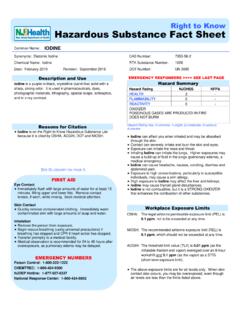
1 Common Name: CREOSOTE . CAS Number: 8001-58-9. DOT Number: NA 1993 RTK Substance number: 0517. DOT Hazard Class: 3 (Combustible liquid) Date: January 2001 Revision: February 2007. ---------------------------------------- --------------------------------- ---------------------------------------- --------------------------------- HAZARD SUMMARY. * CREOSOTE can affect you when breathed in and by passing * Exposure to hazardous substances should be routinely through your skin. evaluated. This may include collecting personal and area * CREOSOTE should be handled as a CARCINOGEN--WITH air samples. You can obtain copies of sampling results EXTREME CAUTION.
2 From your employer. You have a legal right to this * Skin contact can cause irritation, burning, redness, rash information under the OSHA Access to Employee and itching, which is made worse by exposure to sunlight. Exposure and Medical Records Standard (29 CFR. * Repeated exposure can cause changes in skin pigment. ). * Contact can cause severe eye irritation and burns and may * If you think you are experiencing any work-related health cause loss of vision. problems, see a doctor trained to recognize occupational * CREOSOTE may affect the nervous system. diseases. Take this Fact Sheet with you. * CONSULT THE NEW Jersey DEPARTMENT OF.
3 HEALTH AND SENIOR SERVICES HAZARDOUS WORKPLACE EXPOSURE LIMITS. SUBSTANCE FACT SHEETS ON COAL TAR PITCH, No occupational exposure limits have been established for COKE OVEN EMISSIONS, BENZO(a)PYRENE, CREOSOTE . This does not mean that this substance is not CHRYSENE AND ANTHRACENE FOR FUTHER harmful. Safe work practices should always be followed. INFORMATION. * CREOSOTE is a PROBABLE CARCINOGEN in humans. There may be no safe level of exposure to a carcinogen, so IDENTIFICATION. CREOSOTE is a yellowish to dark brown, oily liquid which is all contact should be reduced to the lowest possible level. produced from heating and separation of Coal Tar.
4 It is used * It should be recognized that CREOSOTE can be absorbed in construction (roofing), railroad and utilities industries, and through your skin, thereby increasing your exposure. for wood treatment and waterproofing. WAYS OF REDUCING EXPOSURE. REASON FOR CITATION * Enclose operations and use local exhaust ventilation at the * CREOSOTE is on the Hazardous Substance List because it is site of chemical release. If local exhaust ventilation or cited by DOT, DEP, IARC, IRIS, NFPA and EPA. enclosure is not used, respirators should be worn. * This chemical is on the Special Health Hazard Substance * A regulated, marked area should be established where List because it is a CARCINOGEN.
5 CREOSOTE is handled, used, or stored. * Definitions are provided on page 5. * Wear protective work clothing. * Wash thoroughly immediately after exposure to CREOSOTE and at the end of the workshift. HOW TO DETERMINE IF YOU ARE BEING. * Post hazard and warning information in the work area. In EXPOSED addition, as part of an ongoing education and training The New Jersey Right to Know Act requires most employers effort, communicate all information on the health and to label chemicals in the workplace and requires public safety hazards of CREOSOTE to potentially exposed workers. employers to provide their employees with information and training concerning chemical hazards and controls.
6 The federal OSHA Hazard Communication Standard (29 CFR. ) requires private employers to provide similar training and information to their employees. CREOSOTE page 2 of 6. This Fact Sheet is a summary source of information of all Request copies of your medical testing. You have a legal right potential and most severe health hazards that may result from to this information under the OSHA Access to Employee exposure. Duration of exposure, concentration of the substance Exposure and Medical Records Standard (29 CFR ). and other factors will affect your susceptibility to any of the potential effects described below. WORKPLACE CONTROLS AND PRACTICES.
7 ---------------------------------------- ---------------------------------- Unless a less toxic chemical can be substituted for a hazardous HEALTH HAZARD INFORMATION substance, ENGINEERING CONTROLS are the most effective way of reducing exposure. The best protection is to Acute Health Effects enclose operations and/or provide local exhaust ventilation at The following acute (short-term) health effects may occur the site of chemical release. Isolating operations can also immediately or shortly after exposure to CREOSOTE : reduce exposure. Using respirators or protective equipment is less effective than the controls mentioned above, but is * Skin contact can cause irritation, burning, redness, rash and sometimes necessary.
8 Itching, which is made worse by exposure to sunlight. * Contact can cause severe eye irritation and burns and may In evaluating the controls present in your workplace, consider: cause loss of vision. (1) how hazardous the substance is, (2) how much of the substance is released into the workplace and (3) whether harmful skin or eye contact could occur. Special controls Chronic Health Effects should be in place for highly toxic chemicals or when The following chronic (long-term) health effects can occur at significant skin, eye, or breathing exposures are possible. some time after exposure to CREOSOTE and can last for months or years: In addition, the following controls are recommended: Cancer Hazard * Where possible, automatically pump liquid CREOSOTE from * CREOSOTE is a PROBABLE CARCINOGEN in humans.
9 Drums or other storage containers to process containers. There is some evidence that it causes skin cancer in humans * If your exposure to CREOSOTE occurs from Coke Oven and it has been shown to cause skin cancer in animals. Emissions, refer to the OSHA Coke Oven Emissions * Many scientists believe there is no safe level of exposure to Standard (29 CFR ). a carcinogen. Such substances may also have the potential for causing reproductive damage in humans. Good WORK PRACTICES can help to reduce hazardous exposures. The following work practices are recommended: Reproductive Hazard * According to the information presently available to the New * Workers whose clothing has been contaminated by Jersey Department of Health and Senior Services, CREOSOTE CREOSOTE should change into clean clothing promptly.
10 Has not been tested for its ability to affect reproduction. * Contaminated work clothes should be laundered by individuals who have been informed of the hazards of Other Long-Term Effects exposure to CREOSOTE . * Repeated exposure can cause changes in skin pigment, * Eye wash fountains should be provided in the immediate usually to a gray-yellow or bronze color. work area for emergency use. * CREOSOTE may affect the nervous system. * If there is the possibility of skin exposure, emergency shower facilities should be provided. MEDICAL * On skin contact with CREOSOTE , immediately wash or shower to remove the chemical. At the end of the Medical Testing workshift, wash any areas of the body that may have If symptoms develop or overexposure is suspected, the contacted CREOSOTE , whether or not known skin contact has following are recommended: occurred.