Transcription of Crude overhead system design considerations - …
1 Crude overhead system design considerationsProper Crude unit overhead system design is important when building a new unit or revamping an existing one to process different crudes. overhead condenser designs should meet the specific processing objectives, such as distillate yield, run length and energy recovery Process flow schemes and equipment design play a major role in atmospheric Crude column and condenser system corrosion and fouling. There are two major types of overhead systems single- and two-drum but there are many different process flow schemes and several exchanger configurations.
2 Some overhead systems experience severe corrosion and fouling that increase the atmospheric column operating pressure, reduce the distillate yield or require exchanger bundle changes at intervals less than the normal four- to six-year turnarounds. Some Crude columns have to be shut down to remove salts deposited on the internals. Corrosion and foulingThe atmospheric Crude column and overhead system are exposed to a number of corrosive species, depending on the Crude type, slop oil processing and desalter operation.
3 Desalter operation is an integral part of overhead system corrosion and the two cannot be separated. Calcium and magnesium chloride salts hydrolyse in the atmospheric heater, creating HCl. When processing difficult-to-desalt crudes such as Venezuelan extra-heavy, diluted bitumen blends and conventional crudes such as Doba, salt content entering the heater can be high, with large amounts of HCl produced. The most common sources of corrosion and fouling are the presence of strong acid formed from the HCl in the condensers and salts deposited from the reaction of ammonia or amine neutraliser and HCl that leads to fouling and under-deposit corrosion.
4 Process operating conditions that influence corrosion and fouling include the Crude column overhead temperature, reflux temperature, overhead vapour water content, Crude temperature and water wash. Since the process flow scheme and equipment design determine the localised temperature and location of the initial water condensation on the exchanger tube wall or inside the column, corrosion and fouling cannot be separated from the process flow scheme and operating conditions.
5 Low Crude temperatures entering the Crude column overhead vapour exchanger reduce the tube wall temperatures below the water dewpoint, facilitating strong acid formation. Exchanger tube wall temperature is not measured; it must be calculated based on stream rates and properties as well as the exchanger design parameters. Crude oils that are difficult to desalt such as diluted bitumen are a processing challenge, because they pose corrosion and fouling problems in the Crude overhead system as well as the top of the Crude column.
6 In some cases, the Crude column fouling and corrosion can limit unit run length. Corrosion and fouling inside the atmospheric column are caused by low temperature reflux, in conjunction with the presence of HCl, NH3 and amines. When column internal fouling and corrosion are likely, two-drum overhead systems are needed to avoid low temperatures that cause localised (shock) water condensation inside the column. Water absorbs the HCl, NH3 and amines, and once the water vapourises as reflux flowing down the column heated salts are deposited.
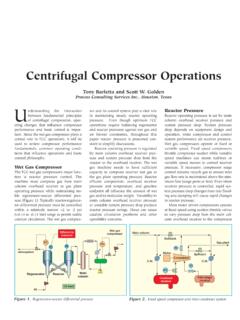
7 These salts will continue to accumulate, causing a higher pressure drop. Eventually, they must be removed or column capacity will degrade, requiring a shutdown. Online water washing and the injection of chemical dispersant are common methods used to remove the salts. Increasingly common is the presence of amine-based H2S scavengers that form very corrosive salts at the top of the column when the temperature drops below 275 F (135 C). design and operation of the condensing system are an integral part of managing the rate of Tony Barletta and Steve WhiteProcess Consulting PTQ Q3 2007 drum155110250290 Wet gasSourwaterTemperature, FNaphthaproductFigure 1 Single-drum systemfouling and corrosion at the top of the system exchanger designs are numerous.
8 Typically, horizontal exchangers are used with condensing on either the tube or shell side of the exchangers. Shell-side condensing is most common, even though the likelihood of fouling and corrosion increases because it is more difficult to effectively water wash or chemically treat the areas around the baffles, where low velocity prevents chemical or water wash from reaching the exchanger tubes. Salts and corrosion products deposit in these regions, facilitating under-deposit corrosion.
9 Tube-side condensing is increasingly preferred because it makes it easier to water wash and chemically treat. Vertical tube-side condensation has the benefit of being self-draining and it is relatively easy to distribute wash water and filming and neutralise chemicals to minimise fouling. Crude overhead systemsCrude column overhead systems condense naphtha product and column reflux, or a portion of it. Some of this heat is recoverable. Consequently, many overhead systems exchange part of the condensing heat with raw Crude .
10 overhead systems use either a single drum (Figure 1), where product and reflux are withdrawn at approximately 110 F (43 C), or two drums (Figure 2), where reflux is withdrawn from the first hot drum and product from the second cold drum. Often, these drums are referred to as reflux or hot and product or cold drums. The reflux drum operates as high as 280 F (138 C) with no water present, or as low as 190 F (88 C) with a water phase. Some systems force water condensation at the inlet of the condensing side of the exchanger to dilute the acid strength, thus avoiding corrosion.