Transcription of DATA SHEET ARUBA CX 6000 SWITCH SERIES
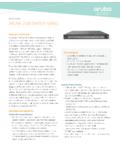
1 DATA SHEETPRODUCT OVERVIEWThe ARUBA CX 6000 SWITCH SERIES is modern family of entry level access switches ideal for branch offices, midsize businesses, and small enterprises. Optimized for reliable, simple and secure access, the CX 6000 SERIES provides a convenient and cost-effective wired access solution for networks supporting IoT, mobile, and cloud applications. The CX 6000 SERIES is based on the ARUBA ASIC architecture with the programmable AOS-CX operating system used across the entire ARUBA CX portfolio for a more consistent, more efficient operator experience. This fully managed SERIES has convenient built-in uplinks with up to 370W of PoE+ to support IoT devices such as security cameras and wireless APs. A compact and fanless model is ideal for use in quiet, small work CX 6000 SERIES is easy to deploy and use with flexible management choices that include Web GUI, CLI, cloud-based and on-premise ARUBA Central management, so you can choose the best fit for your business and network environment.
2 Delivering Layer 2 capabilities with enhanced access security, traffic prioritization, and IPv6 support, the CX 6000 also simplifies ownership and brings peace of mind with no SWITCH software licensing and a Limited Lifetime DIFFERENTIATORSAOS-CX - a modern software system The ARUBA CX 6000 SWITCH SERIES is based on AOS-CX, a modern, database-driven operating system that is built on a modular Linux architecture. With the CX 6000 SERIES , the benefits of the AOS-CX architecture is extended to small enterprise deployments providing the following unique capabilities: Easy access to all network configuration state information REST APIs for fine-grained programmability of network tasks ARUBA CX 6000 SWITCH SERIES A micro-services architecture that enables full integration with other workflow systems and services All software processes communicate with the database rather than each other, ensuring near real-time state and resiliency ARUBA ASICs - programmable innovation Based on over 30 years of continuous investment, ARUBA s ASICs create the basis for innovative and agile software feature advancements, unparalleled performance and deep visibility.
3 These programmable ASICs are purpose-built to allow for a tighter integration of SWITCH hardware and software within campus and data center architectures to optimize performance and capacity. The ARUBA CX 6000 is based on the ARUBA ASIC architecture. KEY FEATURES Enterprise-class Layer 2 connectivity with support for ACLs, robust QoS and static routing Convenient built-in 1 GbE uplinks and up to 370W of Class 4 PoE for support of IoT devices Compact and fanless 12 port model for quiet deployment Management flexibility with support for ARUBA Central1, easy-to-use Web GUI, CLI, and ARUBA NetEdit Simple deployment with Zero Touch Provisioning Software defined ready with REST APIs Simplify adds, moves and changes with colorless ports1 ARUBA Central support in future SHEET ARUBA CX 6000 SWITCH SERIES2 Access layer performanceThe ARUBA CX 6000 SWITCH SERIES uses internally developed ARUBA ASICs that provide very low latency, increased packet buffering, and adaptive power consumption.
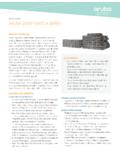
4 Each SWITCH includes the following: Up to 104 Gbps in non-blocking bandwidth and up to Mpps for forwarding Selectable queue configurations that allow for increased performance by defining a number of queues and associated memory buffering to best meet the requirements of network applications Management flexibilityInnovative design supports cloud-based and on-premise management, CLI and easy to use Web GUI with same hardware, eliminating rip and replace of equipment as network management needs ARUBA Central1 provides single pane of glass, unified network operations of wired, WLAN, SD-WAN, and public cloud infrastructure. Simplify adds, moves and changesReduce manual IT operation tasks around initial deployment or on-going configuration changes to accommodate adds, moves and changes with colorless ports using local user roles and local-MAC-Authentication (LMA). Instead of statically pre-configuring access ports to VLANs and maintaining the SWITCH port to VLAN mapping, colorless ports can automatically apply the role/policy enterprise-class accessTo provide ideal deployment for branch offices, midsize businesses, and small enterprises, the CX 6000 family includes five fixed 1U models.
5 Highlights include: 1U models support 24 and 48 access ports of IEEE 1 GbE with four built-in 1 GbE uplink SFP ports. The 24 and 48 port PoE models support up to 370W IEEE Class 4 Power over Ethernet for up to 30W per port Compact and fanless model supports 12 ports of IEEE 1 GbE with four uplinks (two built-in 1 GbE uplink SFP ports, two built-in 1 GbE ports), and 139W IEEE Class 4 Power over Ethernet for up to 30W per port Support for Energy Efficient Ethernet IEEE reduces power consumption during periods of low network traffic Support for pre-standard PoE detects and provides power to pre-standard PoE devices Auto-MDIX provides automatic adjustments for straight-through or crossover cables on all 10/100/1000 ports Unsupported Transceiver Mode (UTM) allows to insert and enable all unsupported 1G transceivers and cables. Note that there is no warranty nor support for the transceiver/cable when this feature is used Jumbo frames allow for high-performance backups and disaster-recovery systems; provides a maximum frame size of 9198 bytes Packet storm protection against broadcast, multicast and unknown unicast storms with user-defined thresholdsResiliency and availabilityTo support a highly-available Layer 2 access deployment, the CX 6000 supports the following features: Uni-directional Link Detection (UDLD) to monitor link connectivity and shut down ports at both ends if uni directional traffic is detected, preventing loops in STP-based networks IEEE LACP supports up to 8 LAGs, each with up to 8 links per LAG.
6 And provides support for static or dynamic groups and a user-selectable hashing algorithm IEEE multiple Spanning Tree provides high link availability in VLAN environments where multiple spanning trees are required; and legacy support for IEEE and IEEE SmartLink provides easy-to-configure link redundancy of active and standby linkQuality of Service (QoS) features To support congestion actions and traffic prioritization, the CX 6000 includes the following: Strict priority (SP) queuing Traffic prioritization (IEEE ) for real-time classification Class of Service (CoS) sets the IEEE priority tag based on IP address, IP Type of Service (ToS), Layer 3 protocol, TCP/UDP port number, source port, and DiffServ Rate limiting sets per-port ingress enforced maximums and per-port, per-queue minimums Large buffers for graceful congestion management DATA SHEET ARUBA CX 6000 SWITCH SERIES3 Simplified configuration and managementThe CX 6000 SERIES supports a choice of management interfaces so you can choose the management tool that works best for your network environment.
7 Migrating to a different management is non-disruptive due to innovative hardware design that supports cloud-based and on-premise management, CLI and easy-to-use- web GUI with same hardware. Features include: Intuitive, easy to use SWITCH Web GUI provides easy to use dashboard, robust tool set and SWITCH insights Cloud-based ARUBA Central1 provides single pane of glass management of wired and wireless network with automated alerts and easy to use configuration Built-in programmable and easy-to-use REST API interface Industry-standard CLI with a hierarchical structure for reduced training time and expense. Delivers increased productivity in multivendor environments sFlow (RFC 3176) is ASIC-based wire speed network monitoring and accounting with no impact on network performance; network operators can gather a variety of network statistics and information for capacity planning and real-time network monitoring purposes Management security restricts access to critical configuration commands, provides multiple privilege levels with password protection and local and remote syslog capabilities allow logging of all access SNMPv1/v2c/v3 support provides Read capability of industry standard Management Information Base (MIB), and private extensions SNMP support includes: Write Set Speed and Duplex, Write Port Security, Write POE Priority, Write Config Mgmt, SNMP-Read single OID for average CPU and memory, SNMP MIB View SNMP Trap include.
8 Transceiver Traps (insertion/removal), SNMP Trap, SNMP MIB-SNMB Authentication, SNMPv2 MIB, Port Sec MIB-Port Sec, Config MIB-Running Config Change, Config MIB, AAA Server MIB, AAA Server State Remote monitoring (RMON) with standard SNMP to monitor essential network functions. Supports events, alarms, history, and statistics groups as well as a private alarm extension group TFTP and SFTP support offers different mechanisms for configuration updates; trivial FTP (TFTP) allows bidirectional transfers over a TCP/ IP network; Secure File Transfer Protocol (SFTP) runs over an SSH tunnel to provide additional security Debug and sampler utility supports ping and traceroute for IPv4 and IPv6 Network Time Protocol (NTP) synchronizes timekeeping among distributed time servers and clients; keeps timekeeping consistent among all clock-dependent devices within the network so the devices can provide diverse applications based on the consistent time IEEE Link Layer Discovery Protocol (LLDP) advertises and receives management information from adjacent devices on a network, facilitating easy mapping by network management applications Dual flash images provides independent primary and secondary operating system files for backup while upgrading multiple configuration files can be stored to a flash image Unidirectional link detection (UDLD)
9 Monitors the link between two switches and blocks the ports on both ends of the link if the link goes down at any point between the two devices ARUBA NetEdit automated SWITCH configuration and managementThe entire ARUBA CX portfolio empowers IT teams to orchestrate multiple SWITCH configuration changes for smooth end-to-end service rollouts. ARUBA NetEdit introduces automation that allows for rapid network-wide changes, and ensures policy conformance post network updates. Intelligent capabilities include search, edit, validation (including conformance checking), deployment and audit features. Capabilities include: Centralized configuration with validation for consistency and compliance Time savings via simultaneous viewing and editing of multiple configurations Customized validation tests for corporate compliance and network design Automated large-scale configuration deployment without programming Note: A separate software license is required to use ARUBA 2 SwitchingThe following Layer 2 services are supported: VLAN support and tagging support for IEEE (4094 VLAN IDs) and 512 VLANs simultaneouslyDATA SHEET ARUBA CX 6000 SWITCH SERIES4 Jumbo packet support improves the performance of large data transfers; supports frame size of up to 9,198 bytes Rapid Per-VLAN Spanning Tree (RPVST+) allows each VLAN to build a separate spanning tree to improve link bandwidth usage.
10 Is compatible with PVST+ STP supports standard IEEE STP, IEEE Rapid Spanning Tree Protocol (RSTP) for faster convergence, and IEEE multiple Spanning Tree Protocol (MSTP) MVRP allows automatic learning and dynamic assignment of VLANs Bridge Protocol Data Unit (BPDU) tunneling transmits STP BPDUs transparently, allowing correct tree calculations across service providers, WANs, or MANs Port mirroring duplicates port traffic (ingress and egress) to a monitoring port; supports 4 mirroring groups Internet Group Management Protocol (IGMP) Controls and manages the flooding of multicast packets in a Layer 2 network Layer 3 ServicesThe following Layer 3 services are supported: Address Resolution Protocol (ARP) determines the MAC address of another IP host in the same subnet; supports static ARPs Domain Name System (DNS) provides a distributed database that translates domain names and IP addresses, which simplifies network design; supports client and server Supports internal loopback testing for maintenance purposes and increased availability; loopback detection protects against incorrect cabling or network configurations and can be enabled on a per-port or per VLAN basis for added flexibilityLayer 3 RoutingThe following Layer 3 routing services are supported: Static IP routing provides manually configured routes.