Transcription of DATA VALIDATION, PROCESSING, AND REPORTING
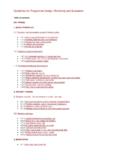
1 Page 9-1 Wind Resource Assessment Handbook Chapter 9 DATA VALIDATION, PROCESSING, ANDREPORTINGA fter the field data are collected and transferred to your office computing environment, the nextsteps are to validate and process data, and generate reports. The flow chart presented in Figure the sequence and roles of these steps. Figure Validation FlowchartData validation is defined as the inspection of all the collected data for completeness andreasonableness, and the elimination of erroneous values. This step transforms raw data into validated validated data are then processed to produce the summary reports you require for analysis. ThisRaw Data FilesDevelop Data Validation RoutinesGeneral System and Measured Parameter Checks Range tests Relational tests Trend tests Fine-tune Routines with ExperienceValidate Data Subject all data to validation Print validation report of suspect values Manually reconcile suspect values Insert validation codes Alert site operator to suspected measurement problemsCreate Valid Data FilesData Processing and Report GenerationChapter 9 Data Validation, Processing, and ReportingPage 9-2 Wind Resource Assessment Handbookstep is also crucial to maintaining high rates of data completeness during the course of the monitoringprogram.
2 Therefore data must be validated as soon as possible, within one - two days, after they aretransferred. The sooner the site operator is notified of a potential measurement problem, the lower the riskof data DATA VALIDATION METHODSData can be validated either manually or automatically (computer-based). The latter is preferred totake advantage of the power and speed of computers, although some manual review will always berequired. Validation software may be purchased from some data logger vendors, created in-house usingpopular spreadsheet programs ( , Microsoft Excel, Quatro Pro, Lotus 123), or adapted from other utilityenvironmental monitoring projects. An advantage of using spreadsheet programs is that they can also beused to process data and generate reports. These programs require an ASCII file format for imported data;the data logger's data management software will make this conversion if binary data transfer is are essentially two parts to data validation, data screening and data verification.
3 Data Screening: The first part uses a series of validation routines or algorithms to screen allthe data for suspect (questionable and erroneous) values. A suspect value deserves scrutiny butis not necessarily erroneous. For example, an unusually high hourly wind speed caused by alocally severe thunderstorm may appear on an otherwise average windy day. The result of thispart is a data validation report (a printout) that lists the suspect values and which validationroutine each value failed. Data Verification: The second part requires a case-by-case decision on what to do with thesuspect values retain them as valid, reject them as invalid, or replace them with redundant,valid values (if available). This part is where personal judgment by a qualified person familiarwith the monitoring equipment and local meteorology is needed. Before proceeding to the following sections, you should first understand the limitations of datavalidation.
4 There are many possible causes of erroneous data: faulty or damaged sensors, loose wireconnections, broken wires, damaged mounting hardware, data logger malfunctions, static discharges,sensor calibration drift, and icing conditions, among others. The goal of data validation is to detect as manysignificant errors from as many causes as possible. Catching all the subtle ones is impossible. For example,a disconnected wire can be easily detected by a long string of zero (or random) values, but a loose wire thatbecomes disconnected intermittently may only partly reduce the recorded value yet keep it withinreasonable limits. Therefore, slight deviations in the data can escape detection (although the use ofredundant sensors can reduce this possibility). Properly exercising the other quality assurance componentsof the monitoring program will also reduce the chances of data preserve the original raw data, make a copy of the original raw data set and apply the validationsteps to the next two subsections describe two types of validation routines, recommend specific validationcriteria for each measurement parameter, and discuss the treatment of suspect and missing data.
5 A. Validation RoutinesChapter 9 Data Validation, Processing, and ReportingPage 9-3 Wind Resource Assessment HandbookValidation routines are designed to screen each measured parameter for suspect values before theyare incorporated into the archived data base and used for site analysis. They can be grouped into two maincategories, general system checks and measured parameter General System Checks Two simple tests evaluate the completeness of the collected data: Data Records: The number of data fields must equal the expected number ofmeasured parameters for each record. Time Sequence: Are there any missing sequential data values? This test should focuson the time and date stamp of each data Measured Parameter Checks: These tests represent the heart of the data validationprocess and normally consist of range tests, relational tests, and trend tests.
6 Range Tests: These are thesimplest and most commonly usedvalidation tests. The measured dataare compared to allowable upper andlower limiting values. Table examples of range testcriteria. A reasonable range for mostexpected average wind speeds is 0 to25 m/s. However, the calibrationoffset supplied with many calibratedanemometers will prevent zerovalues. Negative values clearlyindicate a problem; speeds above 25m/s are possible and should beverified with other information. Thelimits of each range test must be setso they include nearly (but notabsolutely) all of the expected valuesfor the site. Technicians can fine-tune these limits as they gainexperience. In addition, the limitsshould be adjusted seasonally where appropriate. For instance, the limits for airtemperature and solar radiation should be lower in winter than in summer. If a value meets a criterion, that check considers the value valid. However, mostparameter values should have several criteria checks, because a single criterion isunlikely to detect all problems.
7 For example, if a frozen wind vane reports anaverage direction of exactly 180 for six consecutive ten-minute intervals, the valueswould pass the 0-360 range test, but the stationary vane would report a standarddeviation of zero and be flagged as Range Test Criteria*Sample ParameterValidation CriteriaWind Speed: Horizontal Averageoffset < Avg. < 25 m/s Standard Deviation0 < Std. Dev. < 3 m/s Maximum Gustoffset < Max. < 30 m/sWind Direction Average0 < Avg. 360 Standard Deviation3 < Std. Dev. < 75 Maximum Gust0 < Max. 360 Temperature(Summer shown) Seasonal Variability5 C < Avg. < 40 CSolar Radiation(Optional: Summer shown) Averageoffset Avg. < 1100 W/m Wind Speed: Vertical(Optional) Average **(F/C)offset < Avg. < (2/4) m/s Standard Deviationoffset < Std. Dev.< (1/2) m/s Maximum Gustoffset < Max. < (3/6) m/sBarometric Pressure(Optional: sea level) Average94 kPa < Avg.
8 < 106 kPa T(Optional) Average Difference> C (1000 hrs to 1700 hrs) Average Difference< C (1800 hrs to 0500 hrs) All monitoring levels except where noted.**(F/C): Flat/Complex TerrainChapter 9 Data Validation, Processing, and ReportingPage 9-4 Wind Resource Assessment Handbook Relational Tests: This comparison isbased upon expected physicalrelationships between variousparameters. Table gives examplesof relational test criteria. Relationalchecks should ensure that physicallyimprobable situations are not reportedin the data without verification; forexample, significantly higher windspeeds at the 25 m level versus the 40m level. Trend Tests: These checks are based on the rate of change in a value over lists sample trend test criteria. An example of a trend that indicates anunusual circumstance and a potential problem is a change in air temperature greaterthan 5 C in one examples of validation criteria in Tables , , and are not exhaustive, nor are theynecessarily apply to all sites.
9 With use, technicians will learn which criteria are most often triggered andunder what conditions. For example, some criteria may almost always be triggered under light windconditions, yet the data are valid. This occurrence may argue for one set of criteria under light windconditions (below 4 m/s) and another set for strongerwinds. Therefore the technician(s) should modify criteriaor create new ones as needed. A secondary benefit of the data validationprocess is that the person(s) directly involved in thevalidation process will become very familiar with thelocal wind climatology. The behavior of the wind undervarious weather conditions will become apparent, as willthe relationship between various parameters. This is aninvaluable experience that cannot be appreciated solely by poring over monthly summary tables and may beimportant for evaluating the impact of the local meteorology on wind turbine operation and Note: Some data loggers and their data retrieval software record the system battery voltage foreach averaging interval.
10 Range and relational tests can be incorporated into your wind data validationroutines to check for a reduction in battery voltage that may indicate a system Treatment of Suspect and Missing DataAfter the raw data are subjected to all the validation checks, what should be done with suspectdata? Some suspect values may be real, unusual occurrences while others may be truly bad. Here aresome guidelines for handling suspect data: 1. Generate a validation report (printout or computer-based visual display) that lists allsuspect data. For each data value, the report should give the reported value, the date andtime of occurrence, and the validation criteria that it Relational Test Criteria*Sample ParameterValidation CriteriaWind Speed: Horizontal Max Gust vs. AverageMax Gust * Avg. 40 m/25 m Average ** m/s 40 m/25 m Daily Max 5 m/s 40 m/10 m Average 4 m/s 40 m/10 m Daily Max m/sWind Speed: Redundant(Optional) Average m/s Maximum m/sWind Direction 40m/25 m Average 20 All monitoring levels except where noted.