Transcription of Daylighting in Schools - HMG
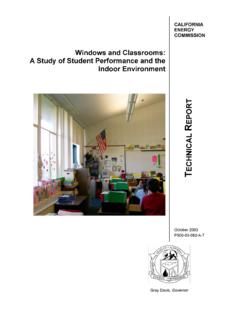
1 Daylighting in SchoolsAn Investigation into the Relationship BetweenDaylighting and Human PerformanceCondensed ReportAugust 20, 1999 Submitted to:George LoisosThe Pacific Gas and Electric Companyon behalf of theCalifornia Board for Energy Efficiency Third Party ProgramSubmitted by:HESCHONG MAHONE GROUP11626 Fair Oaks Blvd. #302 Fair Oaks, CA 95628 Legal NoticeThis report was prepared by Pacific Gas and Electric Company and funded by California utility customers under theauspices of the California Public Utilities PG&E nor any of its employees and agents:(1)makes any written or oral warranty, expressed or implied, regarding this report, including but not limited to thoseconcerning merchantability or fitness for a particular purpose;(2)assumes any legal liability or responsibility for the accuracy, completeness, or usefulness of any information,apparatus, product, process, method, or policy contained herein; or(3)represents that use of the report would not infringe any privately owned rights, including, but not limited to, patents,trademarks, or copyrights.
2 1999 by Pacific Gas and Electric Company. All rights BOARD FOR ENERGY EFFICIENCY CONDENSED REPORTDAYLIGHTING IN SCHOOLSHESCHONG MAHONE GROUPiAugust 20, 1999 TABLE OF CONTENTSACKNOWLEDGEMENTS_____1 EXECUTIVE SUMMARY_____21. Daylighting IN school Data_____62. ANALYSIS AND Capistrano of the Other Seattle Fort Collins and Fort Collins Variables_____213. DISCUSSION AND about Visibility Due to Higher Illumination Visibility Due to Improved Light Arousal Behavior_____29 CALIFORNIA BOARD FOR ENERGY EFFICIENCY CONDENSED REPORTDAYLIGHTING IN SCHOOLSHESCHONG MAHONE GROUP1 August 20, 1999 ACKNOWLEDGEMENTSThis study was performed on behalf of the California Board for Energy Efficiencyfor the Third Party Program administered by Pacific Gas and Electric, as part ofPG&E contract 460 000 8215. George Loisos was the project manager andMona Yew the Contract Heschong, Partner in the Heschong Mahone Group, directed the study . Shehas been assisted at the Heschong Mahone Group by Douglas Mahone, KalpanaKuttaiah, Nehemiah Stone, Cathy Chappell, Jon McHugh, and Jackie Okura of RLW Analytics conducted the statistical analysis under thedirection of Dr.
3 Roger Wright, Principal, RLW Erwine of Cascadia Conservation investigated Daylighting conditions atthe Seattle Public Schools . Neal Digert and Ken Baker of Architectural EnergyCorporation investigated Daylighting conditions at Poudre school District in FortCollins, Colorado. Both Cascadia Conservation and Architectural EnergyCorporation participated in data acquisition and development of the are deeply indebted to the school district personnel who made this studypossible, by providing data and allowing us access to district records andfacilities. Jeff Bristow and Chuck Berridge at Capistrano Unified school District inSouthern California, Mike O Connell at Seattle City Public Schools in WashingtonState and Hugh Mowery at Poudre school District in Fort Collins, Colorado,provided access to their district s data and assisted with its interpretation. DaveDoomey, Ken Harkner and Bob Sendzik at Capistrano, Kathy Johnson at Seattleand Mike Spearnak at Poudre helped provide information about and access totheir district are very thankful to the many other people who also made this studypossible, through their interest in the significance of this work and theirwillingness to provide helpful information and support.
4 We would especially liketo thank those who took the time to review and comment on the draft reports:Gregg Ander, Dr. Ed Arens, Dr. Gale Berger, Dr. Robert Clear, Dr. RickDiamond, Dr. Judith Heerwagen, Dr. Paul Holland, Dr. Gage Kingsbury, EleanorLee, Dr. Margaret Morris, and Dr. David Wyon; and Steven Selkowitz whoorganized the BOARD FOR ENERGY EFFICIENCY CONDENSED REPORTDAYLIGHTING IN SCHOOLSHESCHONG MAHONE GROUP2 August 20, 1999 EXECUTIVE SUMMARYThis study looks at the effect of Daylighting on human performance . It includes afocus on skylighting as a way to isolate illumination effects from other qualitiesassociated with Daylighting from windows, such as view and ventilation. In thisproject, we established a statistically compelling connection between daylightingand student performance , and between skylighting and retail sales. This reportfocuses on the school obtained student performance data from three elementary school districtsand looked for a correlation to the amount of daylight provided by each student sclassroom environment.
5 We used data from second through fifth grade studentsin elementary Schools for two reasons: because there is extensive data availablefrom highly standardized tests administered to these students, and becauseelementary school students are generally assigned to one teacher in oneclassroom for the school year. Thus, we reasoned that if the physicalenvironment does indeed have an effect on student performance , we would bemostly likely to be able to establish such a correlation by looking at theperformance of elementary school analyzed test score results for over 21,000 students from the three districts,located in Orange County, California, Seattle, Washington, and Fort Collins,Colorado. The data sets included information about student demographiccharacteristics and participation in special school programs. We reviewedarchitectural plans, aerial photographs and maintenance records and visited asample of the Schools in each district to classify the Daylighting conditions in over2000 classrooms.
6 Each classroom was assigned a series of codes on a simple 0-5 scale indicating the size and tint of its windows, the presence and type of anyskylighting, and the overall amount of daylight study used multivariate linear regression analysis to control for otherinfluences on student performance . Regressions were compared using data fromtwo separate tests, math and reading, for each district. Each math and readingmodel was also run separately using first the window and skylight codes, andthen the overall daylight code. We reasoned that if daylight effects were trulyrobust the variables should perform similarly in all models. Thus, we created atotal of twelve models for comparison, consisting of four models for each of Daylighting conditions at the Capistrano school district were the mostdiverse, and the data from that district were also the most detailed. ThusCapistrano became our most precise model. In this district, we were able to studythe change in student test scores over a school year.
7 Controlling for all otherinfluences, we found that students with the most Daylighting in their classroomsprogressed 20% faster on math tests and 26% on reading tests in one year thanthose with the least. Similarly, students in classrooms with the largest windowareas were found to progress 15% faster in math and 23% faster in reading thanCALIFORNIA BOARD FOR ENERGY EFFICIENCY CONDENSED REPORTDAYLIGHTING IN SCHOOLSHESCHONG MAHONE GROUP3 August 20, 1999those with the least. And students that had a well-designed skylight in their room,one that diffused the daylight throughout the room and which allowed teachers tocontrol the amount of daylight entering the room, also improved 19-20% fasterthan those students without a skylight. We also identified another window-relatedeffect, in that students in classrooms where windows could be opened werefound to progress 7-8% faster than those in rooms with fixed windows. Thisoccurred regardless of whether the classroom also had air conditioning.
8 Theseeffects were all observed with 99% statistical studies in Seattle and Fort Collins used the final scores on math and readingtests at the end of the school year, rather than the amount of change from thebeginning of the year. In both of these districts we also found positive, and highlysignificant, effects for Daylighting . Students in classrooms with the mostdaylighting were found to have 7% to 18% higher scores than those in roomswith the three districts have different curricula and teaching styles, different schoolbuilding designs and very different climates. Yet the results of the studies showconsistently positive and highly significant effects. This consistency supports theproposition that there is a valid and predictable effect of Daylighting on results of this study of student performance , when considered along withthose of the companion study showing the positive effect of skylighting on retailsales, also strongly support the thesis that these performance benefits fromdaylighting can be translated to other building types and human BOARD FOR ENERGY EFFICIENCY CONDENSED REPORTDAYLIGHTING IN SCHOOLSHESCHONG MAHONE GROUP4 August 20, 19991.
9 Daylighting IN SCHOOLSThis report is part of a study that looks at the effect of Daylighting on humanperformance. This part of the study looks at how Daylighting , from windows orskylights, affects the test scores of students in three elementary school part of the study reports on how the use of skylighting affected the salesof a large chain retailer. We found a statistically compelling connection betweendaylighting and student performance , and between skylighting and retail study was supported by the California Board for Energy Efficiency, andadministered by Pacific Gas and Electric and retail stores were chosen as the subject of the study because wecould obtain extensive data on occupant performance for nearly identicalbuildings. We believe that the conclusions may be transferable to other types ofbuildings, such as offices and factories, since it is really human performance thatwe are investigating. If Daylighting enhances the performance of children inschools, it is not too large a stretch to suppose that it might also enhance theperformance of adults in office buildings.
10 If Daylighting motivates buyers at aretail store, it is not too large a stretch to presume that it might also motivateworkers in a Condensed Report is intended for the non-specialist reader. It is a summaryof a more extensive report that details the study methodology and statisticalanalysis. If you have questions about the study that are not answered here, werecommend reading the Detailed BackgroundThe impact of Daylighting on the performance of school children has been asubject of interest for many years. Before fluorescent lighting became prevalent,it was generally assumed that all school rooms would be daylit as a matter ofcourse. The California Department of Education had a rigorous review processfor the architectural design of classrooms to ensure that Daylighting standardswere met. As a result, California classrooms built in the 1950 s and early 1960 sremain excellent examples of Daylighting practice. The finger plan with multiplerows of single classrooms, each with windows on two sides, became a standardfor California K-12 , starting in the late 1960 s a number of forces came into conflict with thedaylit design of classrooms.