Transcription of Debbie Hepplewhite’s simple to complex …
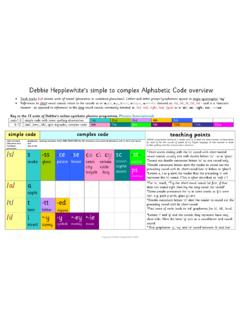
1 Debbie hepplewhite s simple to complex alphabetic code overview Slash marks /ai/ denote units of sound (phonemes or combined phonemes). Letters and letter groups (graphemes) appear in single apostrophes ay . References to short vowel sounds relate to the sounds as in apple, egg, insect, octopus, umbrella denoted as: /a/, /e/, /i/, /o/, /u/ - said in a staccato manner - as opposed to references to the long vowel sounds commonly denoted as: /ai/, /ee/, /igh/, /oa/, /yoo/ as in aid, eel, night, oak, statue . Key to the 12 units of Debbie s online synthetic phonics programme, Phonics International: units1-5 simple code with some spelling alternatives 1st 2nd 3rd 4th 5th 6-12 /air/, /eer/, /zh/, split digraphs, complex code 6th 7th 8th 9th 10th 11th 12th simple codecomplex codeteaching points Debbie s programme introduces a simple code of at least one letter/s- sound correspondence for each of the 44+ sounds of speech of the English language.
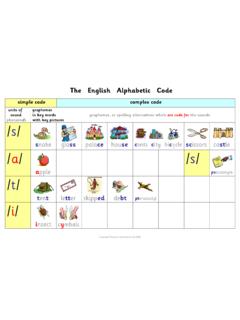
2 It then expands to teach further spellings and their pronunciation variations. units of sound (phonemes and combined phonemes) graphemes: spelling variations which ARE code FOR the 44+ phonemes and combined phonemes such as /k+s/ and /y+oo/and key words /s / s snake-ss glass -ce palace -se housece ci cy cents certain city circle bicycle lacy sc scissors scythe ascent -st- castle*Short words ending with the /s/ sound with short medial vowel sounds usually end with double letters ss - as in glass . * sound out double consonant letters ss as one sound only. *Double consonant letters alert the reader to sound out the preceding vowel with its short sound (see a below re glass ) *Letters e, i or y alert the reader that the preceding c will represent the /s/ sound . (This is often described as soft c .) ps pseudonym/a / a apple *For a , teach, Try the short vowel sound /a/ first, if that does not sound right then try the long vowel /ai/ sound .
3 *Some people pronounce the a in some words as if it were /ar/: path p-ar-th; glass g-l-ar-s /t/ t tent -tt letter -ed skipped *Double consonant letters tt alert the reader to sound out the preceding vowel with its short sound . *Past tense of verbs leads to ed graphemes for /t/, /d/, /e+d/. /i / i insect*-y sunny -y cymbals *-ey monkey*-ie movie *Letters i and y and the sounds they represent have very close links. Here the letter y acts as a vowel -letter and vowel - sound . * End graphemes y , ey and ie sound between /i/ and /ee/. Copyright Debbie hepplewhite 2008/p / p pan -pp puppet *Double consonant letters pp alert the reader to sound out the preceding vowel with its short sound . /n / n net -nn bonnet kn knot gn gnome-ineengine *Double consonant letters nn alert the reader to sound out the preceding vowel with its short sound . *Some people would refer to silent k or silent g ; others prefer to say that kn and gn are code for the /n/ sound .
4 /k / k kit c cat -ck duck ch chameleonqu bouquetque plaque *Letter c represents a /k/ sound when preceding the letters a , o and u . *Short words with short vowels usually end with ck and this grapheme never begins words. /e / e egg -ea head -ai said *When reading short unknown words with single letter e , teach, Try the short vowel /e/ sound first, if that does not sound right then try the long vowel /ee/ sound . /h/ h hat wh who *When letter names are taught, point out that the name for the letter h is pronounced aitch not haitch . /r/ r rat -rr arrow wr write rh rhino *Some people would refer to silent w or silent h ; others prefer to say that wr and rh are code for the /r/ sound (phoneme). /m / m map -mm hammer -mb thumb -mn column-me welcome *Double consonant letters mm alert the reader to sound out the preceding vowel with its short sound .
5 *Some people would refer to silent b or silent n ; others prefer to say that mb and mn are code for /m/. /d / d dig -dd puddle -ed rained *Double consonant letters dd alert the reader to sound out the preceding vowel with its short sound . *Past tense of verbs leads to ed graphemes for /t/, /d/, /u+d/. /g/ g girl -gg juggle gu guitar gh ghost-gue catalogue *Double consonant letters gg alert the reader to sound out the preceding vowel with its short sound . *Letter u in gu acts as a block between the letters g and e , i or y indicating the g is code for /g/ and not /j/. Copyright Debbie hepplewhite 2008/o / o octopuswa watch qua qualify alt salt *For o , teach, Try the short vowel /o/ sound first, if that does not sound right then try the long vowel /oa/ sound . *Alert the reader that the graphemes w or qu preceding a single letter a can indicate that a is code for the /o/ sound .
6 /u / u umbrellao son -ou touch ough thorough *For u , teach, Try the short vowel /u/ sound first, if that does not sound right then try the long vowel /yoo/ sound . *The letter u is sometimes code for a long /oo/ sound : flu, judo, truth, Ruth, Pluto. /l/ l ladder-ll shell *To make the /l/ sound , roll up the tongue and say ul . *Short words with short vowels usually end with ll as in bell. *Double consonant letters ll alert the reader to sound out the preceding vowel with its short sound except -all (/or+l/). schwa /u l/ -le kettle -il pencil -al hospital-el camel *Teach the schwa effect involving /l/ through words such as: little, table, pupil, cymbal, label (pronounced close to ul ). Teach that literal sounding out when reading, however, helps with spelling: h-o-s-p-i-t-a-l. /f/ f feather-ff cliff ph photo -gh laugh *Double consonant letters ff alert the reader to sound out the preceding vowel with its short sound .
7 *Short words with short vowel sounds usually end with ff as in off and cliff. /b / b bat -bb rabbit bu building *Double consonant letters bb alert the reader to sound out the preceding vowel with its short sound . /j/ j jug -ge cabbage ge gi gygerbil giraffe gymnast -dge fridge*Letters e, i or y alert the reader that the preceding letter g might represent the /j/ sound . (This is often referred to as soft g .) *Words ending with the /j/ sound are spelt with ge or dge ( dge follows single letter, short vowel sounds like fridge ). /y/ y yawn *Teach early on that letter y represents 4 sounds as in yes, my mummy and cymbal . It is often interchangeable with the the letter i and the sounds /i/, between /i and ee/, and /igh/. Copyright Debbie hepplewhite 2008/ai/ ai aid -ay tray a table -ae sundaea-e cakes-ey prey eigh eight -ea break *The a-i as in baking alerts the reader to pronounce /ai/.
8 *Grapheme ea as code for the /ai/ sound is rare. Note the three common root words: break, steak, great. /w / w web wh wheel *Letter w preceding vowel graphemes should alert the reader to different possible pronunciations ; (w)a - wasp, wag; (w)ar - warm, wary; (w)or - work. Note: what /oa/ oa oak ow bow o yo-yo -oe oboe o-e rope ough dough-eauplateau *The o-i as in poking alerts the reader to pronounce /oa/. /igh/ -ighnight -ie tie i behind -y shy i-e bike ei eider *The i-i as in liking alerts the reader to pronounce /igh/. /ee/ ee eel ea eat e emu * -y sunnye-e concrete-ey key *monkey-ie chief *movie -ine sardines*The e-i as in competing alerts the reader to pronounce /ee/. *The y in sunny is between the sound /i/ and /ee/. Similarly, so is ey in monkey and ie in movie . [Also in /i/ row.] /or / or /aw/ dependent on regional and national accents or fork aw dawn au sauce -al chalkoar oars -oordoor ore snore -ourfour *Letter w preceding grapheme ar alerts the reader to say the sound /or/: (w)ar - war, warn, wart, warder.
9 * sound /w/ as in qu [/k/+/w/] also alerts reader to pronounce ar as /or/: (qu)ar - quart, quarter, quartz, quartile. war warm quar quarter augh caughtough thought *Double consonant letters zz alert the reader to sound out the preceding vowel with its short sound . *Short words with short vowel sounds end with zz - jazz. /z / z zebra-zz jazz -s fries -se cheese-ze breezex xylophone *The grapheme ng can be pronounced differently according to regional accent and dependent upon the particular word. *In some words, the n and g are pronounced separately /n g/ -n gong -n jungle /ngk/ -nk ink -nc uncle *Teach nk as if it was one sound unit for reading and spelling purposes even though it is really two; that is: /ng/+/k/. This combined sound may be denoted as /nk/. Copyright Debbie hepplewhite 2008/v / v violin -ve dove *Teach that words ending with the /v/ sound end with the grapheme ve.
10 Short /oo/ oo book oul should -u push *Teach the two sounds represented by the grapheme oo at the same time; short /oo/, long /oo/. *Progress to linking the /oo/ as in moon with the spelling and pronunciation variations of ew , ue and u-e - all of which can represent both the long /oo/ sound and the /yoo/ sound . long /oo/ oo moon-ue blue u-e flute -ewcrew -ui fruit -ou soup -o move ough through/ks / -x fox -ks books -cks ducks -kes cakes /gz / -x exam -ggseggs *Teach the letter x as if it was one sound unit /ks/ whereas it is really two sounds /k/+/s/. Provide word lists of -x words, -ks , cks and -kes words to compare: fox, boxes, looks, beaks, ducks, likes. /ch / ch chairs-tch patch /ch u/ schwa -ture picture *Grapheme tch indicates a preceding short vowel sound ; ditch, fetch, thatch, notch, hutch, watch. *Grapheme ch follows long vowel sounds (bleach, pooch, reaches); but also some common words with short vowels which need to be noted: rich, which, such, much, touch.