Transcription of December 21 - medicaid.gov
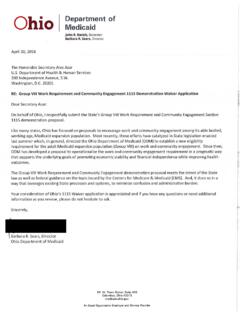
1 December 21, 2021. Dawn Stehle Deputy Director for Health & medicaid Arkansas Department of Human Services Box 1437. Slot S201. Little Rock, AR 72203-1437. Dear Dawn Stehle: The Centers for Medicare & medicaid Services (CMS) is approving Arkansas's request for a new section 1115(a) demonstration titled, Arkansas Health and Opportunity for Me . (ARHOME) (Project Number 11-W-00379/6) (the demonstration ), in accordance with section 1115(a) of the Social Security Act (the Act). Approval of this demonstration will enable Arkansas ( the state ) to provide premium assistance to medicaid beneficiaries with incomes up to and including 133 percent of the federal poverty level (FPL), who are eligible under the new adult group, to assist beneficiaries in the purchase of coverage from qualified health plans (QHPs) offered in the individual market through the Federally Facilitated Marketplace.
2 Furthermore, under this demonstration, the state will have a waiver of retroactive eligibility, allowing the state to limit retroactive coverage to 30 days prior to an application rather than the 90 days required under the medicaid statute. The premium assistance authority and the waiver of retroactive eligibility were both approved and implemented in Arkansas under previous section 1115 demonstration authority. In addition, this ARHOME demonstration will provide Arkansas a time-limited authority, through December 31, 2022, to allow the state to charge monthly premiums of up to two percent of household income for beneficiaries with incomes above 100 percent of the FPL.
3 Premiums and cost-sharing will be subject to an aggregate cap of no more than five percent of family monthly or quarterly income. Cost-sharing limitations described in 42 CFR (a) will be applied to all program beneficiaries. Copayment and coinsurance amounts will be consistent with federal requirements regarding medicaid cost-sharing and with the state's approved state plan. CMS has concluded that the approval of this demonstration with the authorities described above is likely to support the state in its continued medicaid expansion efforts. Accordingly, we have determined that ARHOME as approved is likely to advance the objectives of medicaid .
4 The state will comprehensively monitor and evaluate the effectiveness of each ARHOME. demonstration component per expectations detailed in the special terms and conditions (STCs), and as outlined further below. Page 2. Arkansas had received approval to implement premium requirements under its previous section 1115 demonstration, Arkansas Works (Project Number 11-W-00287/6). However, CMS has since determined that premiums can present a barrier to coverage, and therefore, charging beneficiaries premiums beyond those specifically permitted under the medicaid statute are not likely to promote the objectives of medicaid .
5 This policy determination is informed by findings in recent research across different states with section 1115 demonstrations, which show that charging beneficiaries premiums beyond those authorized under the state plan resulted in shorter enrollment spells, 1 and were associated with lower initial enrollment rates and increased obstacles to accessing care in several states. 2 In Arkansas, findings from the state's evaluation of its expiring Arkansas Works demonstration indicate that after the demonstration was implemented in 2017, beneficiaries had shorter, but more frequent gaps in coverage 3 a finding that is consistent with premium policy research in other states.
6 Further, premium requirements can exacerbate health disparities, as historically under-resourced populations may be disproportionately affected by these policies. For example, research from several states shows that premium policies led to decreased enrollment and shorter enrollment spells for Black beneficiaries compared to their White counterparts, and beneficiaries with lower incomes compared to those with higher incomes. 4 In other states, beneficiaries also reported misperceptions about the affordability of medicaid coverage and concerns about their ability to make monthly contributions under section 1115 demonstrations with premium policies.
7 5 This 1. Dague, L. (2014). The Effect of medicaid Premiums on Enrollment: A Regression Discontinuity Approach. Journal of Health Economics. 37: 1-12. Retrieved from 2. Bradley, K., Niedzwiecki, M., Maurer, K., Chao, S., Natzke, B., & Samra, M. (2020). medicaid Section 1115. Demonstrations Summative Evaluation Report: Premium Assistance, Monthly Payments, and Beneficiary Engagement. Retrieved from ; Social & Scientific Systems, Inc. and the Urban Institute. (2020). Federal Evaluation of Indiana's Healthy Indiana Plan HIP Retrieved from demonstrations/ ; University of Michigan Institute for Healthcare Policy & Innovation.
8 (2018). Report on the Impact of Cost Sharing in the Healthy Michigan Plan: Healthy Michigan Plan Evaluation Domains V/VI. Retrieved from ; and Cliff, , Miller, S., Kullgren, , Ayanian, , & Hirth, R. (2021). Adverse Selection in medicaid : Evidence from Discontinuous Program Rules. National Bureau of Economic Research. Working Paper 28762. Retrieved from 3. Arkansas Department of Human Services. (2021). Arkansas Works Interim Evaluation Report. Under CMS. review. 4. University of Wisconsin-Madison Institute for Research on Poverty. (2019). Evaluation of Wisconsin's BadgerCare Plus Health Coverage for Parents & Caretaker Adults and for Childless Adults 2014 Waiver Provisions.
9 Retrieved from ;. Finkelstein, A., Hendren, N., & Shepard, M. (2019). Subsidizing Health Insurance for Low- Income Adults: Evidence from Massachusetts. American Economic Review. 109(4): 1530-67. Retrieved from ; and The Lewin Group, Inc. (2020). Healthy Indiana Plan Interim Evaluation Report. Retrieved from 5. University of Michigan Institute for Healthcare Policy & Innovation. (2018). Report on the Healthy Michigan Voices 2016-17 Survey of Individuals No Longer Enrolled in the Healthy Michigan Plan. Retrieved from ; and The Lewin Group Inc. (2017). Health Indiana Plan : POWER Account Contribution Assessment.
10 Retrieved from Topics/Waivers/1115/downloads/in/Healthy -Indiana-Plan-2/in-healthy-indiana-plan- support-20-POWER-acct-cont- Page 3. beneficiary concern and confusion could contribute to lower initial and overall enrollment rates, and higher disenrollment rates. On balance, the evidence from recent research across several states on premium policies in section 1115 demonstrations suggests that premiums can reduce access to coverage and care among populations that medicaid aims to serve, and therefore, we do not have reason to believe that charging beneficiaries premiums beyond those authorized under the statute are likely to directly or indirectly promote coverage.