Transcription of Deconvolutional Networks - matthewzeiler
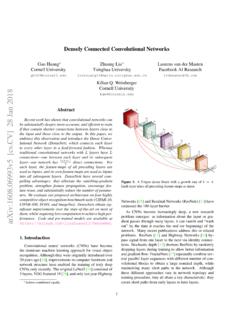
1 Deconvolutional Networks Matthew D. Zeiler, Dilip Krishnan, Graham W. Taylor and Rob Fergus Dept. of Computer Science, Courant Institute, New York University Abstract (a). Building robust low and mid-level image representa- tions, beyond edge primitives, is a long-standing goal in vision. Many existing feature detectors spatially pool edge (b). information which destroys cues such as edge intersections, parallelism and symmetry. We present a learning frame- work where features that capture these mid-level cues spon- Figure 1. (a): Tokens from Fig.
2 2-4 of Vision by D. Marr [18]. taneously emerge from image data. Our approach is based These idealized local groupings are proposed as an intermediate on the convolutional decomposition of images under a spar- level of representation in Marr's primal sketch theory. (b): Se- sity constraint and is totally unsupervised. By building a lected filters from the 3rd layer of our Deconvolutional network , trained in an unsupervised fashion on real-world images. hierarchy of such decompositions we can learn rich feature sets that are a robust image representation for both the anal- ysis and synthesis of images.
3 Approach where the input signal is subjected to multiple layers of convolutions, non-linearities and sub-sampling. 1. Introduction By contrast, each layer in our Deconvolutional network is top-down; it seeks to generate the input signal by a sum In this paper we propose Deconvolutional Networks , a over convolutions of the feature maps (as opposed to the framework that permits the unsupervised construction of hi- input) with learned filters. Given an input and a set of erarchical image representations. These representations can filters, inferring the feature map activations requires solving be used for both low-level tasks such as denoising, as well a multi-component deconvolution problem that is compu- as providing features for object recognition.
4 Each level of tationally challenging. In response, we use a range of tools the hierarchy groups information from the level beneath to from low-level vision, such as sparse image priors and form more complex features that exist over a larger scale efficient algorithms for image deblurring. Correspondingly, in the image. Our grouping mechanism is sparsity: by en- our paper is an attempt to link high-level object recognition couraging parsimonious representations at each level of the with low-level tasks like image deblurring through a unified hierarchy, features naturally assemble into more complex architecture.
5 Structures. However, as we demonstrate, sparsity itself is not enough it must be deployed within the correct ar- 2. Related Work chitecture to have the desired effect. We adopt a convo- lutional approach since it provides stable latent representa- Deconvolutional Networks are closely related to a num- tions at each level which preserve locality and thus facili- ber of deep learning methods [2, 8] from the machine tate the grouping behavior. Using the same parameters for learning community that attempt to extract feature hierar- learning each layer, our Deconvolutional network (DN) can chies from data.
6 Deep Belief Networks (DBNs) [8] and automatically extract rich features that correspond to mid- hierarchies of sparse auto-encoders [22, 9, 26], like our ap- level concepts such as edge junctions, parallel lines, curves proach, greedily construct layers from the image upwards and basic geometric elements, such as rectangles. Remark- in an unsupervised fashion. In these approaches, each layer ably, some of them look very similar to the mid-level tokens consists of an encoder and decoder1 . The encoder provides posited by Marr in his primal sketch theory [18] (see Fig.)
7 1). a bottom-up mapping from the input to latent feature space Our proposed model is similar in spirit to the Convo- while the decoder maps the latent features back to the input lutional Networks of LeCun et al. [13], but quite different 1 convolutional Networks can be regarded as a hierarchy of encoder- in operation. convolutional Networks are a bottom-up only layers [13]. 1. space, hopefully giving a reconstruction close to the origi- model but it only reasons about image edges, as provided nal input. Going from the input directly to the latent rep- by a standard edge detector, unlike ours which directly op- resentation without using the encoder is difficult because it erates on pixels.
8 The biologically inspired HMax model of requires solving an inference problem (multiple elements in Serre et al. [24, 23] use exemplar templates in their inter- the latent features are competing to explain each part of the mediate representations, rather than learning conjunctions input). As these models have been motivated to improve of edges as we do. Fidler and Leonardis [5, 4] propose a high-level tasks like recognition, an encoder is needed to top-down model for object recognition which has an explicit perform fast, but highly approximate, inference to compute notion of parts whose correspondence is explicitly reasoned the latent representation at test time.
9 However, during train- about at each level. In contrast, our approach simply per- ing the latent representation produced by performing top- forms a low-level deconvolution operation at each level, down inference with the decoder is constrained to be close rather than attempting to solve a correspondence problem. to the output of the encoder. Since the encoders are typ- Amit and Geman [1] and Jin and Geman [10] apply hierar- ically simple non-linear functions, they have the potential chical models to deformed Latex digits and car license plate to significantly restrict the latent representation obtainable, recognition.
10 Producing sub-optimal features. Restricted Boltzmann Ma- chines (RBM), the basic module of DBNs, have the addi- 3. Model tional constraint that the encoder and decoder must share weights. In Deconvolutional Networks , there is no encoder: We first consider a single Deconvolutional network layer we directly solve the inference problem by means of effi- applied to an image. This layer takes as input an image y i , cient optimization techniques. The hope is that by comput- composed of K0 color channels y1i , .. , yK. i 0.. We represent ing the features exactly (instead of approximately with an each channel c of this image as a linear sum of K1 latent encoder) we can learn superior features.