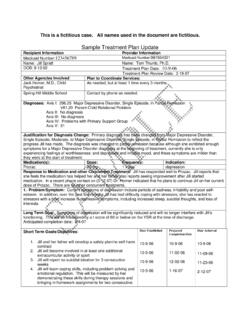
Transcription of Depression Coding Tips and Billing Examples
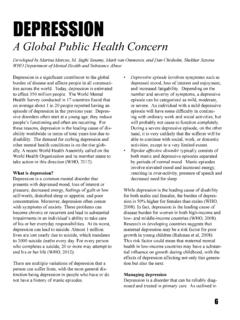
1 Depression Depression Major depressive disorder or clinical Depression is a common but serious mood disorder. It can cause severe symptoms that affect how you feel, think, and handle daily activities, such as sleeping, eating, or working. Symptoms must be present for at least two weeks to be diagnosed1. Causes of Depression are not known, but a prominent theory is altered brain and chemical functions2. Symptoms of Depression The signs and symptoms of Depression can be experienced most of the day, or nearly every day, for at least two weeks. This can include feelings of sadness, anxiousness, hopelessness, irritability, guilt, decreased energy or fatigue, loss of interest, feeling restless, difficulty concentrating or sleeping, appetite changes, and/or thoughts of death or suicidal ideations1.
2 treatment of Depression Depression can be treated, even in severe cases. The earlier the treatment begins, the more effective it is. Depression can be treated with medication and psychotherapy, or a combination of the two1. When treating Depression , studies show co-existing illnesses can improve cost and utilization. Research also suggests pets and exercise can be a potent weapon against mild to moderate depression2. 1 Depression Goal To provide Coding and risk adjustment education including documentation on specificity of the disease and enhance the awareness of related HEDIS measures. Encourage open discussions between coder/provider. Audience Billers, Coders, Providers, including but not limited to Nurse Practitioners, Physician Assistants, General Practitioners, Family Medicine, Internal Medicine, Therapists, Master Level Providers, Psychologists, and Psychiatrists.
3 Resources 1. National Institute of Mental Health: Bipolar Disorder (revised February 2018) 2. WebMD Depression : What Is It? (reviewed July 3, 2018) 3. 2019 ICD-10-CM Expert for Physicians: The Complete Official Code Set, Optum360. 2018 Optum360 LLC 4. PHQ Screeners: Depression Screening; Kroenke K, Spitzer RL, Psychiatric Annuals 20002; 32:509-521 5. HEDIS 2019 Technical Specification for Health Plans 6. US Preventive Services Task Force; Visit our website: 2 Depression Coding Guidance 3 tips : ICD-10 Mapping & Education ICD-10-CM (Major depressive disorder) Attempt for more Avoid broad terms and unspecified codes such as Depression , (ICD 10 CM code) Be thorough in picking up the details in documentation This can lead to a better understanding of the Depression and assist with accurate Coding Remember to code out other mood affective disorders, such as, Manic ( ) and Bipolar ( ) In the documentation use terms that Severity Mild Moderate Severe Episodes Single Recurrent In Remission, partial or full Depression Screening Tool PHQ-9 is a nine question instrument for patients to complete in a primary care setting to screen for the presence and severity of Depression .
4 The results are used to assist the provider in making a Depression diagnosis including the severity. Note all disclaimers on the website Visit Refilling medication Verify Depression is documented in the note and that it is listed and addressed in the Assessment & Plan, noting status and any medication changes. HEDIS 2019 The percentage of members 18 years of age and older who were treated with antidepressant medication, had a diagnosis of major Depression and who remained on an antidepressant medication treatment . There are 2 rates reported for this measure: Acute Phase treatment : The percentage of members who remained on an antidepressant medication for at least 84 days (12 weeks). Continuation Phase treatment : The percentage of members who remained on an antidepressant medication for at least 180 days (6 months) 5.
5 US Preventive Services Task Force Recommend screening all patients over the age of 12 for Depression at every visit or at a standard interval) 6 . --- - -1/30/2019 PHQ 9 Questionnaire for Depression Screening After member has completed the screening, count the number of boxes checked in each of the columns. Take the number and multiply by the value indicated below. Add the subtotals of each to produce the total score. Range is from 0 27. Not at all (#) ___ x 0 = ___ Several days (#) ___ x 1 = ___ More than half of the days (#) ___ x 2 = ___ Nearly every day (#) x 3 = ___ _____ _ Total score Diagnosis Score For Score Proposed Actions ICD-10-CM No or Minimal Depression 0 4 < 4 Suggests the patient may not need Depression treatment Not applicable Mild Depression 5 9 5 14 Clinical judgement should be used for treatment , based on the duration of symptoms and functional impairment or Moderate Depression 10 14 or Moderately severe Depression 15 19 >14 Depression should be treated, using antidepressant, psychotherapy and or a combination of treatment or (moderate) or (severe) Severe Depression 20 27 or (w/o psychotic features) or (w/ psychotic features)
6 In Partial Remission If member has been previously diagnosed with Depression (regardless of severity), document that the Depression is in partial remission in the note. DSM 5 defines partial remission as patient has some symptoms but not meeting full criteria for the last 12 months. or In Full Remission If member has been previously diagnosed with Depression (regardless of severity), document that the Depression is in full remission in the note. DSM 5 defines full remission as patient has no symptoms for the last 12months. or 4 Billing Sample #1 Primary Care Physician Documentation: Medical record SOAP format (condensed) DOS: 04/14/2018 Gender: F DOB: XX/XX/1966 Pulse: 69 F B/P: 142/86 Weight: 130lb Height: BMI: 21 HPI: A 52 female with a history of hypertension and Fe deficiency anemia.
7 Here today for routine follow-up. Patient also complains of decreased interest in things she used to enjoy; experiencing decreased energy, concentration and poor appetite. She is having some family issues with son and his wife. PHQ 9 Assessment: (Included positive questions) Little interest or pleasure in doing things? (score=2)More than half the days Feeling down, depressed, or hopeless? (score=1) Several days Feeling tired or having little energy? (score= 1) Several days Trouble concentrating on things, such as reading the newspaper or watching television? (score=1) Several days Not at all (#) ___ x 0 = ___ Several days (#) _3_ x 1 = _3_ More than half of the days (#) _1_ x 2 = _2_ Nearly every day (#) ___ x 3 = ___ Total score _5__ Problem List/History: HTN: on HCTZ 25 mg, no chest pain and some palpitation with family issues.
8 Fe deficiency anemia: has been off Fe supplement for 1 year; denies blood in stool and urine. ROS: Denies SOB, N/V, abd pain, dysuria, and constipation. Denies suicidal ideations or wanting to hurt others. PMH:Menorrhagia; Anemia PSH: Smokes PPD x 25 years, encouraged her to quit Assessment and Plan: HTN change HCTZ to Amlodipine 5 mg daily Chronic Fe Def anemia etiology believed due to menorraghia but did have TAH in 2016. Labs today showed Hgb , no active bleeding, start Fe TID, order colonoscopy and repeat CBC in 2 weeks. Depression , mild single episode decreased interest, energy and concentration, No SI/HI Performed PHQ Screening with score of 5. Start outpatient behavioral health therapy. Schedule follow up in one month. Consider family counseling. Given pamphlet on how to quit smoking.
9 Claim Diagnosis Codes & Rationale ICD-10-CM Description Medical Record Support I10 Hypertension Assessment & Plan: Provider listed hypertension changed medication from HCTZ to Amlodipine. Anemia, unspecified Assessment & Plan: Provider listed Chronic iron deficiency anemia- reviewed labs and ordered Fe TID and repeat labs in 2 weeks. Major Depressive disorder, single episode, mild HPI, Assessment & Plan: Depression , mild single episode. Patient completed the PHQ 9 Questionnaire with a score of 5.
10 Provider documented Mild Single Episode . Patient was started on outpatient behavioral health therapy. Nicotine dependence, cigarettes PSH, Assessment & Plan: Provider listed smoker of pack a day for 25 years; encouraged her to quit. The provider gave her a pamphlet on how to quit smoking. Personal history of cervical dysplasia Assessment & Plan: Provider stated patient with a history of TAH total abdominal hysterectomy in regards to the anemia. Rationale: ICD-10-CM guidelines state to code any factors influencing health status. This was related to the Fe deficiency anemia and follow up was ordered in 2 weeks. Long term (current) use of drug therapy Medications: HCTZ listed as current medication. Rationale: Codes from Z79- category indicate a patient s continuous use of prescribed drug for the long-term treatment of a condition.